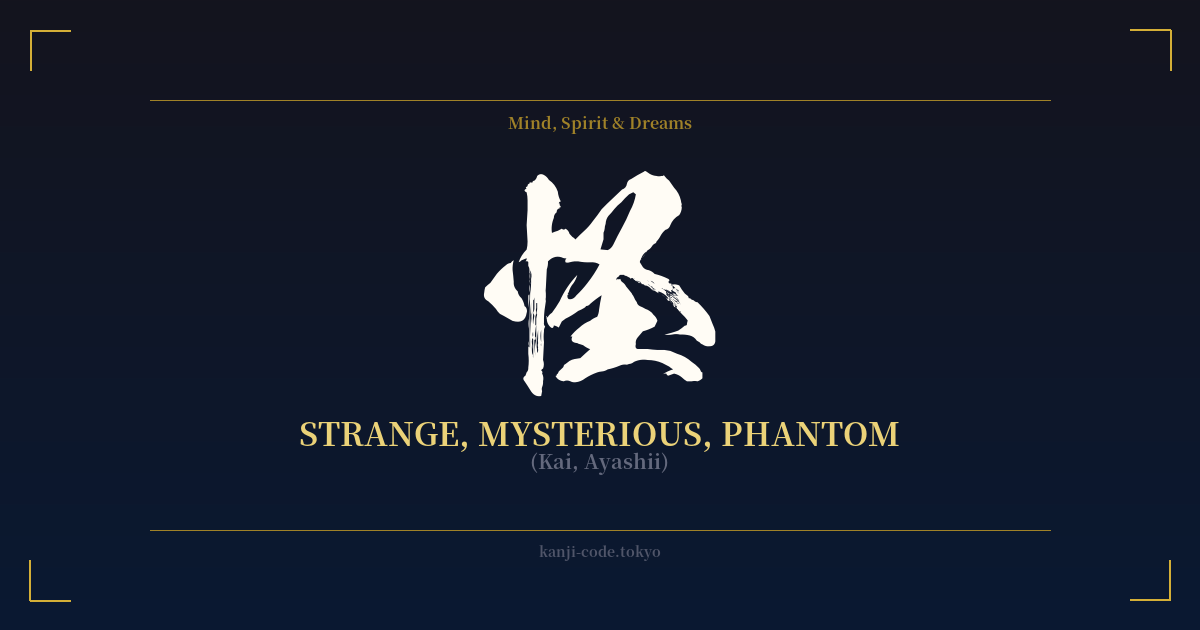
✍️ 怪 (Kai, Ayashii) — Cultural Context
The kanji 怪 (kai) is a fascinating character that pulls you into the shadowy corners of the Japanese imagination. It represents everything that is strange, mysterious, and unexplainable. Its very structure hints at its meaning: the left side is the radical for 'heart' or 'mind' (心), while the right side is a component suggesting something bent or doubtful. Together, they create the image of a feeling in the heart that is warped, uncertain, and not quite right—the birth of suspicion and wonder.
This single character is the cornerstone of a vast and rich world of Japanese folklore. It is the 'kai' in 'yōkai' (妖怪), the catch-all term for the countless monsters, demons, spirits, and goblins that populate traditional stories. From the mischievous Kappa to the terrifying Oni, all fall under the umbrella of 'kai.' To understand this kanji is to understand the Japanese cultural fascination with the supernatural beings that lurk just beyond the veil of human perception.
It is also the heart of 'kaidan' (怪談), which translates to 'ghost stories' or, more literally, 'narratives of the strange.' This genre has been a staple of Japanese entertainment for centuries, from dramatic kabuki plays and woodblock prints depicting ghoulish scenes to modern horror masterpieces like 'The Ring.' The kanji 怪 captures that specific thrill of a well-told ghost story—the chill that runs down your spine, the mix of fear and curiosity.
In everyday language, the adjective 'ayashii' (怪しい) is used to describe anything suspicious, dubious, or fishy. An 'ayashii' person is someone you wouldn't trust. An 'ayashii' noise in the dark is one that puts you on high alert. This modern usage adds a layer of psychological unease to the kanji's supernatural roots. It's not just about phantoms, but about the tangible feeling of doubt and the unknown in our daily lives.
Finally, the character forms the word 'kaijū' (怪獣), meaning 'strange beast' or 'monster,' a term immortalized by Godzilla and the legion of giant creatures that have graced Japanese cinema. In this context, 怪 signifies a monstrous, bizarre, and often destructive force of nature. Whether referring to a subtle ghost or a city-destroying beast, 怪 is the essential symbol of the wonderfully weird and terrifyingly unknown.
🖌️ Font Styles for 怪
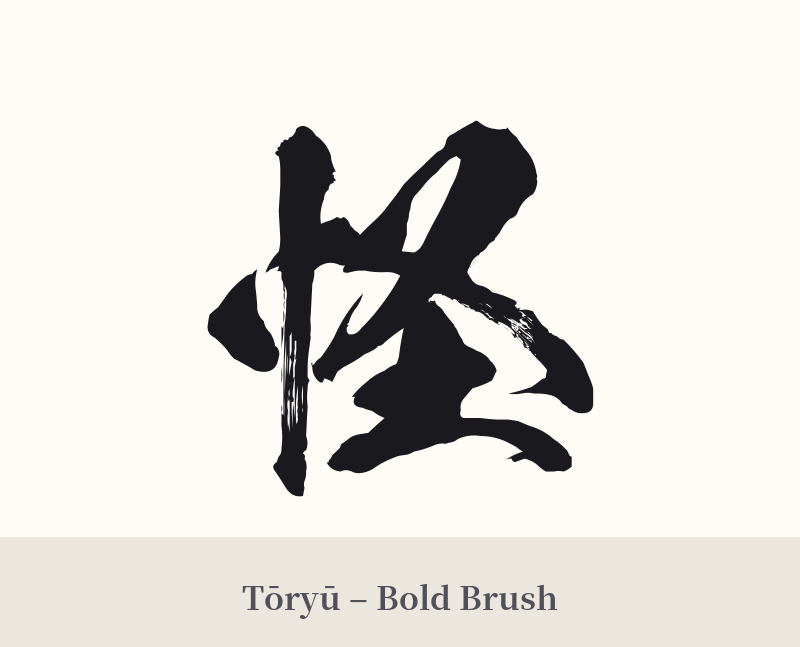
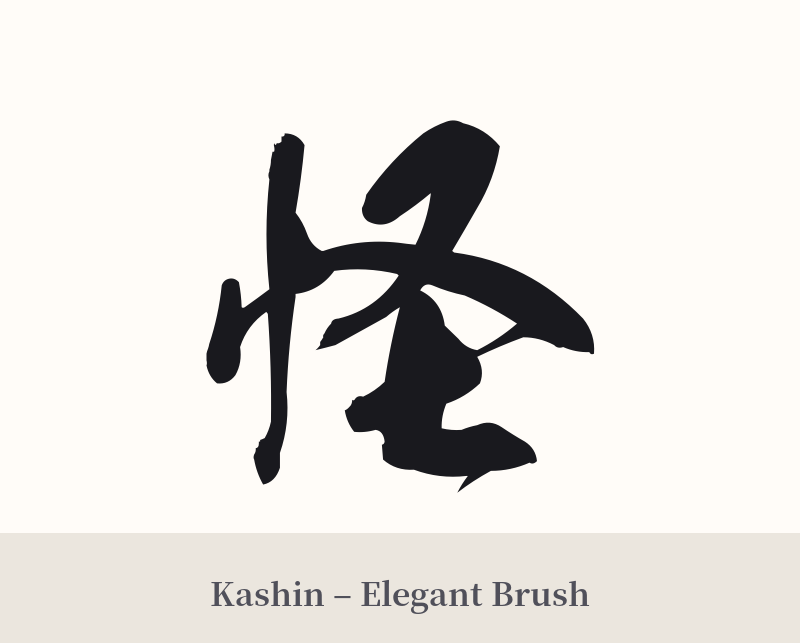
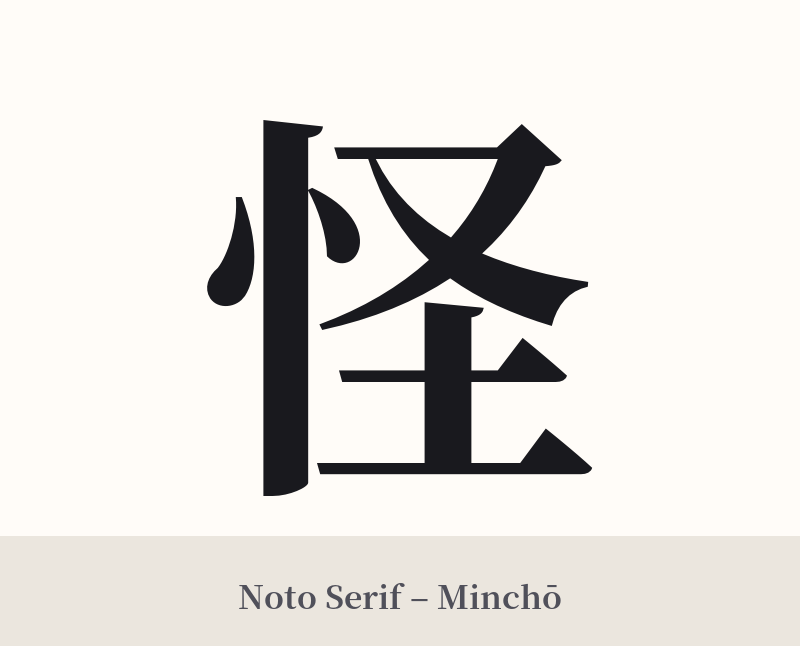
The same kanji can look dramatically different depending on the calligraphy style. Choose a font that matches the mood you want for your tattoo or design.
🎨 Tattoo Suitability
📐 Tattoo Design Guide
The kanji 怪 offers a lot of creative freedom for a tattoo, as its meaning is tied to mystery and the supernatural. Its balanced form works well in various placements and styles.
– Placement: Consider areas that can be partially hidden, playing on the theme of mystery. The inner forearm, calf, or the back of the shoulder are excellent choices. For a more dramatic statement, a larger version on the back or chest allows for more detail.
– Font Style: The style can dramatically alter the mood. A rough, frantic brushstroke (sosho style) can emphasize the chaotic and eerie nature of the supernatural. Conversely, an old, slightly weathered kaisho (block) script can give it the feel of an ancient curse or legend from a scroll.
– Visual Tips: While it's a strong standalone character, you can enhance it with related imagery. Consider weaving it with subtle wisps of smoke or fog, a single peering eye, or elements from yōkai folklore like a Hannya mask, a fox tail, or a ghostly lantern (chōchin-obake). These additions can ground the kanji in a specific story or aesthetic.
Comments