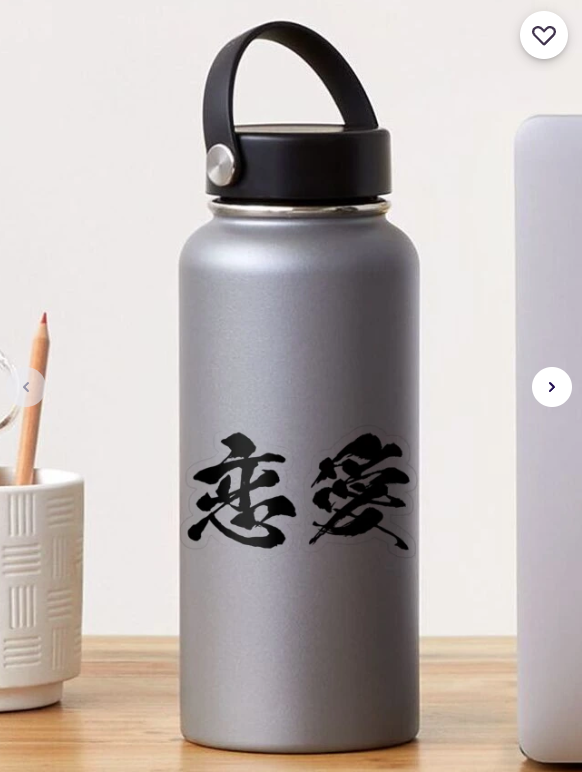
恋愛
Romantic Love
Two characters that map the journey from trembling desire to steady devotion—the whole messy, magnificent arc from “I can’t stop thinking about you” to “I choose you every day.”
Ask Japanese speakers to explain the difference between 恋 (koi) and 愛 (ai), and you’ll get philosophical. 恋 is the beginning—the longing, the obsession, the can’t-eat-can’t-sleep butterflies. It’s what Western culture calls “falling in love,” that chaotic rush where the other person colonizes your thoughts. 愛 is what comes after, if you’re lucky—deeper, steadier, chosen rather than struck by. It’s the love that survives when butterflies migrate elsewhere.
Put them together and you get 恋愛 (ren’ai)—romantic love in its fullest sense, the entire journey from initial spark to enduring flame. The compound acknowledges that real romantic love contains both elements: the passionate yearning AND the committed affection, the chemistry AND the choice, the falling AND the staying. It’s not just attraction. It’s not just companionship. It’s both, ideally transforming from one to the other while keeping traces of each.
Japanese distinguishes romantic love (恋愛) from other forms: 家族愛 (kazoku-ai, family love), 友愛 (yūai, friendship love), 博愛 (hakuai, universal love/charity). The specificity matters. When you say 恋愛, you’re talking about the specific flavor of love involving attraction, desire, courtship, the kind that makes you do stupid things and occasionally brilliant ones. It’s love’s most dramatic, dangerous, and exhilarating form—the kind worth getting permanently inked for.
✨ Kanji Styles Gallery
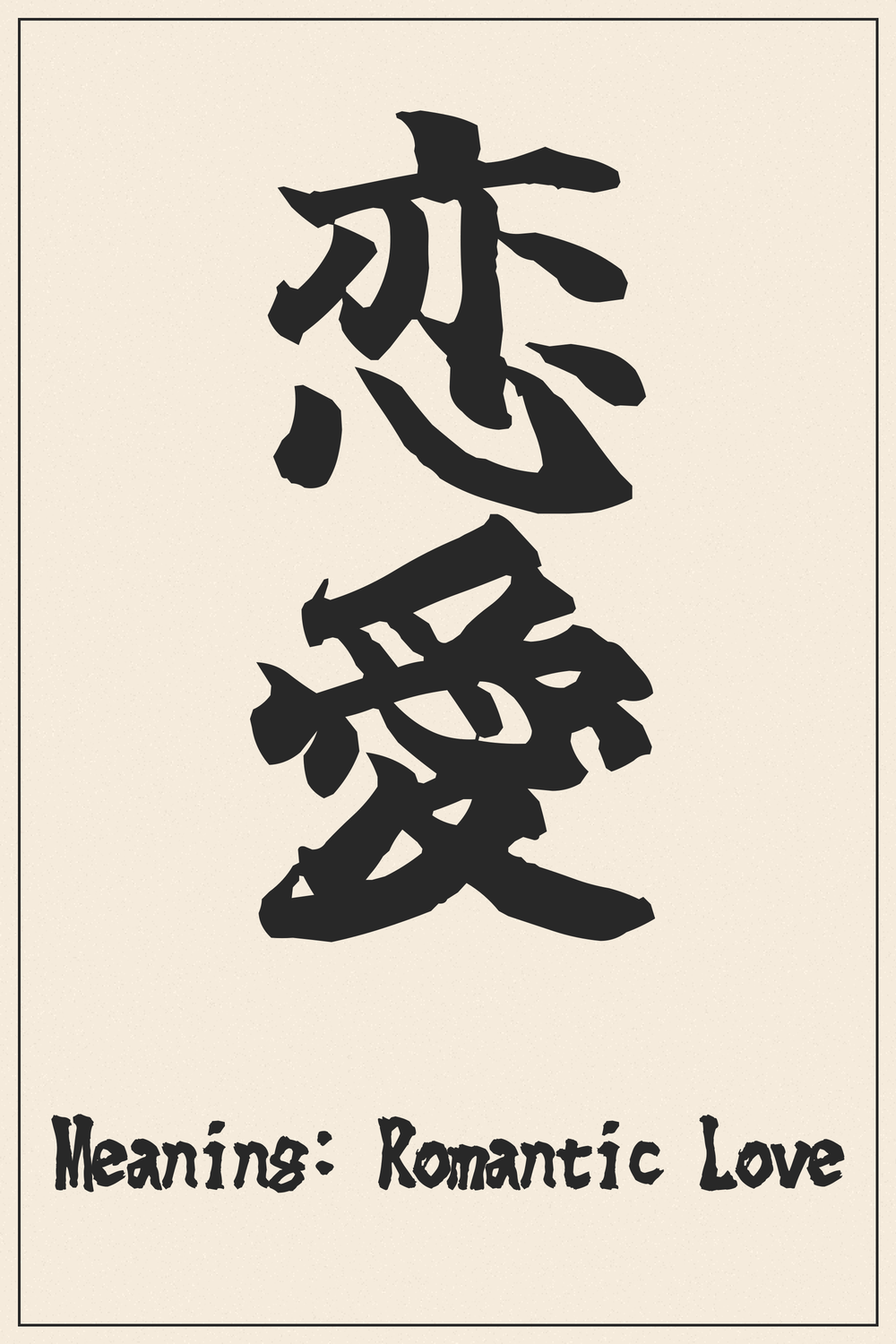
🖌️ Calligraphy Style
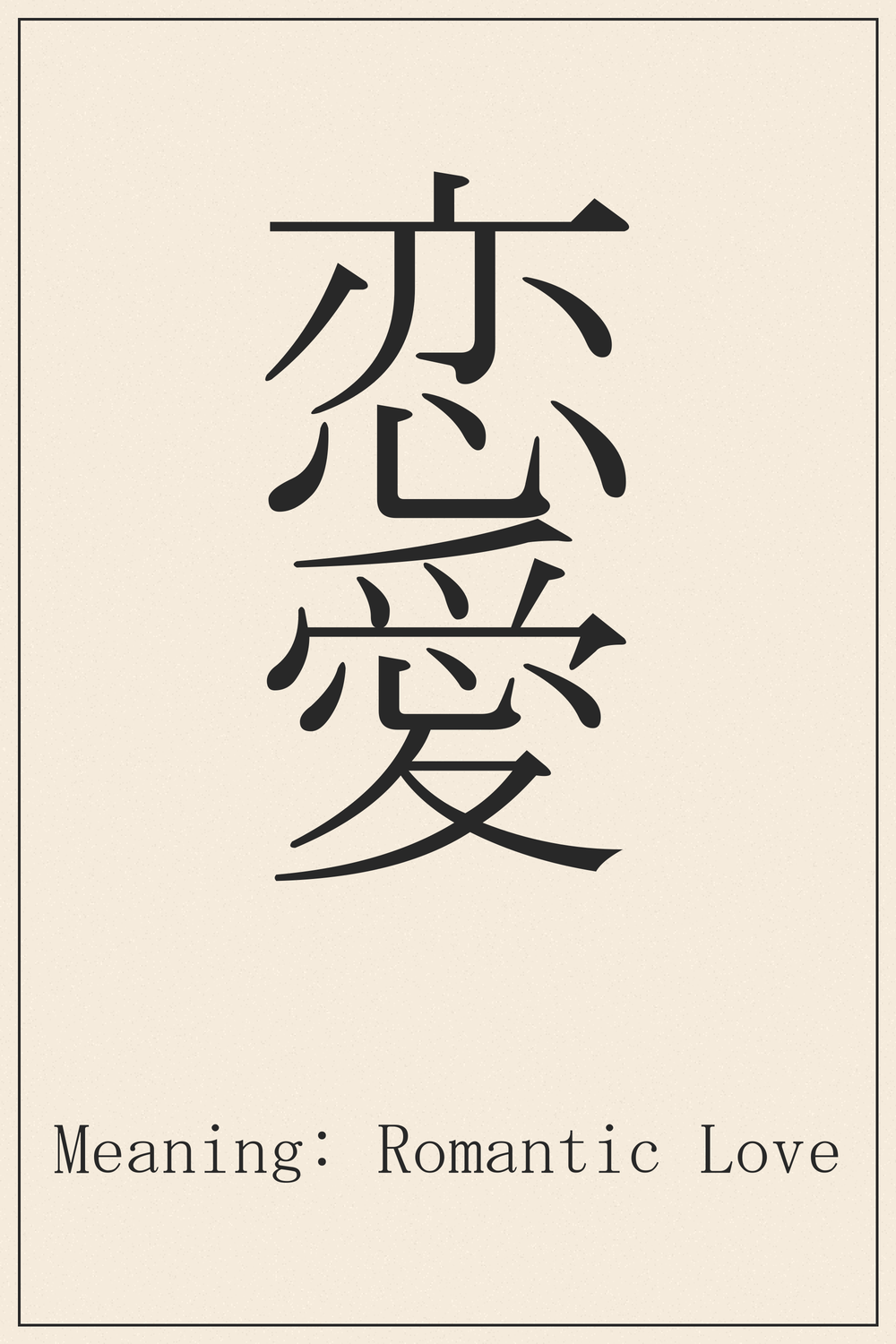
📝 Mincho Style
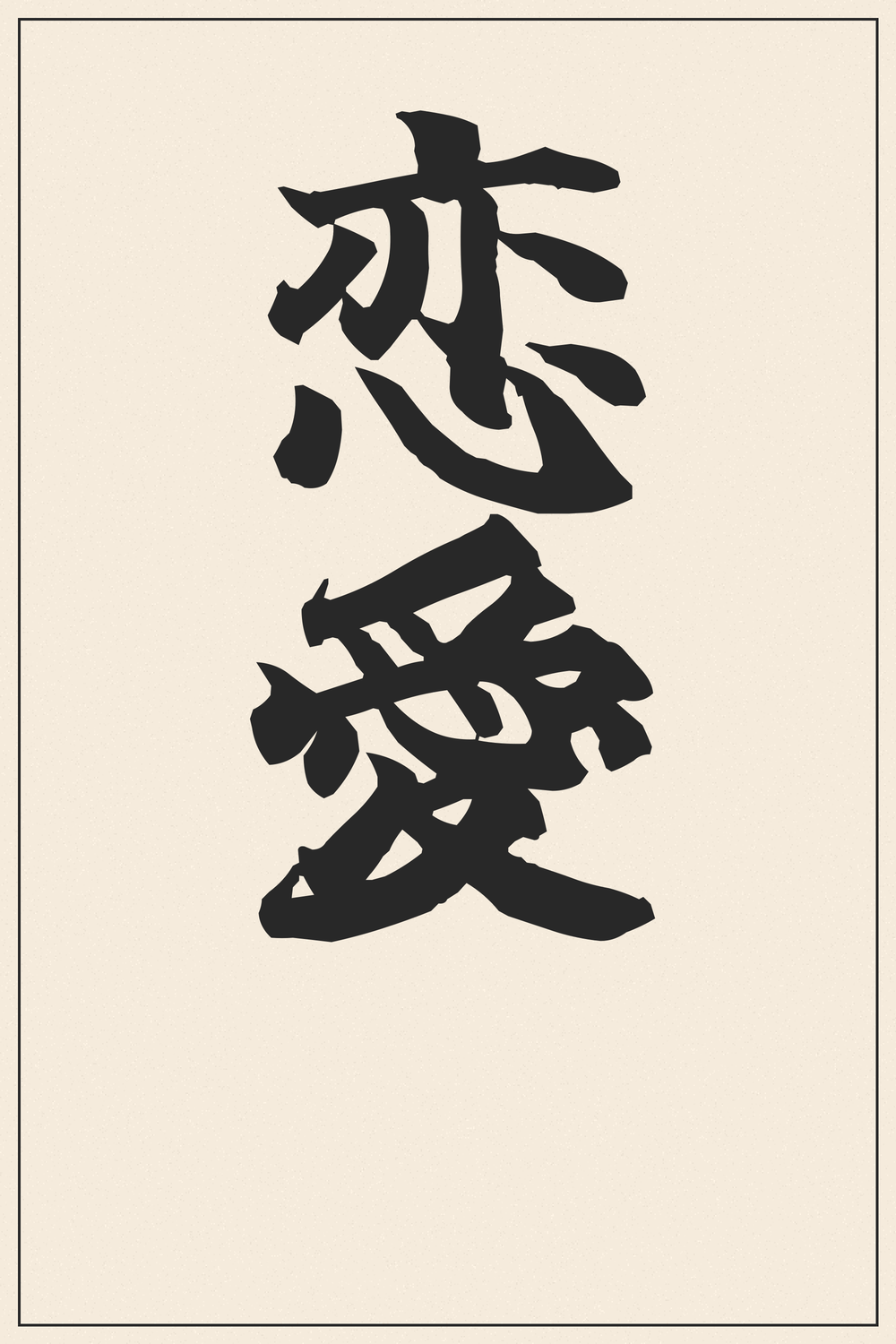
📜 Vertical Writing
⚡ Quick Facts
Breaking Down 恋 (Koi/Ren)
The character 恋 depicts the chaotic emotional state of early attraction. Ancient scribes captured this by combining components suggesting tangled threads (糸), words or expression (言), and heart (心). The imagery suggests a heart entangled with thoughts and speech—you can’t stop thinking about them, can’t stop talking about them, your emotions twist into knots. That’s koi.
As a standalone word, 恋 carries specific connotation. It’s the love you feel powerfully but haven’t yet secured. 片思い (kataomoi, “one-sided love”) uses 恋’s companion character to describe unrequited longing. 初恋 (hatsukoi, “first love”) captures that initial overwhelming experience when desire strikes before you understand it. The character describes love as wanting, craving, being consumed by need for someone who might not even know you exist.
This love burns hot but unstably. Classical Japanese poetry uses 恋 to describe sleepless nights, tears on sleeves, secret meetings, desperate letters. It’s Romeo and Juliet, not the couple celebrating their 50th anniversary. The passion might mature into something lasting, or it might consume itself. 恋 doesn’t judge which—it just names that trembling, obsessive, slightly unhinged state of wanting someone so badly it hurts.
恋文 (koibumi) literally means “longing letter”—the kind you write when you can’t say feelings out loud, when written words become safe container for emotions too big for speech. The character 恋 captures that desperate need to express what you feel before it consumes you entirely, even if the recipient never reads or reciprocates.
Breaking Down 愛 (Ai)
The character 愛 evolved from ancient forms depicting someone embracing or sheltering another—arms wrapped protectively, care given freely. Modern structure contains 心 (heart) at the bottom, supporting components suggesting acceptance and slow, careful movement. The overall impression: love as patient nurturing rather than desperate grasping.
愛 works universally across relationship types. Parents feel 愛 for children. Siblings share 愛. Friends cultivate 愛. God’s love for humanity is 愛. Charity and compassion translate as 愛-based compounds. The character describes love’s enduring, generous qualities—the willingness to sacrifice, the commitment despite flaws, the choice to keep caring when feelings fluctuate.
Where 恋 describes a state you fall into involuntarily, 愛 represents something you cultivate deliberately. You don’t “fall into” 愛—you grow it, tend it, choose it repeatedly. Buddhist philosophy uses 愛 to describe both attachment (which causes suffering) and compassion (which relieves it), acknowledging the character’s complexity. 愛 isn’t simple or easy. It’s the hard work that comes after passion fades, the decision to love when loving requires effort.
From trembling passion to steady devotion—love’s complete journey
The Compound’s Genius
恋愛 as a compound appears in Chinese texts dating back over a millennium, but Japanese culture embraced and expanded the concept. The combination acknowledges that healthy romantic relationships contain both elements: the spark (恋) that starts things and the steadiness (愛) that sustains them. You need initial chemistry or you’ll never start. You need deeper commitment or you’ll never last.
Modern relationship vocabulary uses 恋愛 as foundation. 恋愛結婚 (ren’ai kekkon) means “love marriage”—marrying someone you chose romantically rather than through arrangement. 恋愛小説 (ren’ai shōsetsu) translates as “romance novel.” 恋愛感情 (ren’ai kanjō) describes “romantic feelings.” The compound became the standard term for the entire domain of romantic human relationships.
Some Japanese speakers describe the transition: relationships start as 恋 (passionate longing) and hopefully mature into 愛 (deep affection). The compound 恋愛 captures that progression—from “I want you” to “I choose you,” from chemistry to commitment, from falling to staying. It’s aspirational—not all relationships complete the journey, but those that do contain both characters’ qualities simultaneously.
Cultural Context: Reserved Expression
Traditional Japanese culture considers verbal love declarations somewhat embarrassing or excessive. The phrase 愛してる (aishiteru, “I love you”) carries enormous weight—many married couples never say it aloud, preferring to demonstrate affection through actions: preparing meals, remembering preferences, quiet sacrifices. Words feel cheap compared to consistent behavior proving devotion.
This cultural reserve makes 恋愛 vocabulary particularly important. Since people can’t always speak feelings directly, they need words describing the phenomenon objectively. Saying “we’re in a 恋愛関係 (ren’ai kankei, romantic relationship)” feels less vulnerable than declaring “I’m in love with you.” The compound provides clinical distance that makes discussion possible for people socialized against emotional effusiveness.
Modern Japanese youth—influenced by Western media—express feelings more openly than previous generations. But even contemporary culture retains some traditional restraint. Getting 恋愛 tattooed becomes a way to declare something publicly that you might struggle to voice privately: that romantic love matters to you, that you value passion and commitment, that relationships form your identity’s core component.
Japan’s dating app culture uses 恋活 (koikatsu, “love hunting”) for casual dating seeking passionate connection and 婚活 (konkatsu, “marriage hunting”) for serious partner-seeking. The linguistic split between koi-based and marriage-based searching reflects cultural acknowledgment that passionate attraction and life-partnership compatibility aren’t identical—sometimes they overlap, sometimes they don’t.
🎨 Tattoo Design Ideas
- ✨ Traditional Horizontal Format – Two characters side-by-side in flowing calligraphy creates balanced, romantic composition. The brushwork should feel passionate yet controlled—capturing both 恋’s intensity and 愛’s steadiness. Perfect for upper back, chest, or ribcage placements (5-7 inches wide) where both characters command equal attention.
- ✨ Vertical Column Style – Traditional top-to-bottom arrangement along spine or forearm honors authentic Japanese writing direction. The vertical descent can suggest love’s deepening over time—恋 at top (initial passion) flowing into 愛 below (enduring commitment). Works beautifully for 6-8 inch placements.
- ✨ Heart Integration – Subtle heart outline or silhouette containing or surrounding the characters connects Japanese calligraphy to universal love symbolism. Keep heart minimal and tasteful—thin line work, watercolor suggestion, or negative space rather than solid Valentine graphic. The kanji dominate; heart provides context.
- ✨ Minimalist Modern Line – Clean, precise strokes without decorative flourish for contemporary aesthetic. Despite romantic meaning, the design feels sophisticated through execution simplicity. Perfect for smaller placements (4-6 inches) on inner forearm, shoulder blade, or ankle where elegance matters more than size.
- ✨ Floral Accent Design – Pair 恋愛 with personally meaningful flower—roses for Western romance, cherry blossoms for Japanese aesthetics, your partner’s favorite bloom for intimate significance. Flowers should complement rather than compete, placed beside or wrapping subtly around characters without obscuring them.
- ✨ Partner Set Design – One partner gets 恋, the other gets 愛, creating matching pair that completes when together. This acknowledges each person’s role in the relationship while celebrating unity. Consider matching placement (both left shoulders, both right wrists) for visual symmetry when side-by-side.
Who Chooses This Tattoo
Couples celebrating significant relationships—engagements, marriages, anniversaries—choose 恋愛 as permanent declaration of commitment. It works better than Western “love” tattoos because the characters carry philosophical depth beyond simple sentiment. You’re not just saying “I love someone.” You’re affirming belief in romantic love’s complete journey from passion through devotion.
People who’ve experienced profound romantic transformation select it marking that experience. Maybe you thought you’d never fall in love, then you did. Maybe you survived heartbreak and rebuilt capacity for trust. Maybe you chose love against practical advice and it worked anyway. The tattoo becomes memorial to love’s power to change you fundamentally.
Romantics who value love as life’s central experience—above career, achievement, or individual ambition—wear 恋愛 as identity statement. It announces priorities: relationships matter most. Connection defines meaning. The compound becomes visible reminder during difficult times that love justifies life’s struggles, that passion and commitment together create purpose worth preserving.
Getting someone’s name tattooed risks awkwardness if relationships end. 恋愛 as concept remains meaningful regardless—it honors love itself rather than specific person. That said, consider whether you want permanent reminder of romantic ideology on your body through all life phases. The characters work if love remains central value even when individual relationships change.
Why These Characters Endure
Romantic love has driven humans to brilliant achievements and catastrophic mistakes since consciousness emerged. We write songs about it, wage wars over it, build entire lives around it, destroy ourselves for it. No other emotion combines such euphoria with such vulnerability, such creation with such destruction. We can’t stop falling into it despite knowing the risks.
恋愛 captures that complexity by refusing to simplify. The compound doesn’t pretend love is just butterflies or just commitment—it acknowledges you need both. It maps the difficult journey from wanting someone to choosing them daily, from being struck by lightning to tending a flame through storms. That honesty about love’s dual nature makes the term more valuable than simpler alternatives.
These characters endure because romantic love endures as humanity’s most powerful voluntary vulnerability. We keep risking it despite divorce statistics, heartbreak histories, rational arguments against it. Getting 恋愛 tattooed declares you’re choosing that risk anyway—that passion and commitment together create meaning worth pursuing, worth suffering for, worth marking permanently on skin as testimony that love, in all its messy magnificence, matters most.
Comments