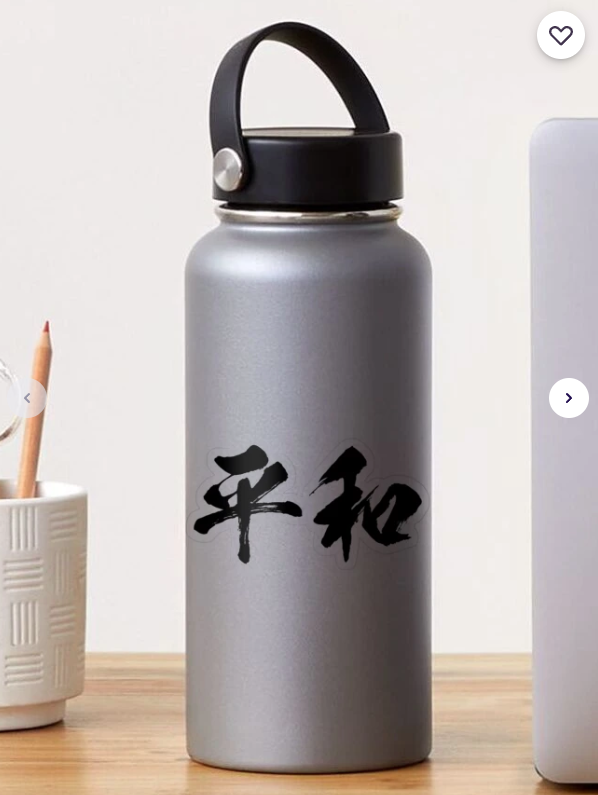
平和
Peace, Harmony
Two characters that emerged from agricultural fields and balanced scales to become Japan’s most powerful post-war aspiration.
On August 15, 1945, Emperor Hirohito announced Japan’s surrender in a radio broadcast that most citizens had never heard his voice before. The word he used repeatedly wasn’t “defeat” or “surrender”—it was 平和 (heiwa), peace. After six years of total war, atomic devastation, and over three million Japanese deaths, this two-character compound became the nation’s new foundation.
But 平和 didn’t start as a war-ending proclamation. The first character 平 (hei) came from ancient images of balanced scales or level fields—surfaces where nothing tilts, tips, or dominates. The second character 和 (wa) depicted grain and mouths, suggesting people eating together in agreement, finding harmony through shared sustenance. Together, they described a state where balance and harmony coexist—where nothing disturbs the equilibrium.
Modern Japan embedded 平和 into its identity so deeply that Article 9 of the post-war constitution became known as the 平和憲法 (heiwa kenpō)—the Peace Constitution—renouncing war as a sovereign right forever. Peace wasn’t just policy; it became national character. The compound appears on memorials, in school mottos, across diplomatic statements, and now, increasingly, on skin as people tattoo their commitment to a world where balance and harmony prevail over violence and chaos.
✨ Kanji Styles Gallery
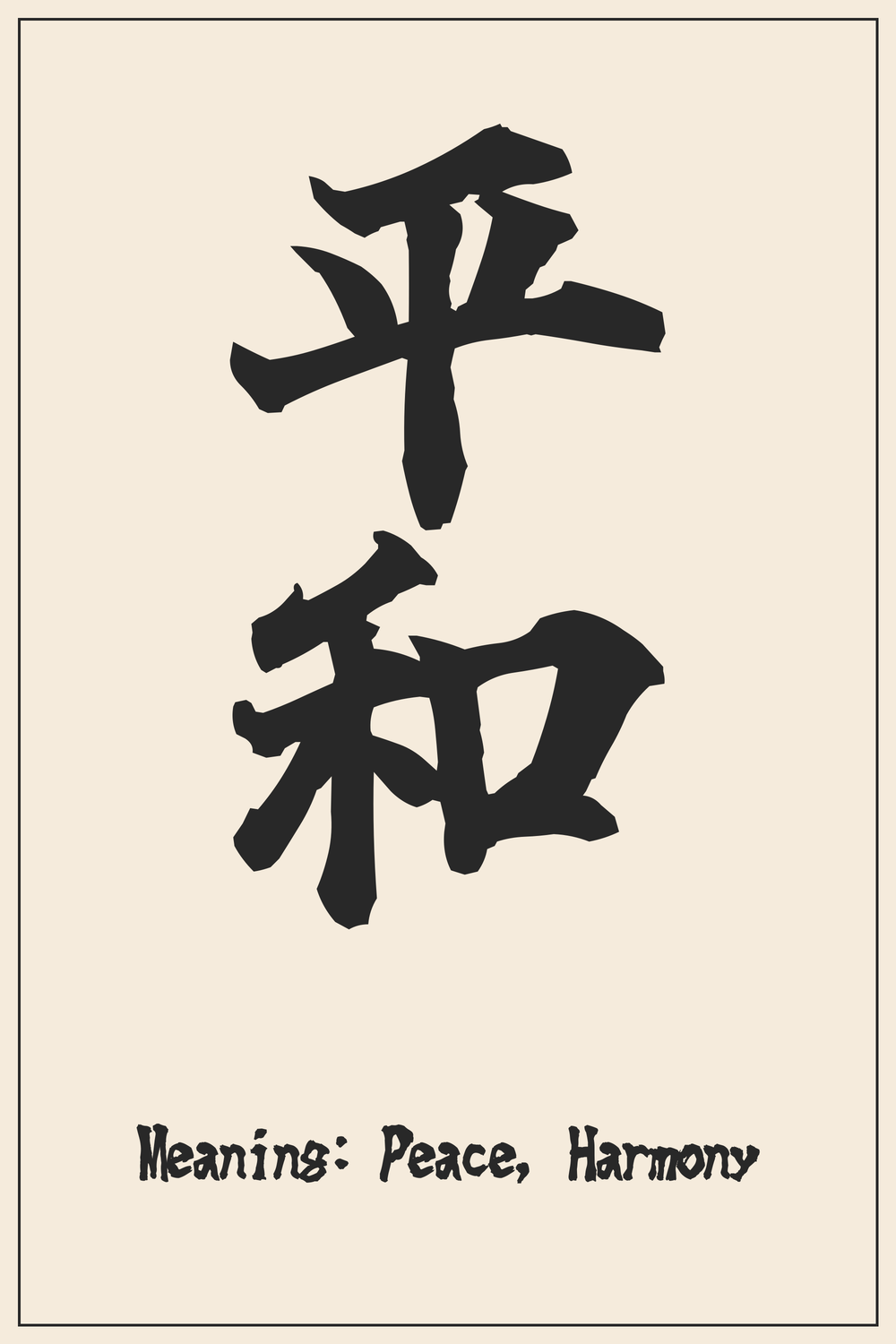
🖌️ Calligraphy Style
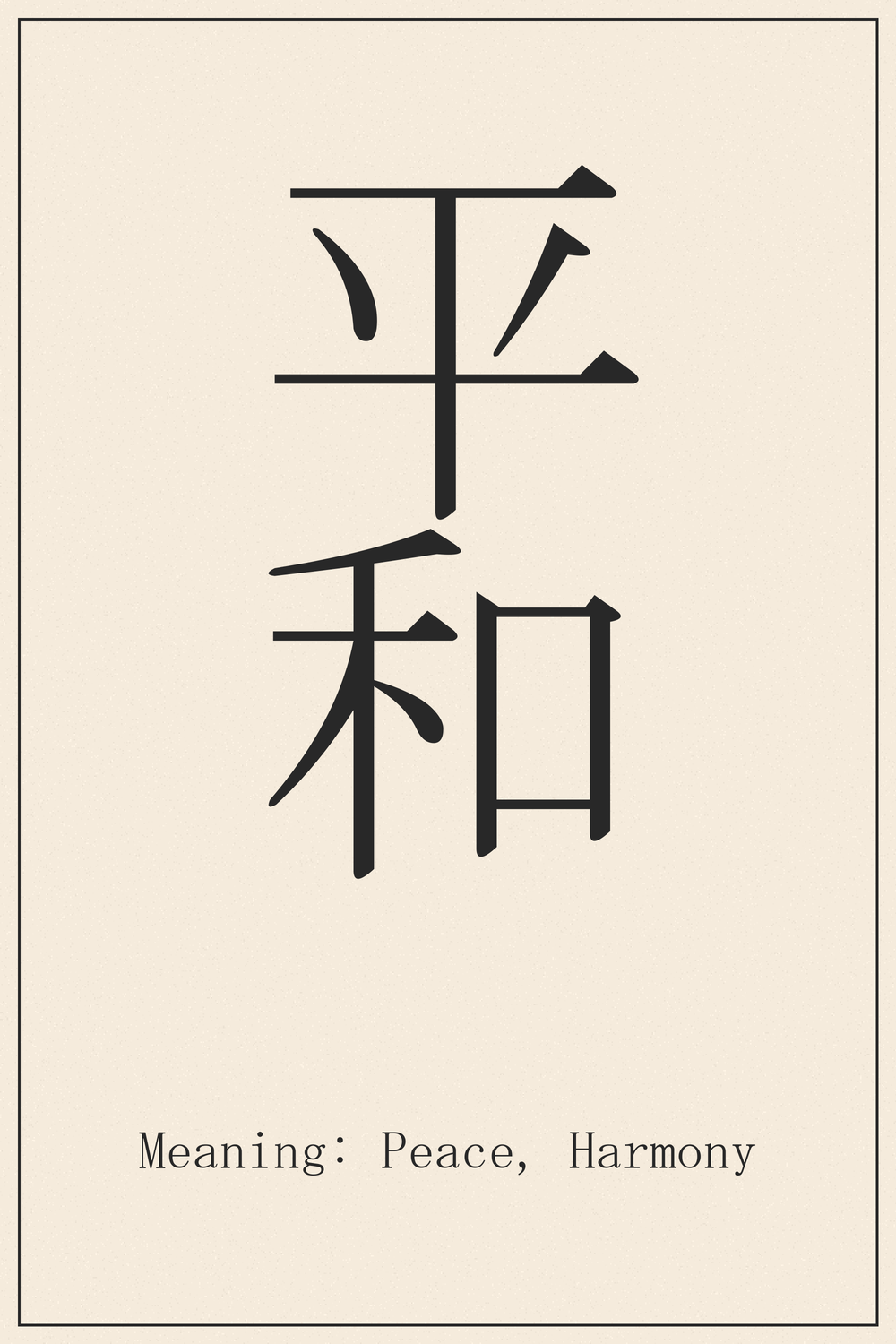
📝 Mincho Style
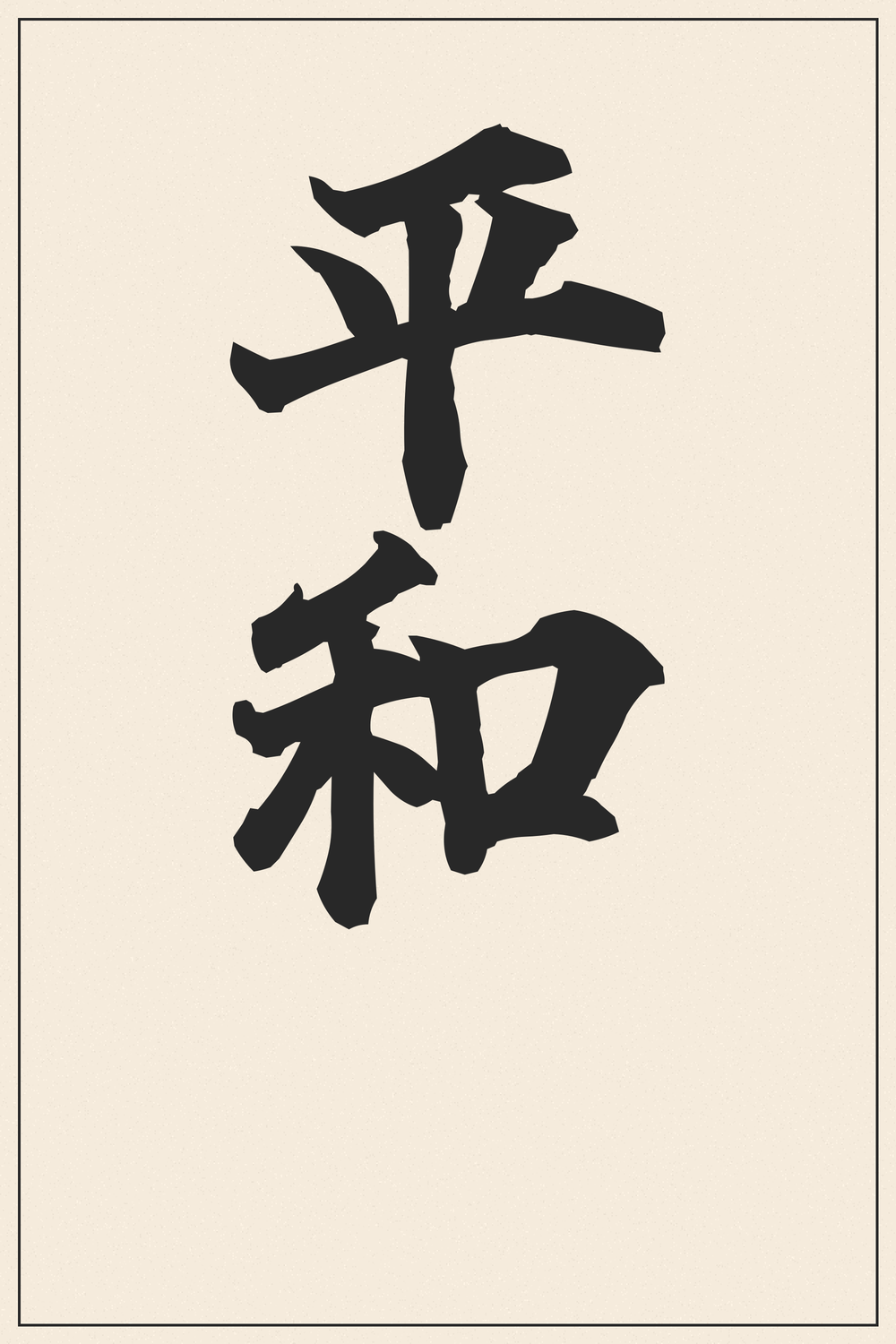
📜 Vertical Writing
⚡ Quick Facts
Breaking Down 平 (Hei)
The character 平 evolved from bronze age images showing a balance scale with weights evenly distributed on both sides—the horizontal line representing the beam, the strokes below suggesting equal weights pulling down with identical force. Ancient merchants used these scales to ensure fairness in trade, creating visual proof that neither buyer nor seller was being cheated.
Over centuries, that concrete image of physical balance expanded into abstract meanings: evenness, flatness, calmness, ordinariness. A 平らな道 (tairana michi) is a flat road without hills. 平日 (heijitsu) means ordinary weekdays, not special occasions. 平民 (heimin) referred to commoners—people of equal, unremarkable status. The character always suggests the absence of extremes, irregularities, or disturbances.
In the context of peace, 平 brings the idea of equilibrium—a world where no force dominates, where power balances perfectly, where tensions cancel out leaving stillness. It’s not passive emptiness. It’s active balance, like a tightrope walker maintaining perfect center, constantly adjusting to prevent falling either direction.
The balance scale imagery in 平 connected directly to Chinese bronze age commerce around 1200 BCE. Fair trade required precise measurement. A character depicting balanced scales became shorthand for “everything is equal, fair, and just”—concepts that later expanded from marketplace transactions to social and political ideals.
Breaking Down 和 (Wa)
The left component 禾 (nogi) depicts a grain stalk bending under the weight of mature rice—the fundamental crop sustaining East Asian civilizations for millennia. It symbolizes harvest, abundance, and the agricultural cycle connecting humans to earth’s rhythms. The right component 口 (kuchi) means mouth, representing speaking, eating, or human presence.
Ancient etymology suggests 和 originally depicted people sharing grain—eating together, speaking in agreement, reaching consensus. Agricultural communities required cooperation to survive. Planting, irrigating, harvesting demanded group coordination. One family couldn’t manage rice cultivation alone. The character captured that necessary harmony, the collective agreement to work together toward mutual survival.
In modern Japanese, 和 carries enormous cultural weight. It means harmony, but also Japan itself—和食 (washoku) is Japanese cuisine, 和服 (wafuku) traditional Japanese clothing, 和室 (washitsu) Japanese-style rooms with tatami mats. The character became synonymous with Japanese identity because group harmony (prioritizing collective wellbeing over individual desires) defines traditional Japanese social structure.
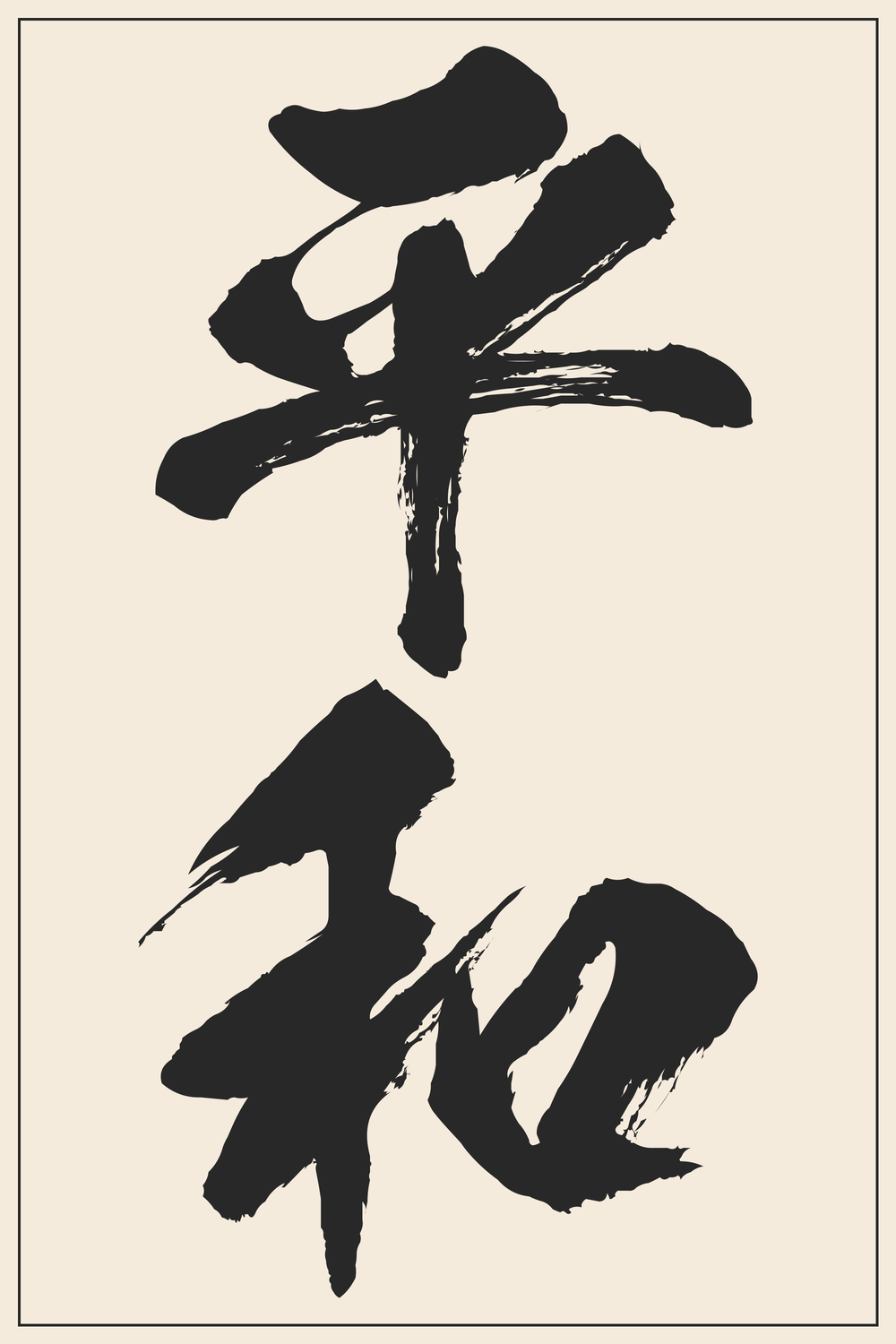
Balance and harmony flow together in traditional brushwork
平和 vs 和平: The Reversal
Japanese actually borrowed both character orderings from Chinese. 和平 (wahei) existed first, meaning essentially the same thing—peace, harmony. But during the Meiji era (1868-1912), when Japan rapidly modernized and adopted Western concepts, linguists preferred 平和 (heiwa) for the Western notion of “peace.”
Why the switch? Putting 平 first emphasizes balance and equilibrium—starting from a foundation of equal standing, then building harmony on top. It suggested the modern diplomatic concept where nations meet as equals before negotiating peaceful coexistence. 和平, with harmony first, felt more traditional, more about cultural consensus than political equality.
Today, 平和 dominates usage. It’s the word in Article 9 of Japan’s constitution, on Hiroshima peace memorials, in international diplomacy. 和平 still exists but sounds archaic, literary. For tattoos, 平和 carries the modern, globally recognized meaning that resonates with contemporary peace movements and personal commitments to nonviolence.
The Hiroshima Peace Memorial Park features 平和 prominently on monuments, plaques, and the iconic cenotaph arch. Visitors from every nation see this compound representing humanity’s hope to never repeat atomic horror. That association gives 平和 profound weight—it’s not abstract philosophy but a plea born from unimaginable suffering.
Peace as Active Practice
Western languages often define peace negatively—the absence of war, the lack of conflict. Japanese 平和 implies something more active: the presence of harmony, the achievement of balance, the ongoing maintenance of equilibrium. You don’t just stop fighting and call it peace. You actively cultivate conditions where conflict becomes unnecessary.
This distinction matters philosophically. A cease-fire isn’t 平和. Two enemies glaring at each other across a demilitarized zone isn’t 平和. True heiwa requires genuine harmony—resolved tensions, mutual understanding, balanced interests. It demands constant work, continuous adjustment, perpetual rebalancing like those ancient scales suggested by 平.
Japanese peace movements embody this active interpretation. They don’t just protest war; they build international friendships, create cultural exchanges, teach conflict resolution, promote environmental sustainability (since resource competition triggers wars). 平和 becomes a practice, not a state—something you do daily, not something you declare once then forget.
Inner Peace, Outer Peace
While 平和 officially refers to political peace between nations or social harmony within communities, Japanese spiritual traditions apply it internally. Buddhist temples teach 心の平和 (kokoro no heiwa)—peace of mind/heart. This inner peace requires the same balance and harmony as external peace: conflicting desires balanced, competing thoughts harmonized, emotional extremes leveled.
Zen meditation practices aim specifically at achieving this internal 平和. When your mind stops fighting itself—when cravings, regrets, anxieties, and ambitions settle into calm equilibrium—you experience heiwa as a lived reality rather than abstract concept. Monks spend decades pursuing this state that the characters describe so simply.
This dual application makes 平和 tattoos personally meaningful even for people not particularly focused on global politics. You’re not necessarily declaring “I’m a peace activist” (though you might be). You could be saying “I seek internal balance,” “I value emotional harmony,” or “I’m learning to quiet the war inside my own head.” The characters hold both meanings simultaneously.
Modern mindfulness practices in the West often borrow Japanese concepts without naming them. When therapists talk about “non-judgment” and “balanced awareness,” they’re essentially teaching 平和 principles—observing your thoughts without letting any single one dominate, maintaining mental equilibrium despite internal and external chaos.
Historical Irony
Japan’s fervent embrace of 平和 after 1945 carries deep irony considering the prior decades. From the 1930s through WWII, Japanese military propaganda emphasized 和 (harmony) too—but as forced unity under imperial dominance, conquering Asia to create a “Greater East Asia Co-Prosperity Sphere” where everyone harmoniously submitted to Japanese rule.
The same characters that now symbolize pacifism and anti-war sentiment were weaponized to justify invasion, occupation, and atrocity. The Showa era (1926-1989) was literally named 昭和 (Showa)—”bright harmony”—during Japan’s most violent period of expansion and war. Language doesn’t determine morality; people wielding language do.
Post-war Japan’s relationship with 平和 represents deliberate reclamation and redefinition. The characters remained, but their meaning transformed through collective trauma and conscious choice. Modern Japanese peace activists know this history—they chose these specific characters precisely because their meaning isn’t fixed, because cultural work can shift symbols from justifying violence toward preventing it.
🎨 Tattoo Design Ideas
- ✨ Traditional Calligraphy Balance – Both characters rendered in classic brushwork with equal visual weight creates symbolic and aesthetic balance. The flowing strokes should feel calm, never aggressive—matching the concept they represent. Best for 5-7 inch horizontal placements across upper back or chest.
- ✨ Minimalist Modern Simplicity – Clean, precise lines without decorative flourishes work for smaller placements (3-4 inches) on inner wrist, ankle, or behind ear. The 13-stroke total maintains readability while keeping the design uncluttered and contemporary.
- ✨ Vertical Scroll Format – Traditional top-to-bottom placement along spine or forearm honors authentic Japanese writing direction. Consider subtle background elements like bamboo or gentle waves that suggest tranquility without overwhelming the characters.
- ✨ Integrated Peace Symbols – Pair 平和 with culturally appropriate imagery like cherry blossoms (fleeting beauty worth preserving), origami cranes (Hiroshima’s symbol of peace), or gentle circular ensō (Zen balance). Keep additions minimal—the kanji should dominate.
- ✨ Watercolor Wash Background – Bold black characters with soft watercolor washes in calming blues, greens, or gentle earth tones behind them suggests the fluid, active nature of peace. The color should enhance, not compete with the kanji.
- ✨ Circular Composition – Arrange the two characters in a circular pattern (like a yin-yang) to emphasize balance and interconnection. This breaks from traditional linear writing but creates powerful visual symbolism showing how the concepts support each other.
Who Chooses This Tattoo
Veterans—particularly those who served in combat zones—gravitate toward 平和 tattoos as personal statements about what they fought for or what they learned. After experiencing war’s reality, many soldiers develop fierce commitment to preventing future conflicts. The characters become a visible pledge: “I know war’s cost. I choose peace.”
Activists working in conflict resolution, humanitarian aid, or social justice wear 平和 as identification with their life’s work. It’s both personal reminder during difficult moments and signal to others about core values. In protest contexts, the tattoo makes a visible statement without saying a word.
But many people choose 平和 for intensely personal reasons disconnected from politics. Survivors of domestic violence get it marking their escape to peaceful lives. People recovering from addiction ink it celebrating internal harmony after years of self-destructive chaos. Parents choose it after navigating family conflicts toward resolution. The characters work at every scale—from global to intimately individual.
In Japan, visible tattoos still carry stigma in certain contexts—hot springs ban them, some employers discriminate against them, older generations associate them with yakuza. Your beautiful 平和 tattoo might ironically create social disharmony in traditional Japanese settings. Modern attitudes are changing, especially in cities, but awareness helps you navigate situations respectfully.
Why These Characters Endure
Peace remains humanity’s most elusive goal. We’ve achieved technological miracles—split atoms, mapped genomes, connected every human wirelessly—yet conflicts rage continuously across the planet. The gap between our capability for cooperation and our tendency toward violence defines the modern human condition.
平和 endures as a symbol because it doesn’t pretend peace is natural or easy. The characters acknowledge that balance requires constant adjustment (平) and harmony demands active cultivation (和). They’re honest about the work involved while maintaining hope that the work is possible and worthwhile.
Getting 平和 tattooed isn’t naïve idealism. It’s acknowledging reality’s difficulty while refusing to accept violence as inevitable. It says “I know maintaining balance and harmony is hard work. I commit to doing that work anyway—in my relationships, my community, my internal life, and if possible, the wider world.” That message grows more relevant as global challenges demand unprecedented cooperation. The ancient characters point toward futures we desperately need to build.
Comments