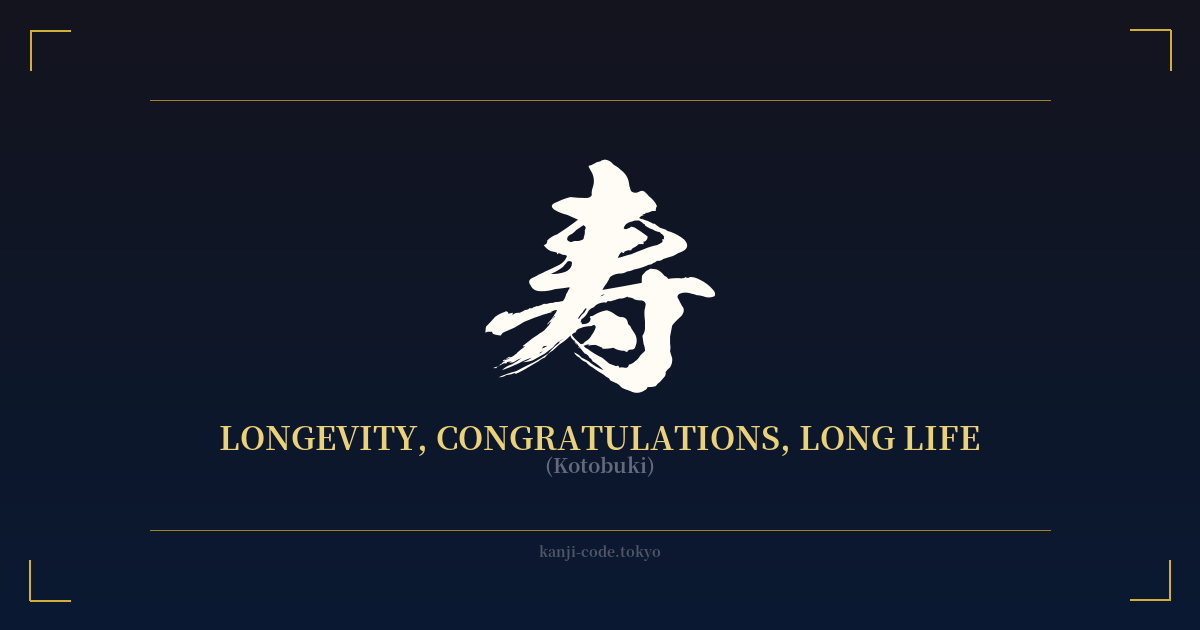
✍️ 寿 (Kotobuki) — Cultural Context
The kanji 寿, most famously read as 'Kotobuki', is one of the most auspicious and cherished characters in the Japanese language. Its core meaning revolves around longevity, long life, and the act of celebration itself. It embodies a deep-seated cultural wish for health, happiness, and a life well-lived.
This character is omnipresent during joyous occasions in Japan. You will find it adorning gift envelopes (shūgi-bukuro) for weddings, special birthday parties for the elderly—such as the 60th (kanreki) or 88th (beiju) birthdays—and various New Year's decorations. Its presence signifies a blessing and a heartfelt congratulation, making it more than just a word; it's a cultural gesture of goodwill.
The history of 寿 is tied to ancient Chinese philosophies, particularly Daoism, which held the pursuit of longevity and immortality in high regard. These ideas permeated Japanese culture, embedding 寿 as a cornerstone of good fortune alongside concepts like wealth (富) and happiness (福). The character's older, more complex form, 壽, visually depicts elements related to old age and time, reinforcing its ancient connection to a long lifespan.
Interestingly, the word 'kotobuki' itself is derived from 'koto-hoki', which means 'to speak words of blessing'. This highlights its performative and celebratory nature. It's not just a state of being long-lived but also the very act of celebrating that life. This dual meaning gives the character a wonderful depth, representing both the goal (a long life) and the joyful moments within it.
Beyond celebrations, 寿 appears in everyday language and concepts. The word for 'lifespan' is 寿命 (jumyō), and even the beloved dish 'sushi' was originally written with this kanji (寿司), thought to relate to the preservation methods that gave the food a longer life. This versatility demonstrates how deeply the concept of 'kotobuki' is woven into the fabric of Japanese thought and daily life.
🖌️ Font Styles for 寿
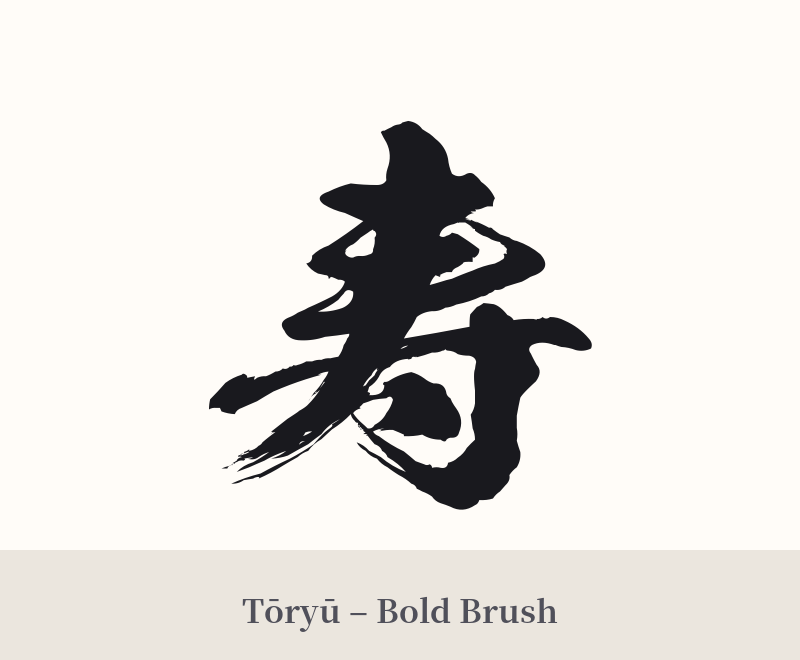
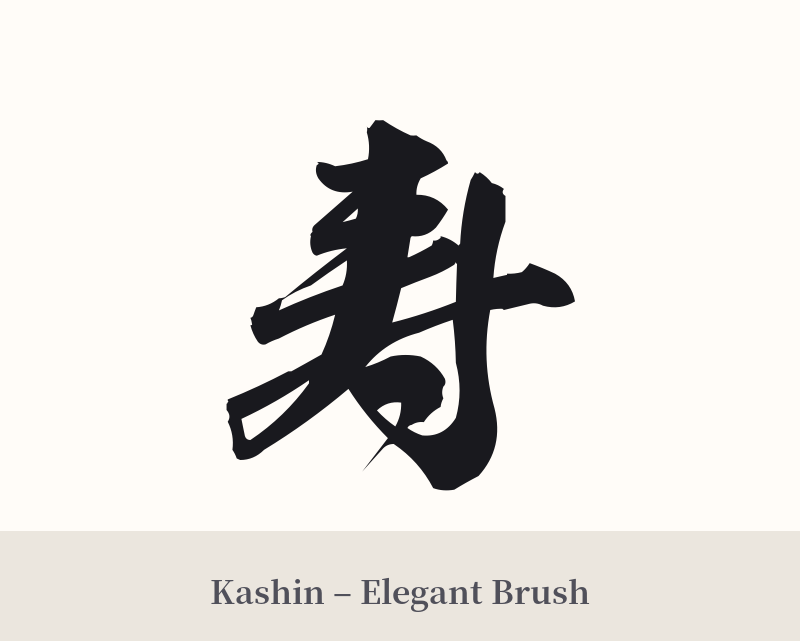
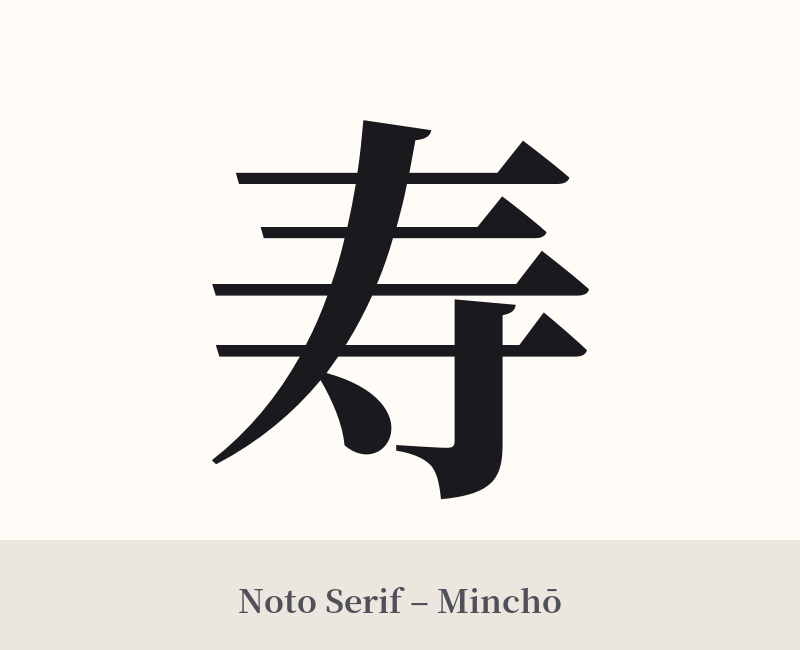
The same kanji can look dramatically different depending on the calligraphy style. Choose a font that matches the mood you want for your tattoo or design.
🎨 Tattoo Suitability
📐 Tattoo Design Guide
The kanji 寿 offers great flexibility for a tattoo design due to its balanced form and positive meaning.
– Placement: For a small, subtle design, the inner wrist, ankle, or behind the ear are excellent choices. For a more prominent statement, the forearm, back of the neck, or calf allows for a larger, more detailed rendering. It also works beautifully as a central element on the chest or shoulder blade.
– Font Style: The style can dramatically alter the feeling. A crisp, blocky 'Kaisho' (regular script) gives it a strong, formal, and timeless look. For a more artistic and fluid feel, a semi-cursive 'Gyosho' or a highly abstract 'Sosho' (cursive script) can create a dynamic and personal design. Consider also the older, more intricate form (壽) for a classic, traditional aesthetic with more visual complexity.
– Visual Tips: To enhance its meaning, consider pairing 寿 with other Japanese symbols of longevity. A crane (tsuru) or a turtle (kame) are classic companions. It can also be placed within an 'ensō' (Zen circle) to represent the eternal cycle of a long and complete life. Incorporating natural elements like pine branches or bamboo stalks, which also symbolize resilience and long life, can create a rich and meaningful composition.
Comments