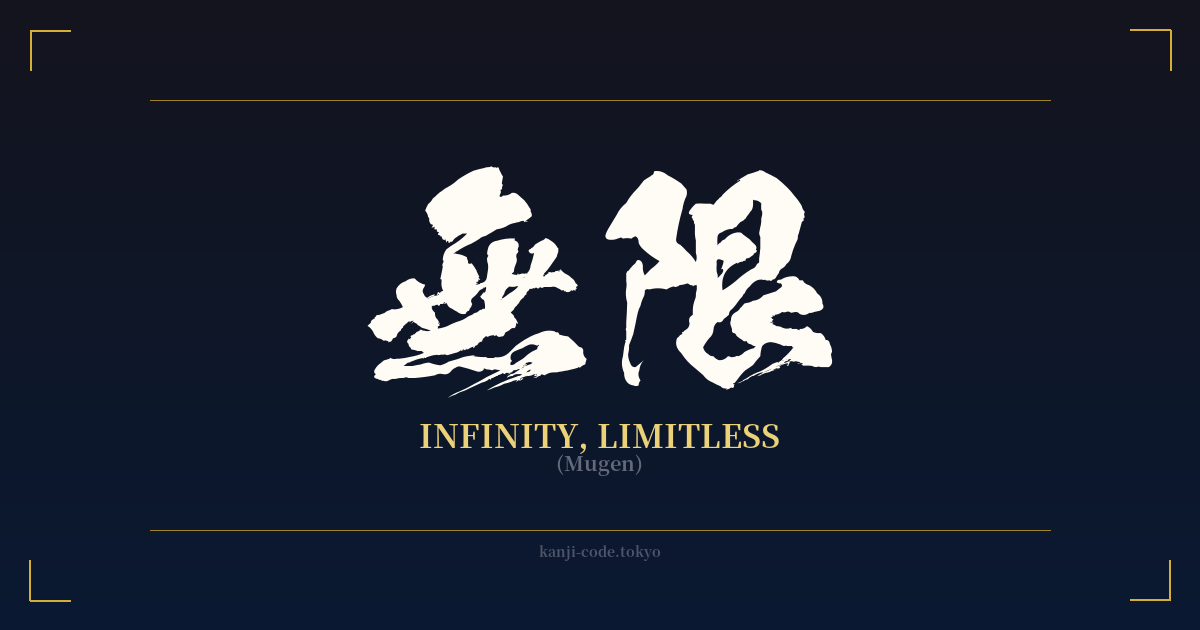
✍️ 無限 (Mugen) — Cultural Context
無限 (Mugen) is a powerful Japanese word that translates to 'infinity,' 'limitless,' or 'boundless.' It’s a concept that transcends mere vocabulary, touching upon deep philosophical, spiritual, and even scientific ideas.
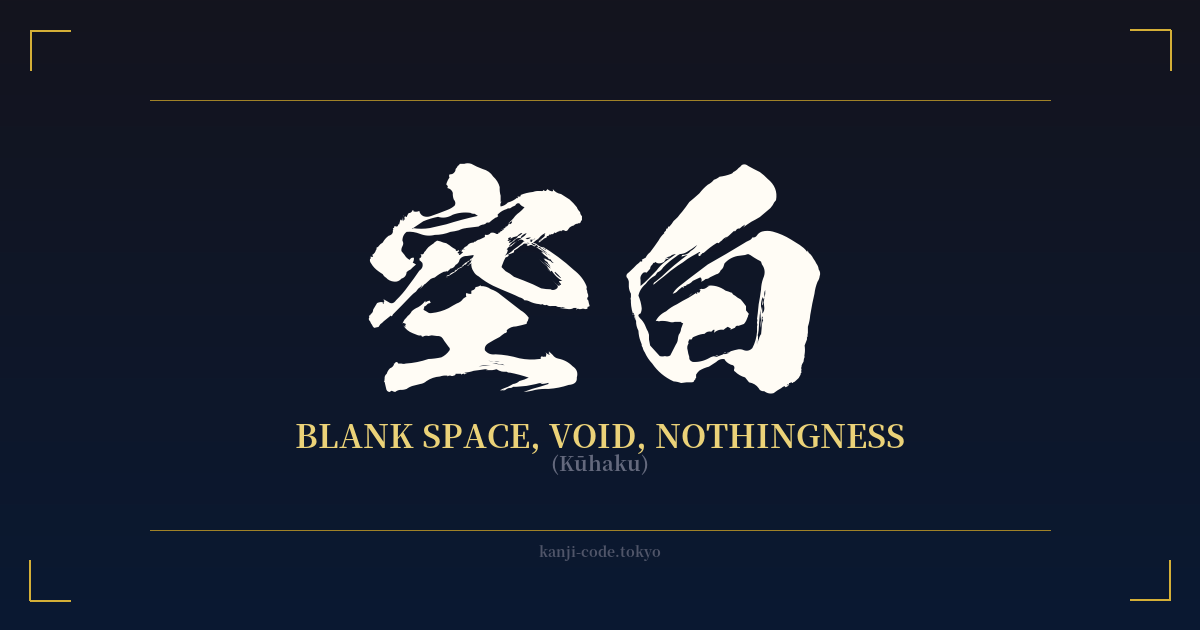
At its core, 無限 is a combination of two characters: 無 (mu), meaning 'nothing' or 'without,' and 限 (gen), meaning 'limit' or 'boundary.' Together, they form the elegantly simple concept of 'without limit.' This isn't just about a large quantity; it’s about the complete absence of any restriction or end.
In Japanese philosophy and spirituality, particularly within Zen Buddhism, the idea of 無 (mu) is central. It represents a void or emptiness that is not negative but is instead full of potential. 無限 expands on this, suggesting a universe of infinite possibilities, an unconstrained consciousness, or a reality that is not bound by our limited perceptions. It resonates with the idea that our potential, the universe itself, or the path to enlightenment has no defined endpoint.
This concept finds a parallel in mathematics and cosmology, where 無限 (or the more technical term 無限大, mugendai) is a fundamental idea. It describes endless sets, the boundless expanse of the cosmos, and theoretical physics concepts that challenge our understanding of space and time. The word captures that sense of awe and mystery we feel when contemplating the universe.
In modern pop culture, 無限 has become an iconic term. It is famously the name of the 'Mugen Train' in the record-breaking anime and film Demon Slayer, symbolizing an endless, dream-like state. It is also the name of the wild and unpredictable swordsman, Mugen, from the classic anime Samurai Champloo, whose fighting style is described as limitless and free-form. In these contexts, Mugen represents unstoppable force, untamed potential, and breaking free from conventional boundaries.
Whether seen as a spiritual goal, a scientific reality, or a symbol of untethered freedom, 無限 remains a potent and inspiring word in the Japanese language. It encourages us to look beyond our perceived limitations and embrace the idea of endless possibility.
🖌️ Font Styles for 無限
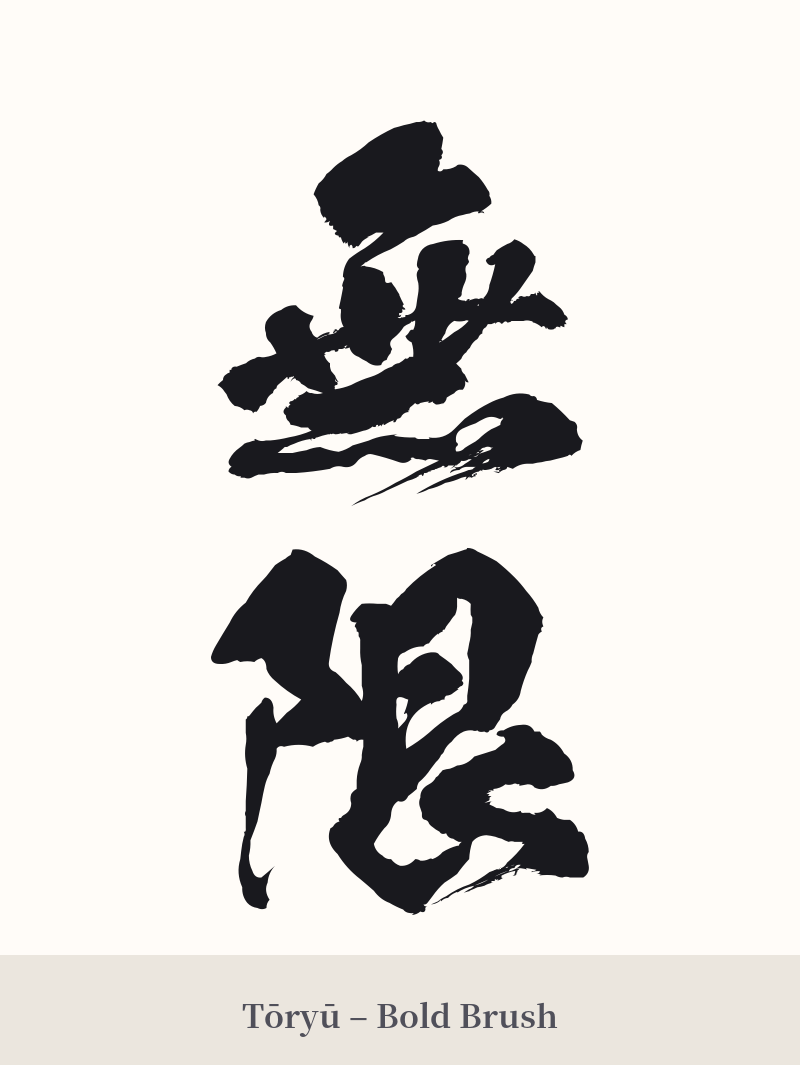
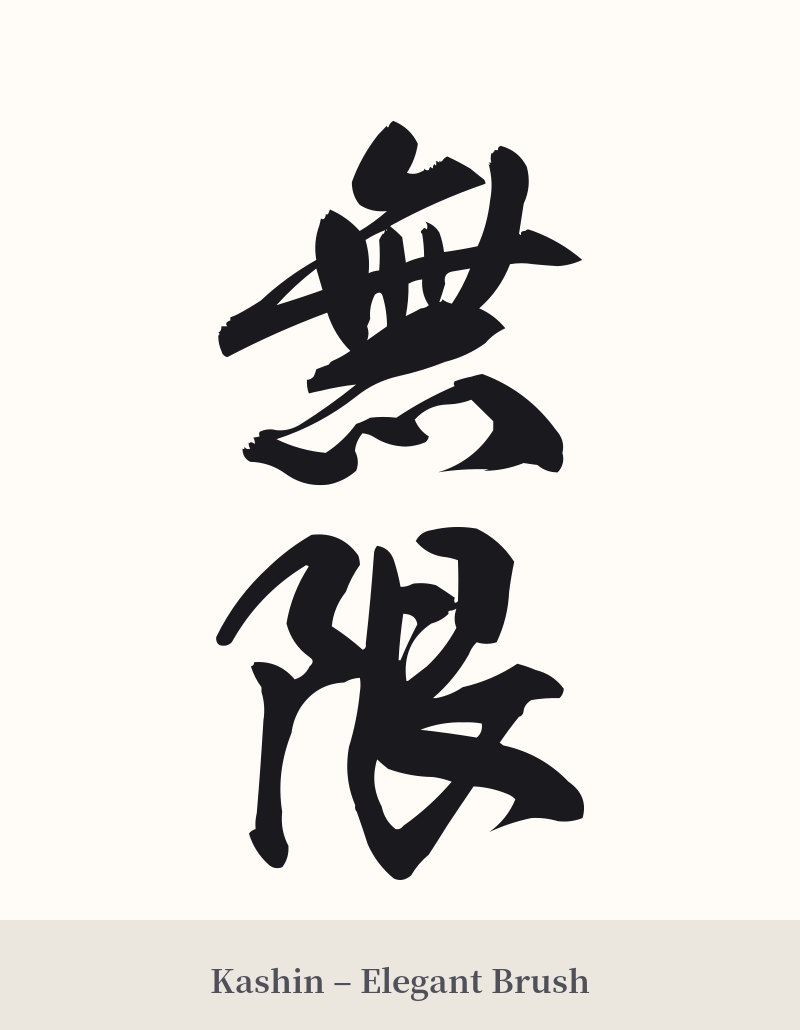
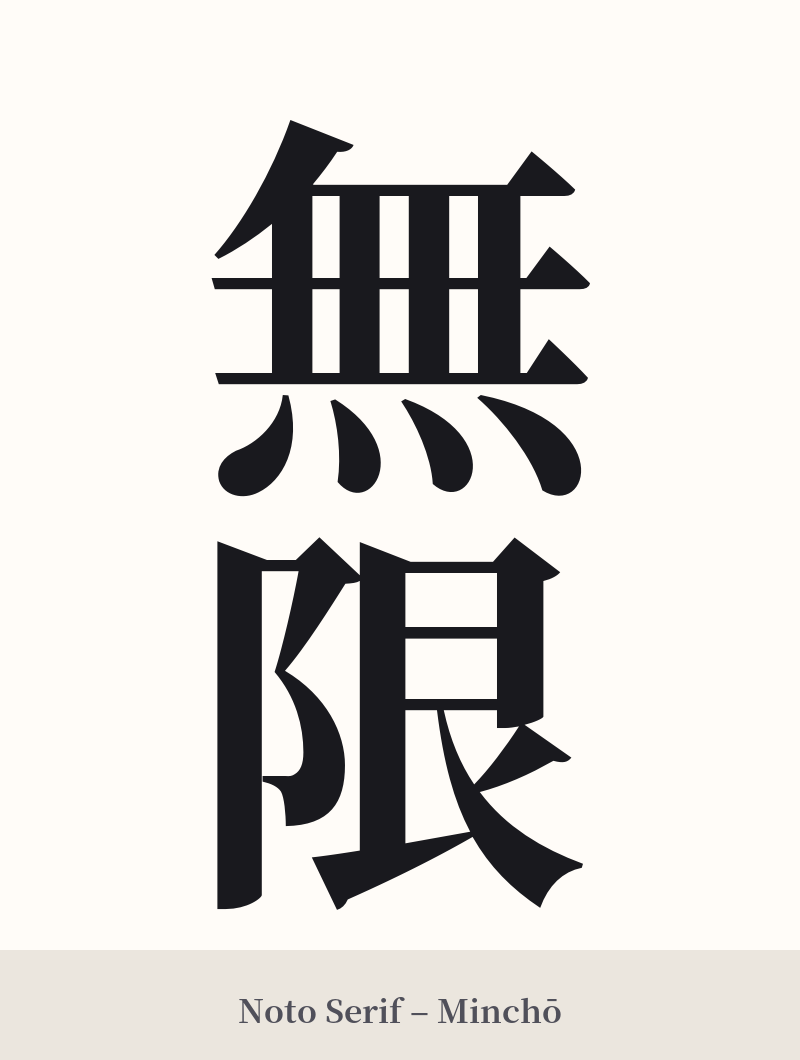
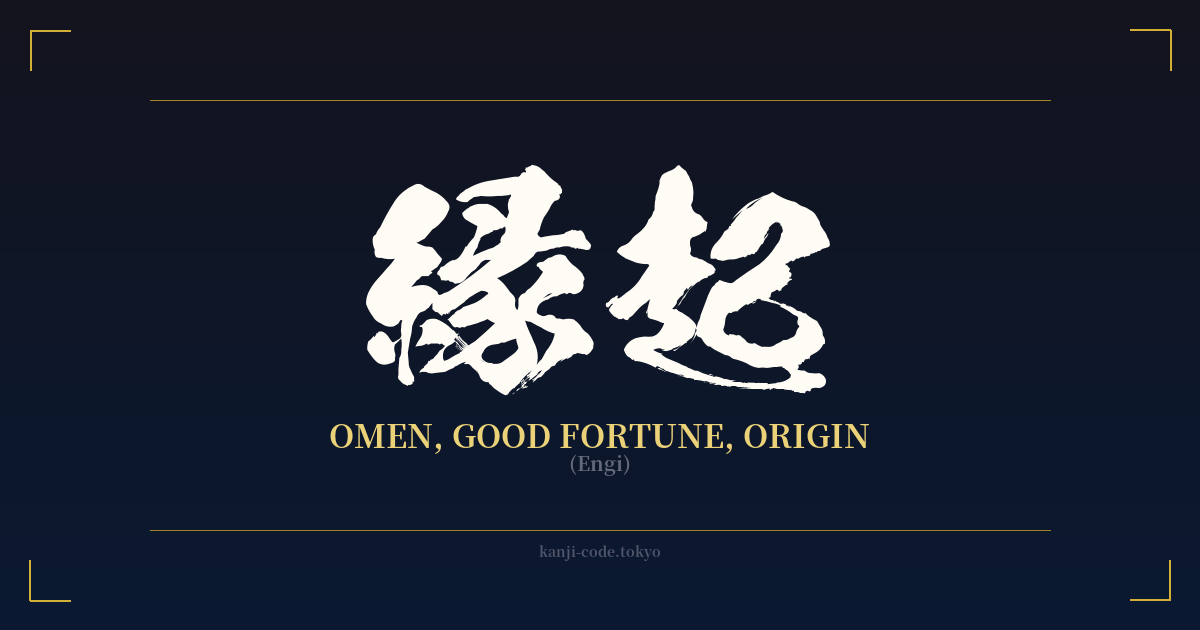
The same kanji can look dramatically different depending on the calligraphy style. Choose a font that matches the mood you want for your tattoo or design.
🎨 Tattoo Suitability
📐 Tattoo Design Guide
The two-character structure of 無限 offers great versatility in tattoo design. Its strong meaning and balanced look make it a compelling choice.
– Placement: For a vertical design, the spine, forearm, or calf are excellent choices, allowing the characters to flow downwards. For a horizontal layout, the chest, upper back, or across the ribs can create a powerful, expansive statement.
– Font Style: A dynamic, semi-cursive or brush script (gyōsho or sōsho) can emphasize the 'limitless' and 'free-flowing' nature of the word. For a more modern or philosophical take, a clean and crisp Mincho typeface provides a sense of clarity and precision.
– Visual Elements: Consider integrating the kanji with other symbols of infinity. The characters could be placed within an Ensō (Zen circle), representing the universe and enlightenment. Alternatively, a design could subtly weave the mathematical infinity symbol (∞) or an Ouroboros (a snake eating its own tail) around or through the kanji to amplify the theme of endlessness.
Comments