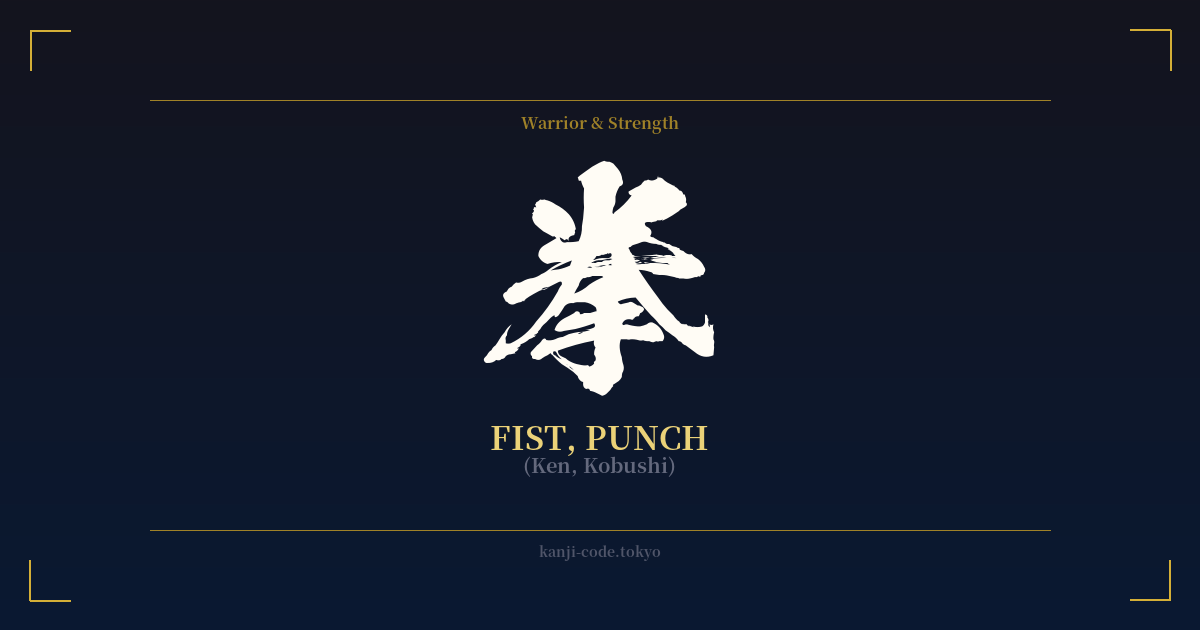
✍️ 拳 (Ken, Kobushi) — Cultural Context
The kanji 拳, read as 'ken' or 'kobushi,' is one of the most direct and powerful characters in the Japanese language. At its surface, it simply means 'fist' or the act of 'punching.' However, its cultural significance runs much deeper, embedding itself into the very heart of Japan's martial arts philosophy.
Visually, the character itself tells a story. It is a pictograph combining elements that suggest 'to roll up' and 'a hand.' This composition vividly illustrates the physical action of clenching one's fingers into a fist, preparing for action. It is a symbol of potential energy, coiled and ready to be unleashed.
In the world of Budō (武道), the Japanese martial ways, 拳 is a cornerstone concept. It appears in the names of famous fighting styles like Kenpō (拳法), which translates to 'Fist Law' or 'Fist Method,' and is a key principle in Karate (空手), the 'Empty Hand' art. Here, the fist is not merely a blunt instrument. It represents the culmination of training, discipline, and the focusing of one's spirit (気, Ki). A proper punch, or 'seiken' (正拳), is a manifestation of mind, body, and spirit working in perfect harmony.
This duality is crucial. The fist is a tool for self-defense and, if necessary, destruction. But the philosophy that guides it emphasizes restraint, control, and the immense responsibility that comes with wielding such power. The term 'tekken' (鉄拳), or 'iron fist,' exemplifies this, used to describe unyielding authority or overwhelming force. It highlights the raw power the symbol can convey.
Beyond the dojo, the word 'kobushi' (拳) is used in everyday language. The phrase 'kobushi o ageru' (拳を上げる) means 'to raise one's fist.' This can signify the start of a fight, but it's also a powerful gesture of protest, solidarity, or unwavering determination. It is the universal symbol of fighting for a cause or standing one's ground.
Therefore, 拳 is more than an anatomical part or a violent action. It is a symbol of focused strength, the discipline to control that strength, and the will to stand firm in one's convictions. It embodies the warrior's spirit in its most concentrated form: power tempered by wisdom.
🖌️ Font Styles for 拳
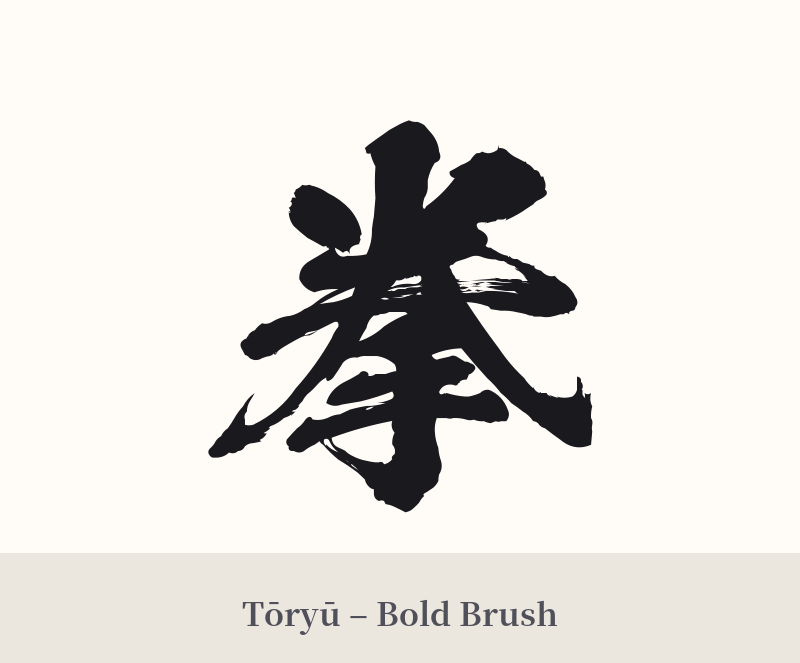
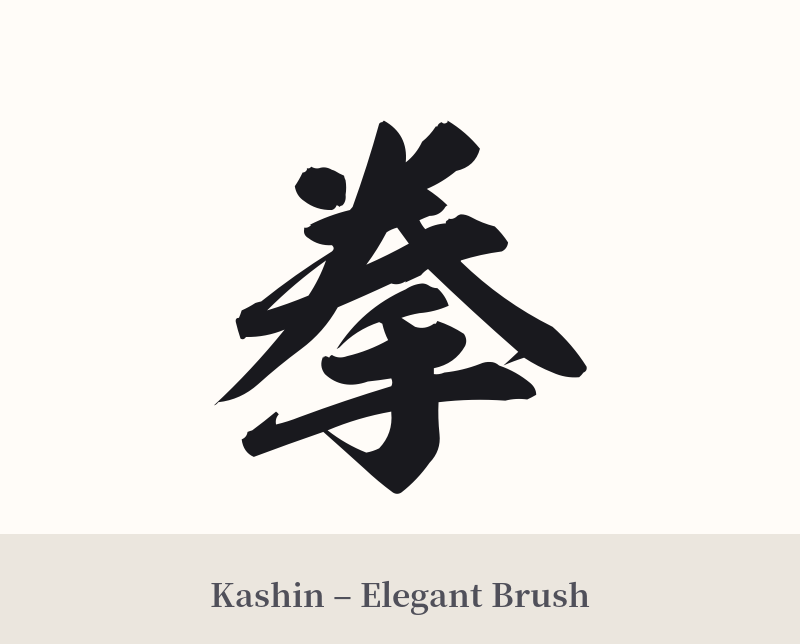
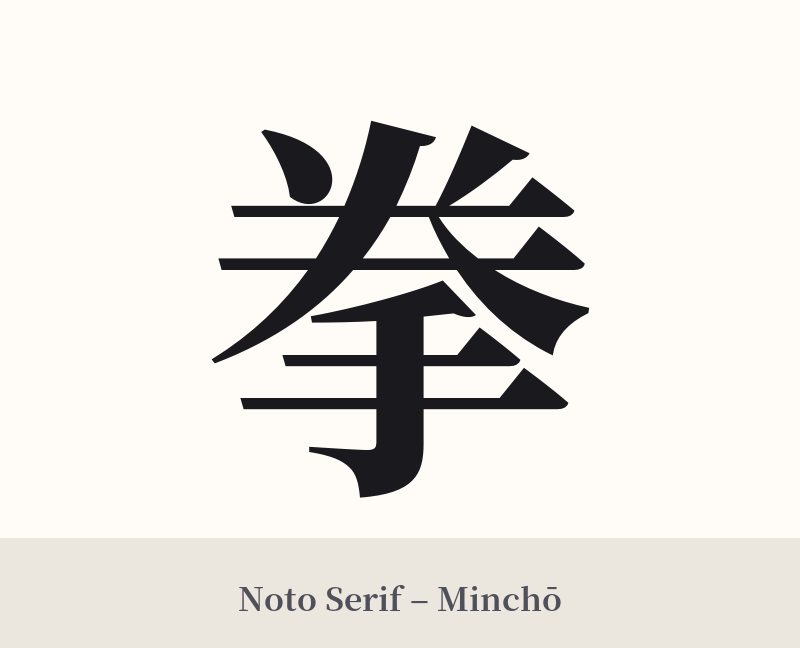
The same kanji can look dramatically different depending on the calligraphy style. Choose a font that matches the mood you want for your tattoo or design.
🎨 Tattoo Suitability
📐 Tattoo Design Guide
For a tattoo of 拳, the design should reflect its inherent power and connection to discipline.
– Placement: High-impact areas like the forearm, bicep, or calf work well, as they are sources of physical power. The back of the shoulder or the chest are also excellent canvases, allowing for a larger, more prominent design.
– Font Styles: A thick, stable script like a bold Kaisho (block style) emphasizes its solid, unshakeable strength. For a more dynamic feel, a Gyosho (semi-cursive) or Sosho (cursive) brushstroke style can capture the fluid motion of a punch, adding a sense of action and energy to the character.
– Visual Tips: While 拳 is strong enough to stand alone, it can be paired with other elements to deepen its meaning. Consider incorporating it with a dragon (龍) for power and wisdom, a tiger (虎) for ferocity, or the kanji for 'spirit' (魂) or 'way' (道). Using red ink for a portion of the character, or as a background splash, can add a sense of energy and passion.
Comments