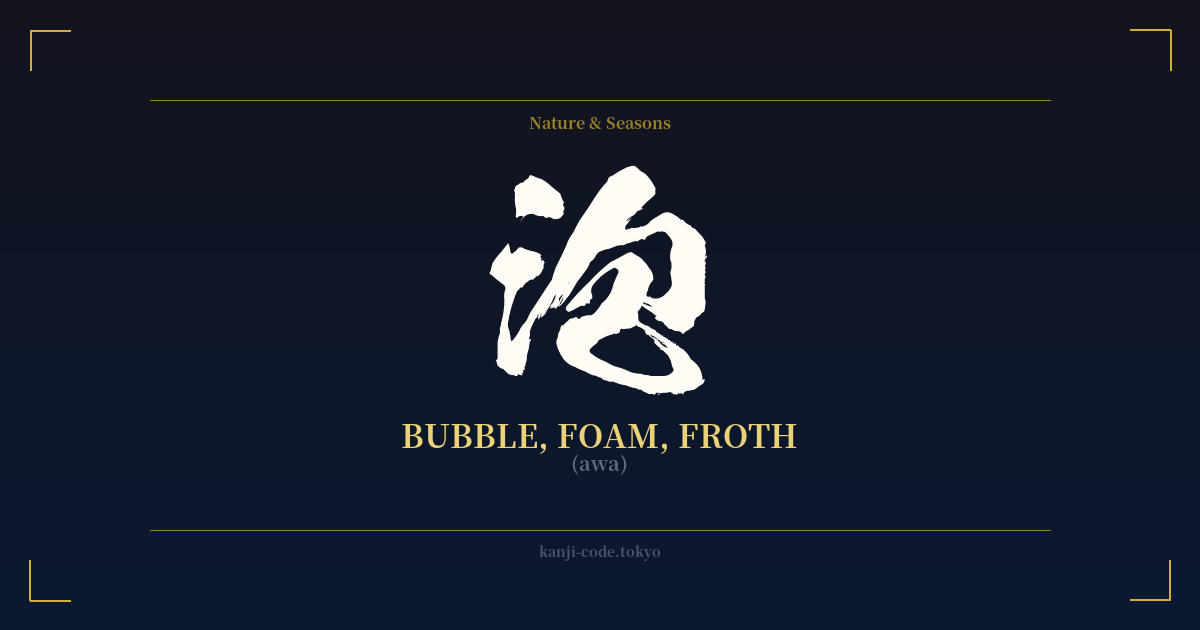
✍️ 泡 (awa) — Cultural Context
The kanji 泡 (awa) literally translates to bubble, foam, or froth. It is a character deeply rooted in the visual and sensory world, instantly evoking images of soap lather, the head on a freshly poured beer, or the effervescence of a carbonated drink. Its structure beautifully illustrates its meaning: the left radical, 氵 (sanzui), is a depiction of water, while the right component, 包 (hō), means 'to wrap' or 'envelop.' Together, they create the image of water wrapping around air—a bubble.
Beyond its literal definition, 泡 carries a profound poetic and philosophical weight in Japanese culture. It is a powerful symbol of transience and the ephemeral nature of life, closely tied to the aesthetic concept of 'mono no aware' (物の哀れ), the gentle sadness of passing things. Just as a bubble forms, shimmers beautifully for a moment, and then vanishes without a trace, so too do moments of joy, beauty, and even life itself. This imagery is frequently used in poetry and literature to capture the fleeting quality of dreams, hopes, and existence.
A common and poignant expression is 水の泡になる (mizu no awa ni naru), which literally means 'to become bubbles on water.' This idiom is used when efforts, plans, or dreams come to nothing, disappearing as quickly and completely as a bubble. It speaks to a sense of resignation and the acceptance that some things are not meant to last.
More recently, 泡 took on a significant economic connotation. The term バブル景気 (baburu keiki), or 'Bubble Economy,' refers to Japan's period of massive economic speculation and inflated asset prices in the late 1980s. When this 'bubble' inevitably burst in the early 1990s, it led to a prolonged economic stagnation. In this context, 泡 represents something artificially inflated, unsustainable, and destined for a sudden collapse. This modern usage adds a layer of caution to the kanji's otherwise poetic meaning, serving as a reminder of the dangers of baseless optimism.
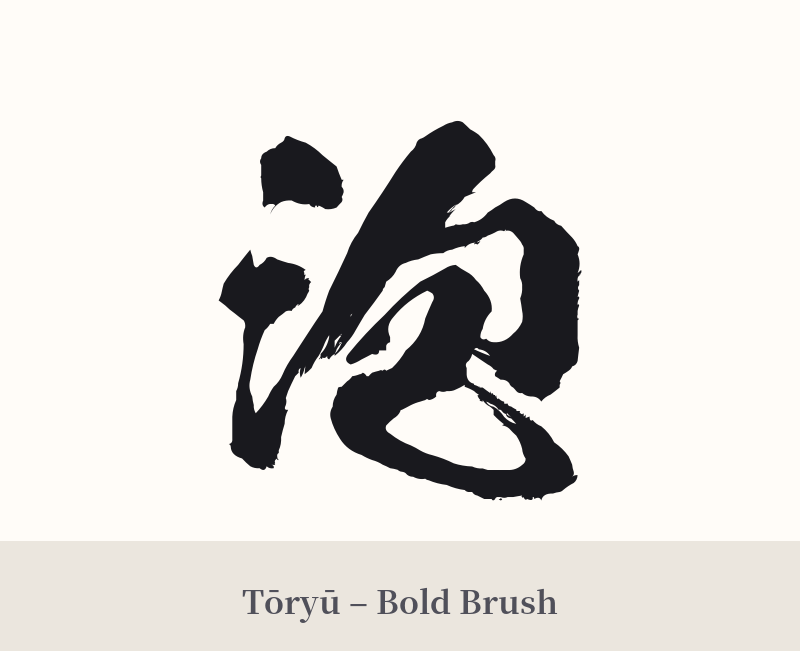
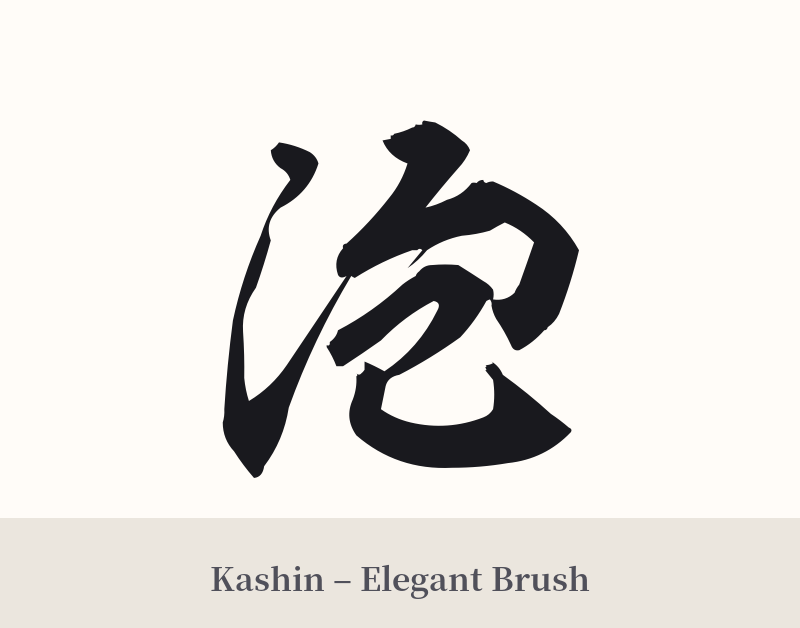
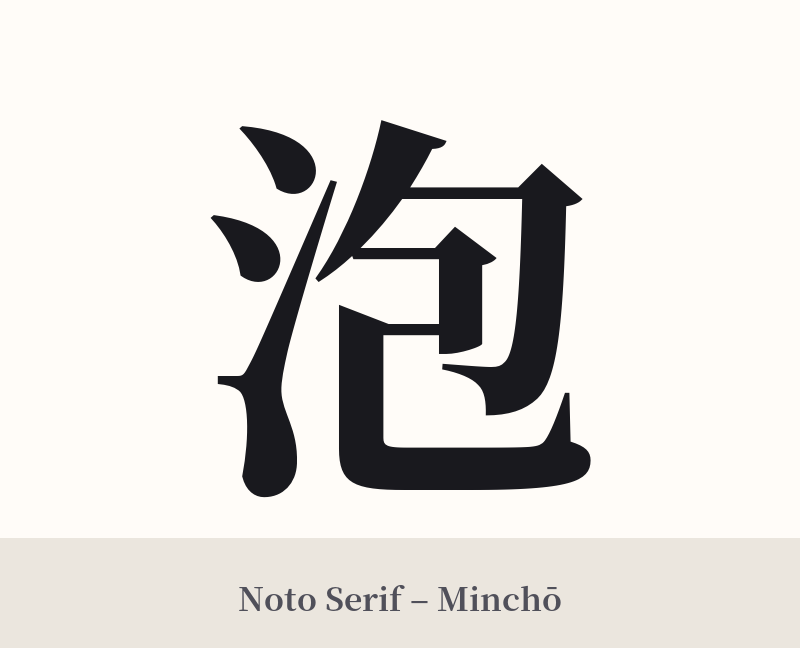
🖌️ Font Styles for 泡
The same kanji can look dramatically different depending on the calligraphy style. Choose a font that matches the mood you want for your tattoo or design.
🎨 Tattoo Suitability
📐 Tattoo Design Guide
For a tattoo, the kanji 泡 (awa) lends itself to designs that emphasize its delicate and transient nature. Its meaning is subtle and poetic, making it suitable for a more personal and thoughtful piece.
– Placement: Smaller, more intimate placements like the inner wrist, behind the ear, on the ankle, or along the collarbone can enhance the feeling of a fleeting secret. For a larger design, it could be placed on the forearm or calf, perhaps integrated into a larger scene.
– Font Style: A flowing, cursive script (草書, sōsho) or semi-cursive script (行書, gyōsho) would beautifully capture the fluid, light quality of a bubble. In contrast, a crisp, clean block font (楷書, kaisho) would give the character a more deliberate, symbolic presence.
– Visual Tips: Consider incorporating the kanji into a larger visual metaphor. The character could be drawn as if it's dissolving or made of tiny bubbles itself. It pairs exceptionally well with other water-related imagery, such as waves, koi fish, or lotus flowers, to create a cohesive design about life's transient flow.
Comments