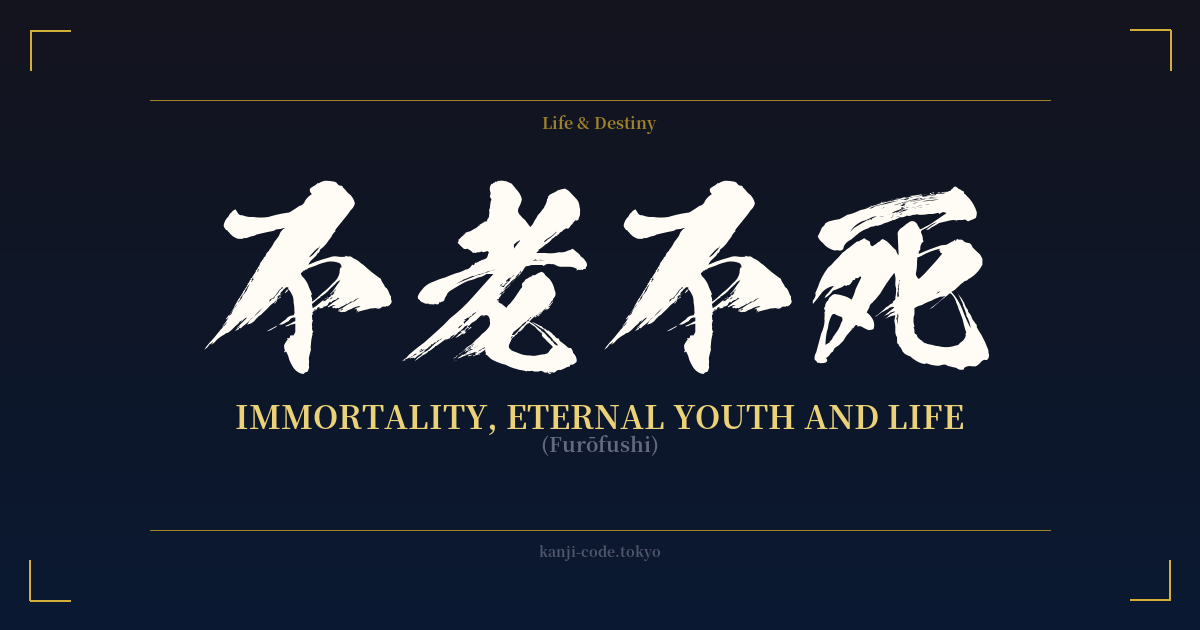
✍️ 不老不死 (Furōfushi) — Cultural Context
不老不死 (Furōfushi) is a four-character compound, or yojijukugo, that captures one of humanity's oldest and most profound desires: to live forever without the decay of aging. The kanji translate literally and poetically as 'not old, not die,' painting a clear picture of eternal youth and endless life.
This concept is not originally Japanese but was imported from China, deeply rooted in Taoist philosophy. Taoist masters and alchemists spent centuries in pursuit of an elixir of life, a mythical substance that could grant immortality. The most famous seeker was China's first emperor, Qin Shi Huang, who dispatched vast expeditions in search of the legendary Mount Penglai, an island where immortals were said to reside. These stories and the underlying philosophy traveled to Japan, where they merged with local beliefs and folklore.
In Japan, the idea of immortality is often associated with 'Sennin' (仙人), immortal sages or mountain hermits. These figures, also derived from Taoist lore, were believed to achieve their status through intense ascetic training, dietary restrictions, and a deep communion with nature. They were masters of the elements, capable of magical feats, and had transcended the physical limitations of the human body. Tales of Sennin populate Japanese legends, representing a life free from worldly concerns and the finality of death.
The term also appears frequently in Japanese literature, art, and modern pop culture. From ancient tales like 'The Tale of the Bamboo Cutter,' where Princess Kaguya leaves behind an elixir of immortality, to countless anime and manga series, the theme is pervasive. In these modern stories, immortality is often explored not just as a blessing but also as a curse—a lonely existence of outliving loved ones and watching the world change endlessly. This duality gives the concept of Furōfushi a tragic and philosophical depth beyond a simple wish for eternal life.
Ultimately, 不老不死 represents more than just the absence of death. It embodies the hope for transcendence, the desire to overcome our natural limits, and the eternal struggle between our finite existence and our infinite aspirations. It's a powerful symbol of a dream that has captivated human imagination across cultures and millennia.
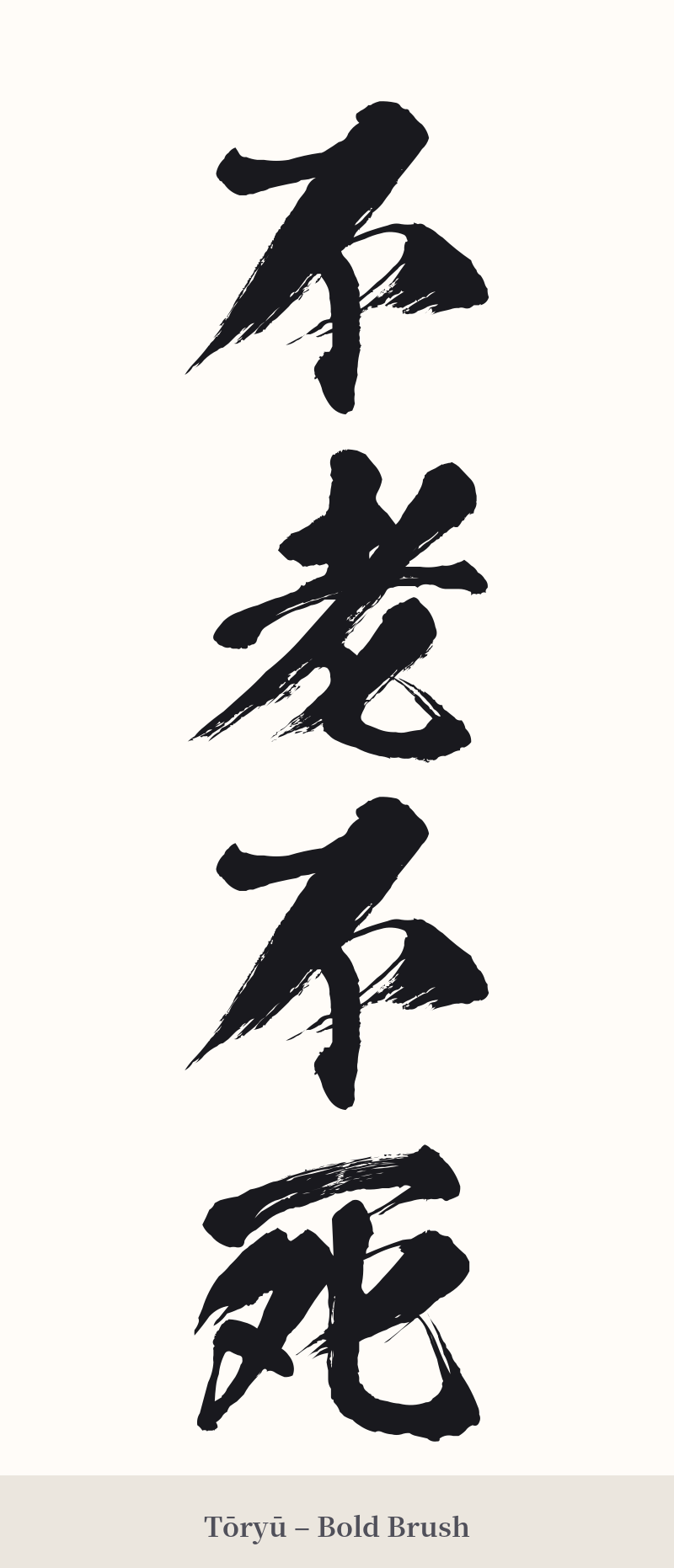
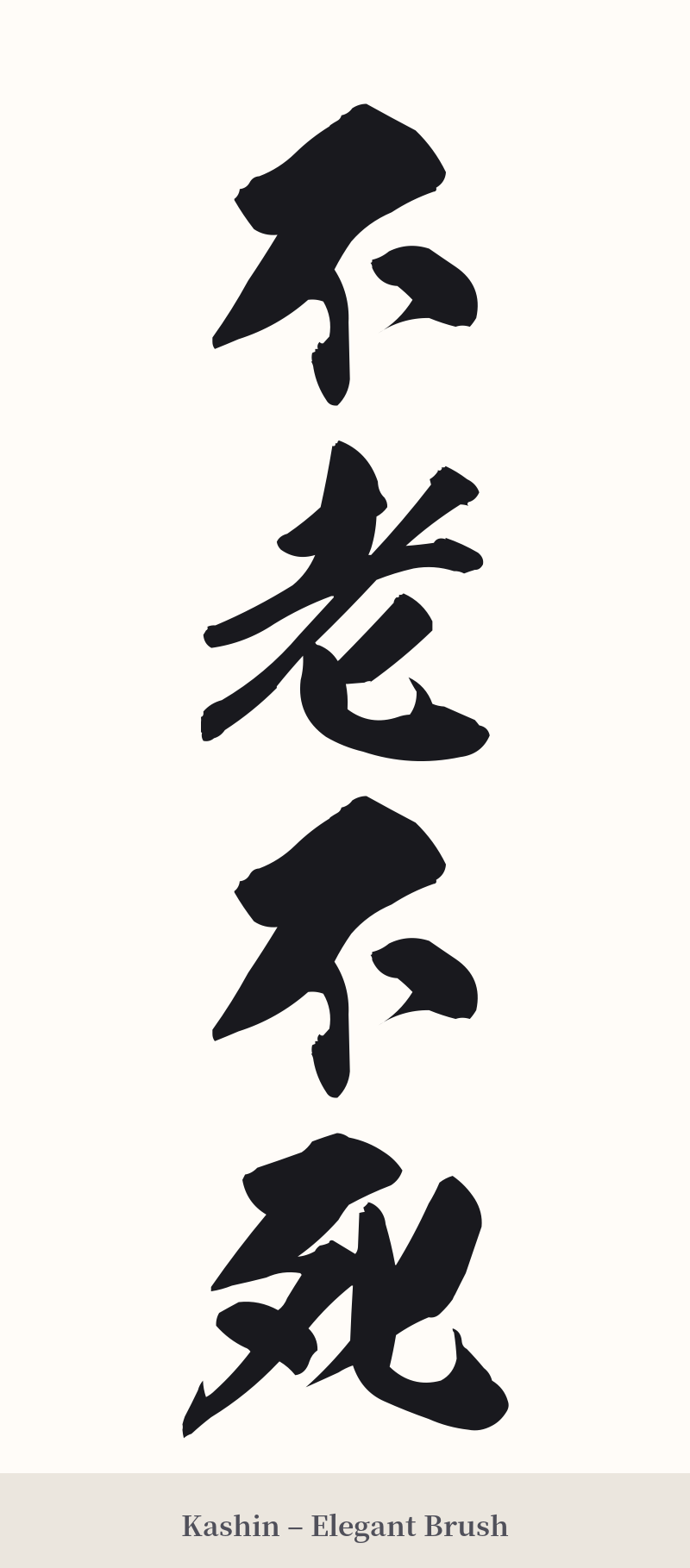
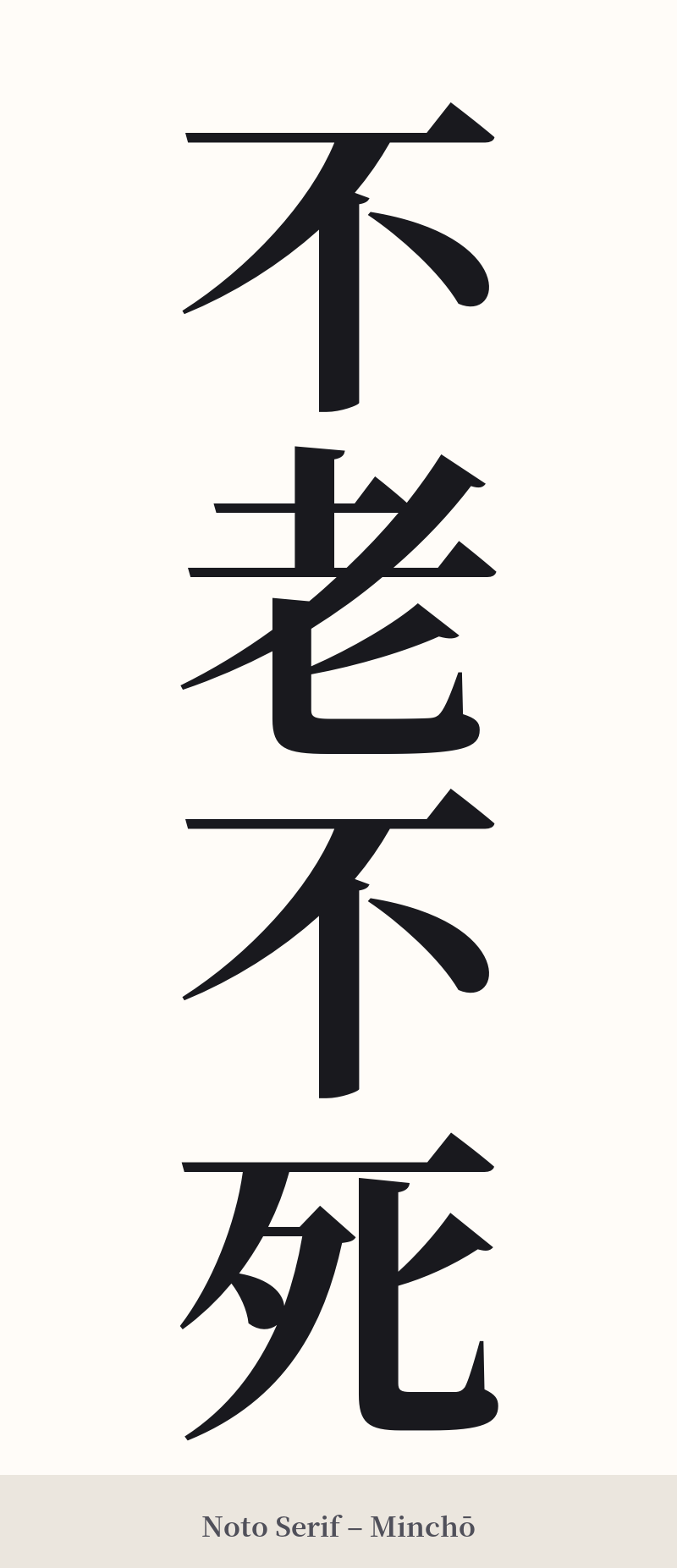
🖌️ Font Styles for 不老不死
The same kanji can look dramatically different depending on the calligraphy style. Choose a font that matches the mood you want for your tattoo or design.
🎨 Tattoo Suitability
📐 Tattoo Design Guide
As a four-character compound (yojijukugo), 不老不死 lends itself beautifully to tattoo designs that emphasize balance and flow.
– Placement: A vertical alignment is the most traditional and visually striking presentation. This looks powerful running down the spine, the forearm, or the side of the calf. For a horizontal design, it works well across the chest, upper back, or along the ribs.
– Font Styles: Consider a classic calligraphy script. 'Kaisho' (block style) offers clarity and strength, giving the characters a timeless, monumental feel. For a more dynamic and artistic look, 'Gyosho' (semi-cursive style) introduces fluid, connected strokes that can represent the eternal flow of life.
– Visual Elements: Enhance the theme by incorporating related imagery. A phoenix (不死鳥, fushichō, literally 'immortal bird') is a perfect companion, symbolizing rebirth and indestructibility. Other powerful symbols like a dragon, a lotus flower rising from mud, or an Enso circle can complement the kanji and deepen its meaning.
Comments