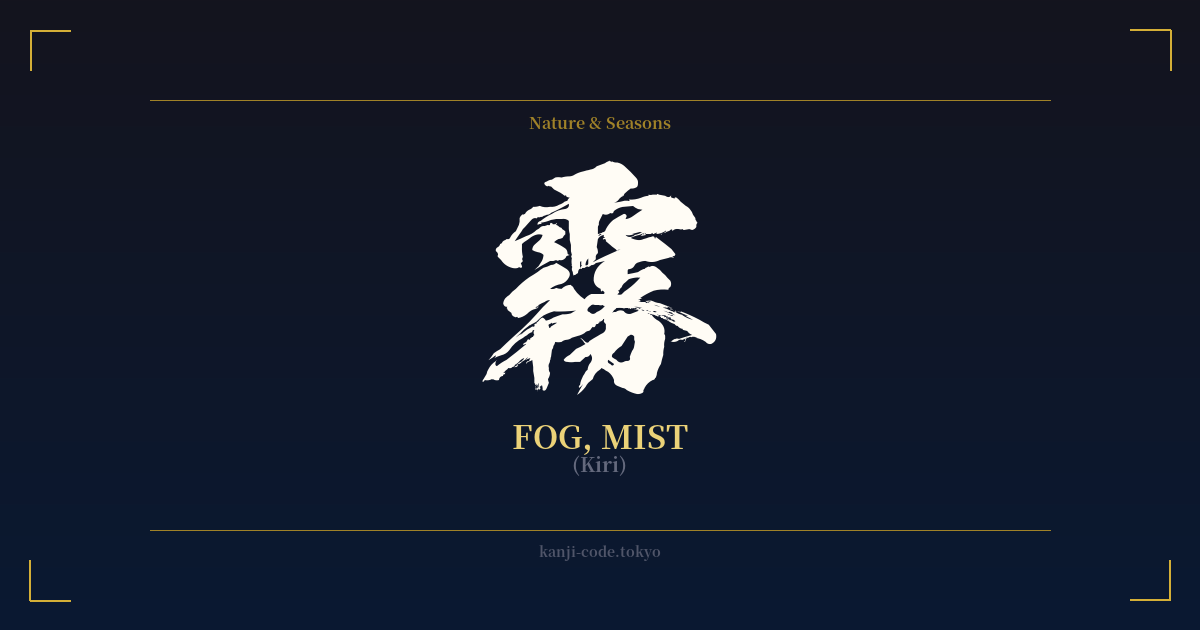
✍️ 霧 (Kiri) — Cultural Context
The kanji 霧 (kiri) translates to 'fog' or 'mist,' a simple word for a weather phenomenon that holds profound weight in Japanese culture. Japan’s humid climate and mountainous terrain create frequent misty landscapes, embedding this image deep within the nation’s artistic and spiritual consciousness.
In Japanese aesthetics, fog is a key component of an ideal known as 'yūgen' (幽玄). Yūgen doesn't have a direct English translation but refers to a deep, mysterious grace, an awareness of the universe that triggers an emotional response too profound for words. Fog perfectly embodies this concept, obscuring the familiar world and suggesting what lies beyond without fully revealing it. It creates a sense of depth and infinity, encouraging contemplation.
This aesthetic is prominent in traditional ink wash painting, or 'sumi-e.' Artists use varying shades of black ink and the white of the paper to depict misty mountains and valleys. The fog is not just an absence of detail but an active element, creating mood, separating planes, and guiding the viewer's eye. The unseen parts of the landscape, veiled by 'kiri,' are often more important than what is explicitly shown.
Literature, particularly poetry, is rich with references to fog. In haiku, 'kiri' is a 'kigo,' or season word, associated with autumn. It often symbolizes impermanence, the fleeting nature of life, or a moment of quiet solitude. The famous poet Matsuo Bashō used mist to evoke powerful feelings of loneliness and the sublime beauty of nature.
Spiritually, fog holds a place in Shintoism as a veil between the physical and the spiritual realms. The approach to a sacred shrine, especially one located in the mountains, is often shrouded in mist, creating a powerful sense of transition. Walking through the 'kiri' is like leaving the mundane world behind and entering a space of gods and spirits ('kami'). This makes fog a symbol of purification and passage into a higher state of being.
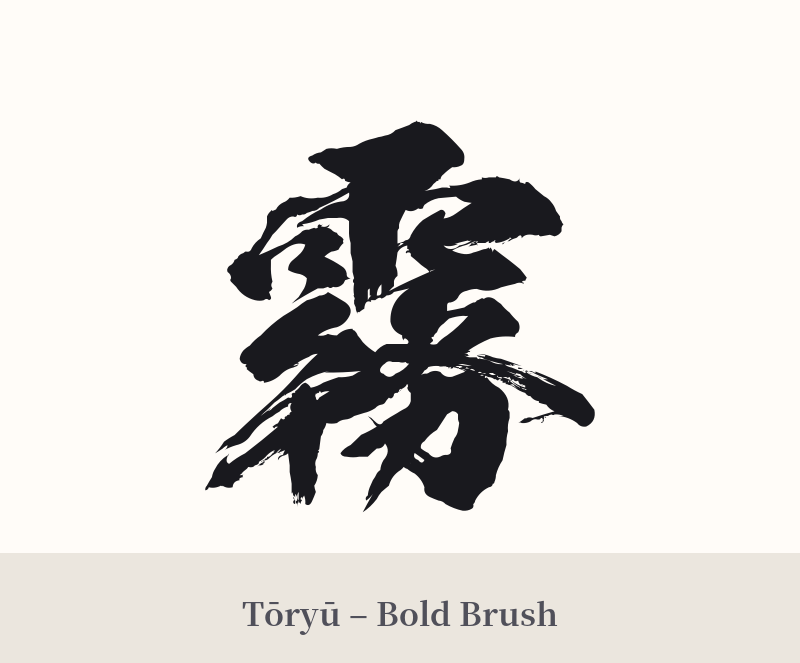
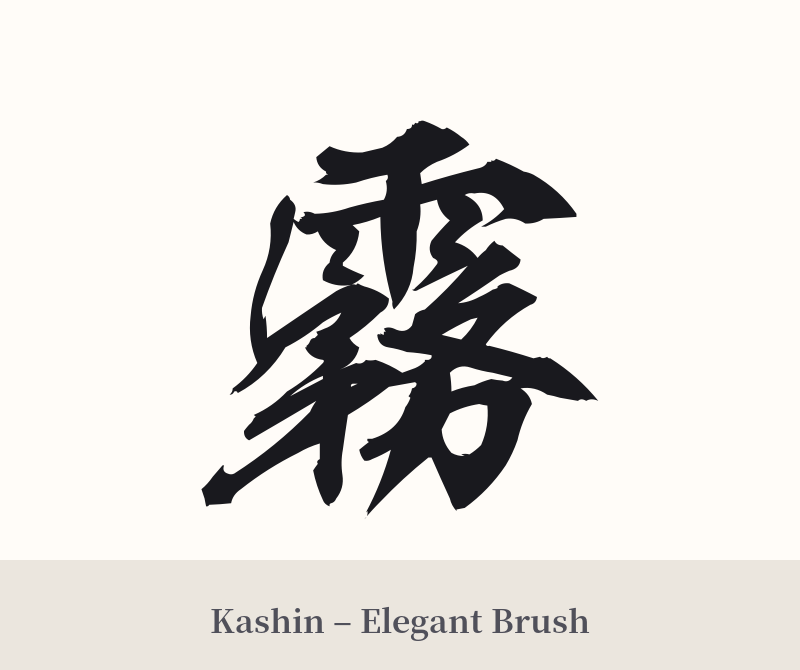
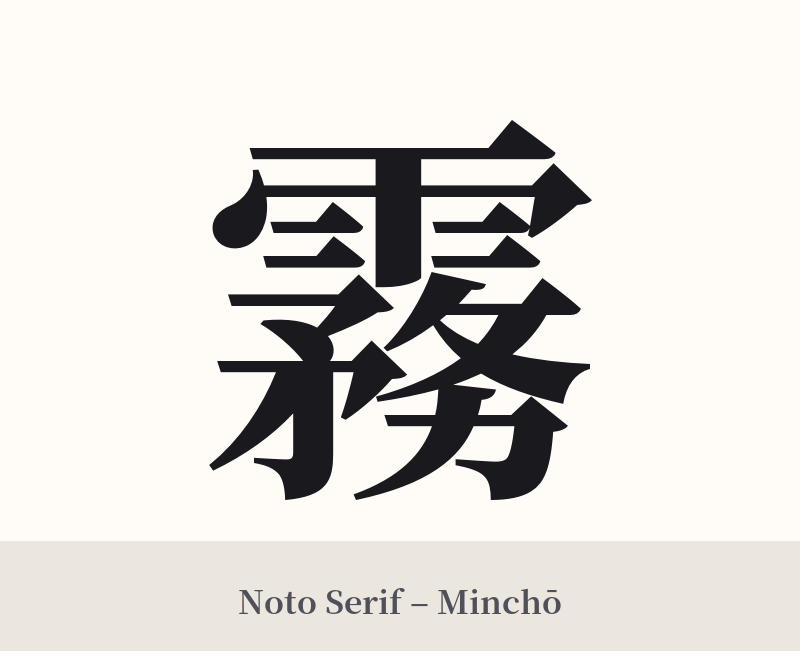
🖌️ Font Styles for 霧
The same kanji can look dramatically different depending on the calligraphy style. Choose a font that matches the mood you want for your tattoo or design.
🎨 Tattoo Suitability
📐 Tattoo Design Guide
For a tattoo of 霧 (kiri), the design choices can greatly enhance its mysterious and ethereal qualities.
– Placement: This character's vertical structure works well on the forearm, the calf, or along the spine. For a more subtle placement, the back of the neck or behind the ear could work, but the size must be large enough to prevent the strokes from bleeding together.
– Font Style: A semi-cursive 'gyōsho' style can mimic the flowing, shifting nature of mist itself. For a more grounded and atmospheric feel, a traditional 'kaisho' (block) script works well, especially when integrated into a larger scene. Avoid overly thin or complex fonts that could compromise legibility.
– Visual Tips: Consider incorporating the kanji into a larger piece. It could emerge from a grey-wash background that simulates fog, or be paired with elements often found in misty scenes, like a solitary pine tree, a torii gate, or mountain silhouettes. A skilled artist could use shading to make the kanji itself appear as if it's dissolving into mist at its edges.
Comments