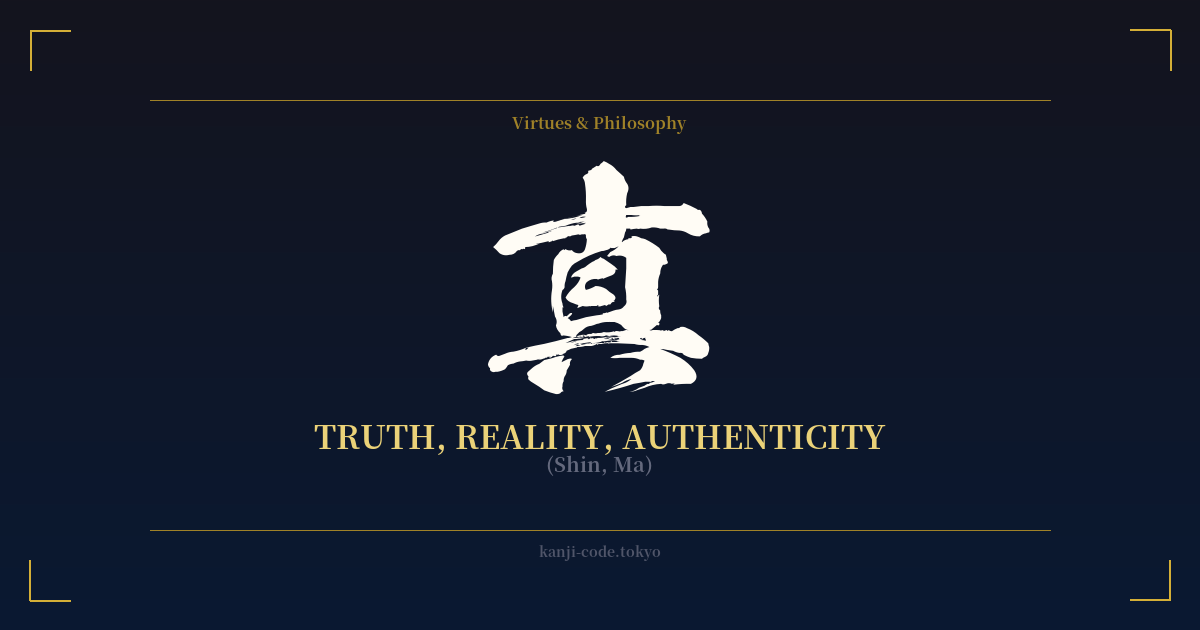
✍️ 真 (Shin, Ma) — Cultural Context
In the intricate dance of Japanese society, the concepts of 本音 (honne), one's true feelings, and 建前 (tatemae), the public facade one presents, are essential for maintaining social harmony. This distinction allows for smooth interactions, but it also creates a space where what is felt and what is shown can differ. The kanji 真 (shin) stands in stark opposition to this duality. It represents an absolute, unvarnished truth—the reality that exists beyond performance and social obligation.
真 is the genuine article. It is the core of words like 真実 (shinjitsu), which refers to the factual truth of a matter, and 真理 (shinri), the universal principles sought by science and philosophy. When you see a photograph, or 写真 (shashin), you are literally looking at a 'copy of truth,' a moment of reality captured and preserved. This character embodies the idea that beneath all layers of interpretation and presentation, a fundamental reality exists.
The etymology of 真 adds to its profound nature. One ancient interpretation depicts a person who has passed away—a body that has undergone its final transformation and can no longer deceive or change. This stark image points to truth as a final, unalterable state. Another theory suggests the character originally showed a ladle filling a pot to its absolute limit, symbolizing completeness and sufficiency. In this view, truth is something whole and lacking nothing.
Both origin stories, though different, converge on the same powerful idea: truth as an ultimate, unchanging essence. This concept resonates deeply within Japanese philosophical traditions, including Bushido and Zen Buddhism. For the samurai, acting with sincerity and truthfulness was a mark of honor. In Zen, the search for one's 'true self' is a central part of the path to enlightenment. Therefore, 真 is not just an abstract idea; it is a quality to be cultivated, a state of being to strive for—pure, authentic, and real.
🖌️ Font Styles for 真
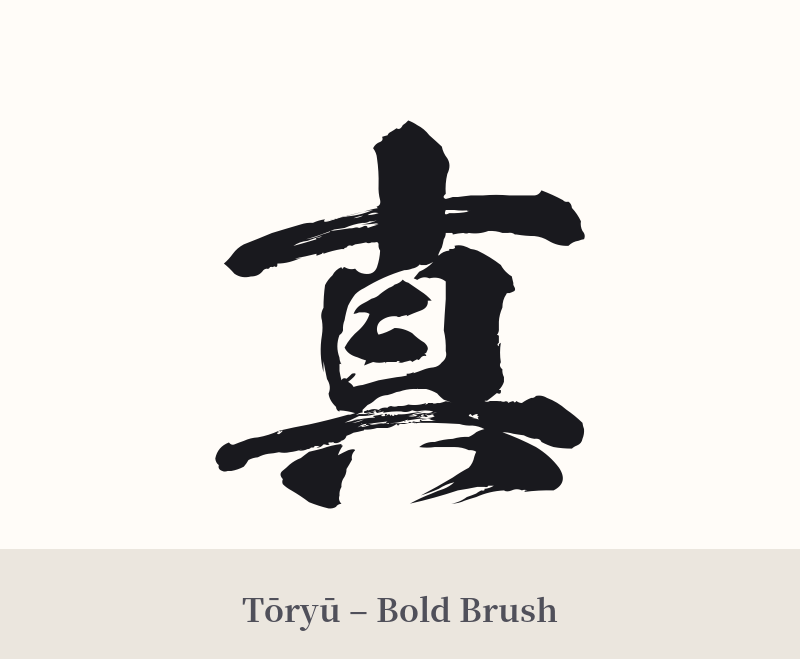
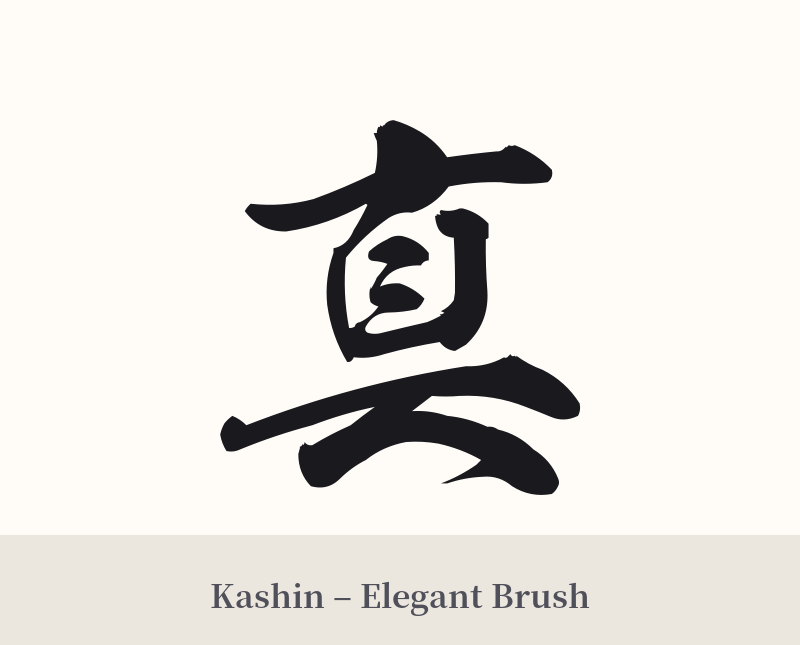
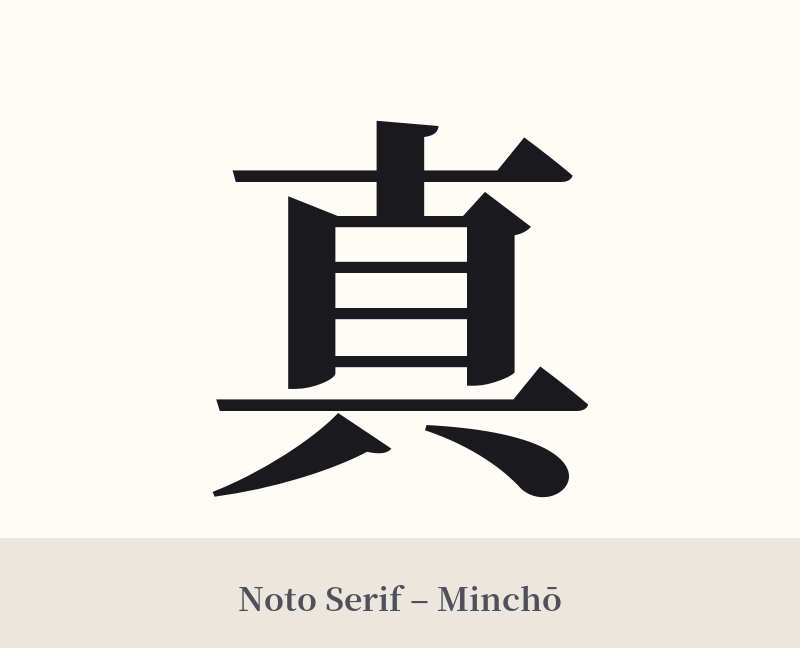
The same kanji can look dramatically different depending on the calligraphy style. Choose a font that matches the mood you want for your tattoo or design.
🎨 Tattoo Suitability
📐 Tattoo Design Guide
The kanji 真 makes a powerful and clear statement, making it well-suited for a standalone tattoo. Its balanced structure allows for versatility in placement and style.
– Placement: Consider areas where a single, symbolic emblem has high impact, such as the inner forearm, the back of the neck just below the hairline, the center of the chest, or over the heart.
– Font Style: A bold, crisp Kaisho (block script) style emphasizes the kanji's meaning of unshakeable truth and clarity. For a more personal and fluid feel, a Gyosho (semi-cursive) style can represent the personal journey of discovering and living one's truth.
– Visual Tips: While 真 stands powerfully on its own, it can be integrated with other elements to add layers of meaning. Pairing it with an Enso (Zen circle) can symbolize the universe or the quest for enlightenment in which truth is found. Placing it within or beside a lotus flower can represent purity and the emergence of truth from the 'mud' of worldly illusions.
Comments