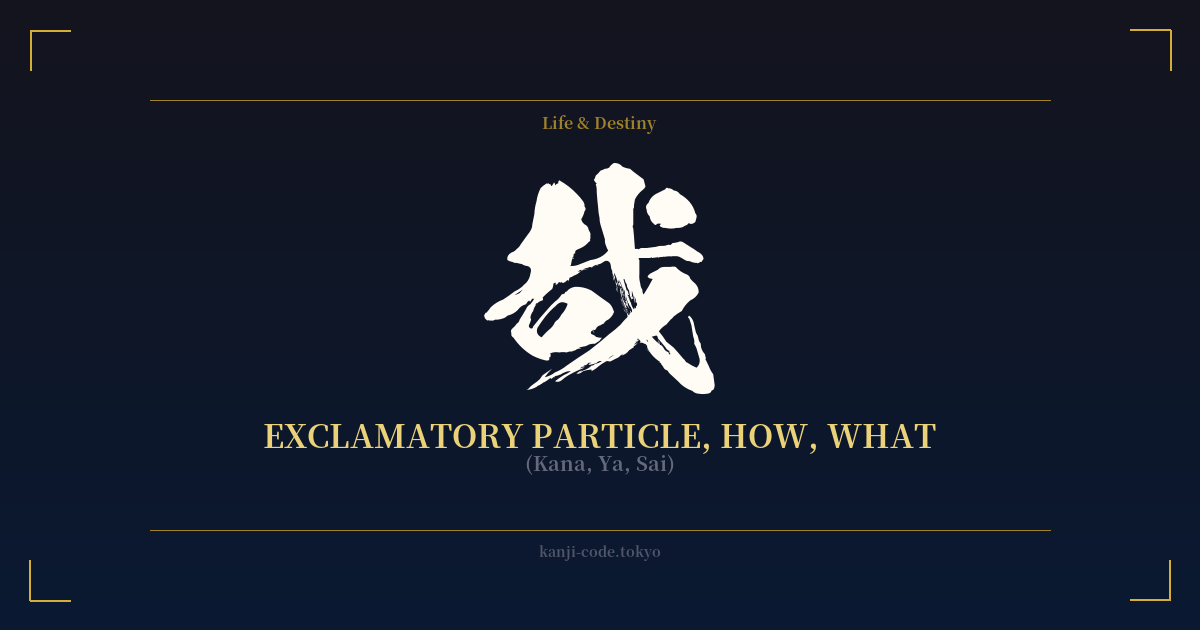
✍️ 哉 (Kana, Ya, Sai) — Cultural Context
The kanji 哉 (kana, ya) is a fascinating character, but not for its standalone meaning. Instead, its power lies in what it does to the words around it. In classical Japanese literature, 哉 is a vital grammatical particle, an exclamatory suffix that injects a wave of emotion—wonder, sorrow, admiration, or a deep sigh—into a phrase. Think of it not as a word, but as the punctuation of feeling.
Its most celebrated role is as a kireji, or “cutting word,” in traditional Japanese poetry like haiku and renga. These cutting words create a pause, a moment of reflection that divides and connects ideas within the poem. The famous poet Matsuo Bashō used it to masterful effect. In one of his most iconic haiku, he writes: 「静かさや 岩にしみ入る 蝉の声」 (Shizukasa ya / iwa ni shimiiru / semi no koe). The 「や」 (ya) at the end of the first line translates to “Ah, the stillness!” It doesn’t just state that it’s quiet; it establishes a profound, contemplative silence that the rest of the poem—the chirp of a cicada seeping into the rocks—fills.
This is the essence of 哉. It’s an exclamation, a question, an utterance of “How…!” or “What…!” For example, 「偉大なるかな」 (idai naru kana) means “How great it is!” The 哉 amplifies the feeling of greatness. Without the preceding context, however, the character is functionally meaningless, like a question mark floating without a question.
In the modern era, the use of 哉 as a sentence-ender has become archaic, confined to historical texts, formal speeches, or literary works aiming for a classical feel. However, the character has found a vibrant new life in a different context: names. It is very commonly used in male given names, typically for its 'ya' sound. Names like Takuya (拓哉), Tetsuya (哲哉), and Kazuya (和哉) are widespread. In this context, 哉 often carries nuances of an interjection of feeling or expressiveness, but its primary role is phonetic.
Therefore, understanding 哉 is to understand a key feature of the Japanese linguistic soul—that emotion is often expressed not through a direct word, but through subtle inflections and particles that color the entire thought. It’s a character of context, not of concept.
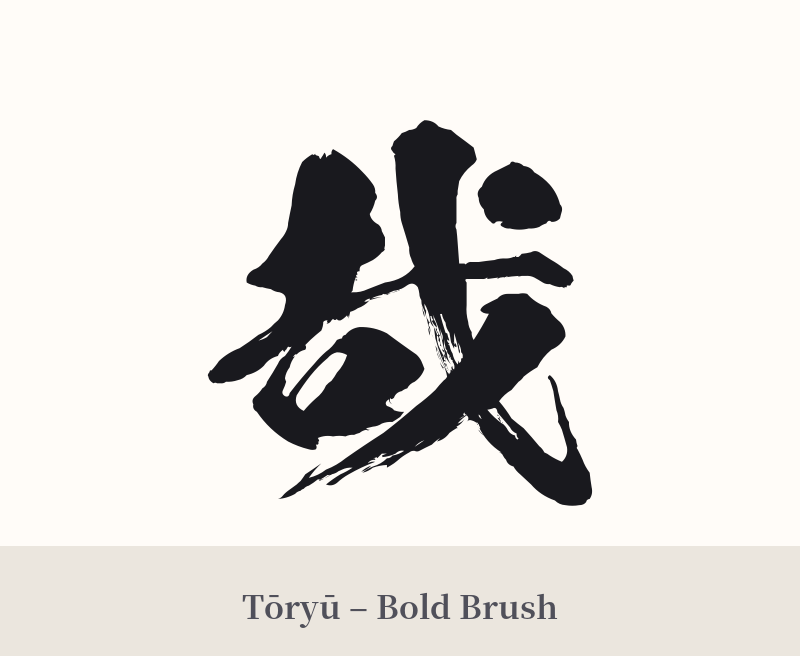
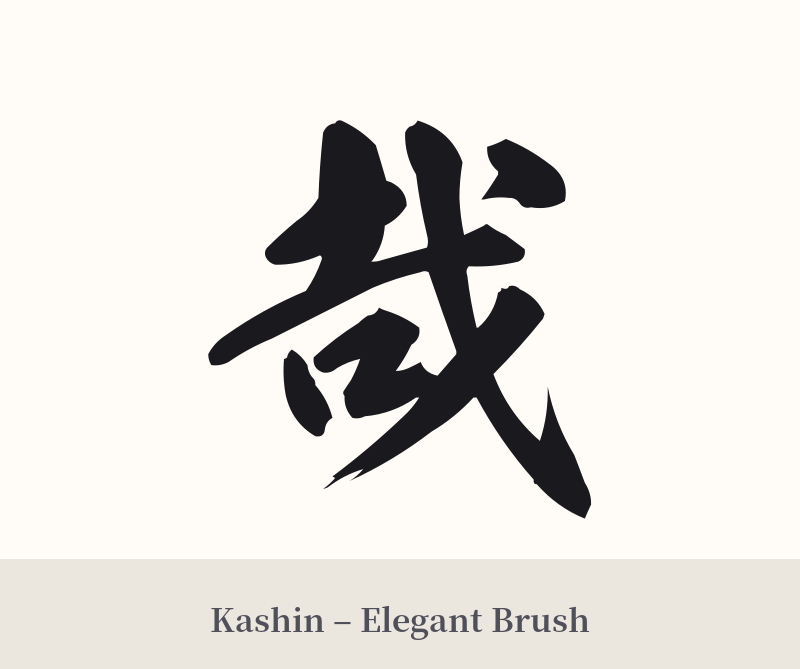
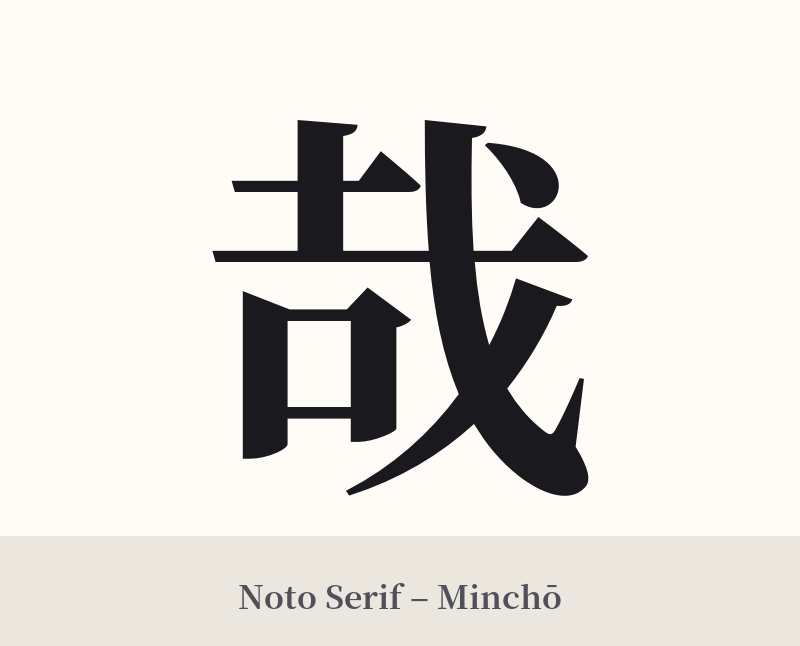
🖌️ Font Styles for 哉
The same kanji can look dramatically different depending on the calligraphy style. Choose a font that matches the mood you want for your tattoo or design.
🎨 Tattoo Suitability
📐 Tattoo Design Guide
Given that 哉 is a grammatical particle with no standalone meaning, it is strongly advised against using it as a solo tattoo. It would be perceived as incomplete or grammatically incorrect. However, if it holds personal significance, such as being part of a name, consider these points:
– Combination is Key: The best way to use 哉 is to pair it with other kanji to form a legitimate name or a classical phrase. Do not isolate it.
– Visuals Over Meaning: If you are drawn purely to its shape, acknowledge that its meaning is null on its own. The character has a pleasing balance with nine strokes, featuring the 'halberd' radical (戈) on the right, which adds a bit of sharp detail.
– Font Style: A classical, calligraphic style like Gyosho (semi-cursive) or Sosho (cursive) would honor its literary origins. For a cleaner look in a name, a crisp Mincho (serif) font would be appropriate.
– Placement: As part of a larger phrase or name, it could be incorporated into a vertical script on the arm, back, or ribs. As a single character, it lacks the conceptual weight for a prominent placement.
Comments