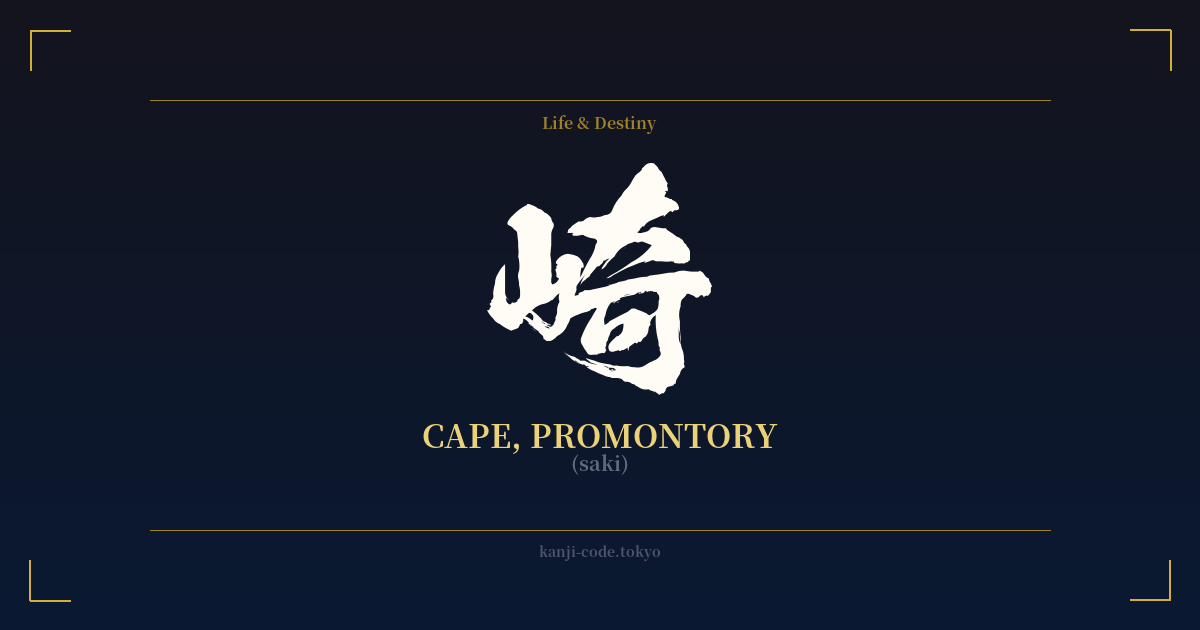
✍️ 崎 (saki) — Cultural Context
The kanji 崎 (saki) holds a simple yet profound place in the Japanese language, referring to a cape or promontory—a piece of land jutting out into a body of water. Its meaning is deeply rooted in the geography of Japan itself, an archipelago nation defined by its vast and intricate coastline. The character beautifully captures this image through its components: on the left is 山 (yama), the radical for 'mountain,' and on the right is 奇 (ki), which can mean 'strange,' 'curious,' or 'excellent.'
This combination evokes the image of a mountain that extends in an unusual or striking way, forming a point into the sea. It’s a 'strange mountain' that doesn't just sit inland but actively engages with the water, creating a dramatic and scenic landscape. This literal, geographical meaning forms the foundation of its use.
Because of Japan's geography, the character 崎 is ubiquitous in place names. The most famous example is Nagasaki (長崎), meaning 'long cape.' Others include Miyazaki (宮崎), 'shrine cape,' and Kawasaki (川崎), 'river cape.' Its presence is a constant reminder of the physical landscape that has shaped Japanese culture, travel, and history. These capes were historically vital as landmarks for sailors, strategic points for defense, and sacred locations for shrines overlooking the sea.
Beyond place names, 崎 is one of Japan's most common surname elements, as seen in Yamazaki (山崎), 'mountain cape.' This means that the character is instantly recognizable to any Japanese person, but often as a component of a name rather than as a standalone concept. While it lacks the abstract philosophical depth of characters like 愛 (love) or 道 (the way), 崎 offers a different kind of meaning. It symbolizes a connection to the natural world, the boundary between land and sea, a vantage point for observation, and the feeling of standing at the edge of the world, looking out at the vast unknown. It speaks to a love of nature, scenery, and the quiet power of the earth's formations.
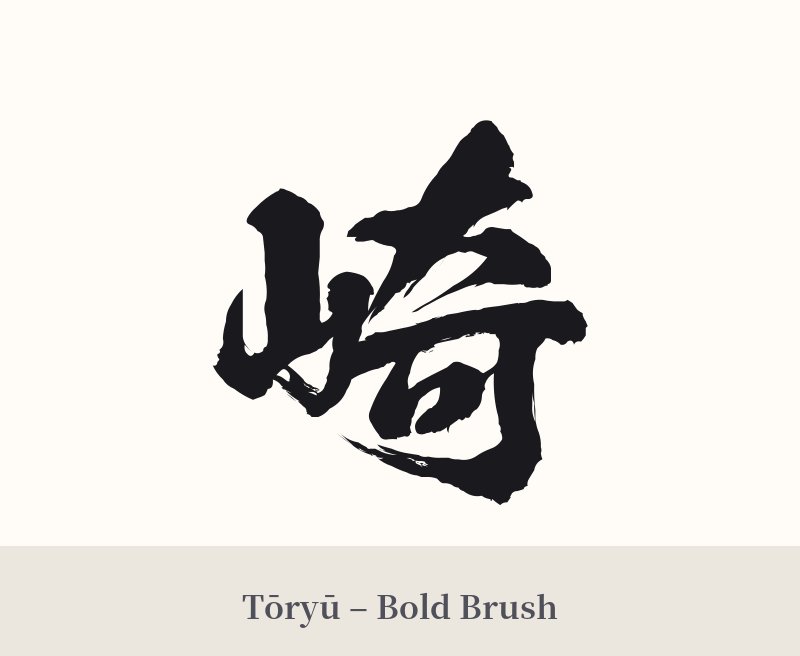
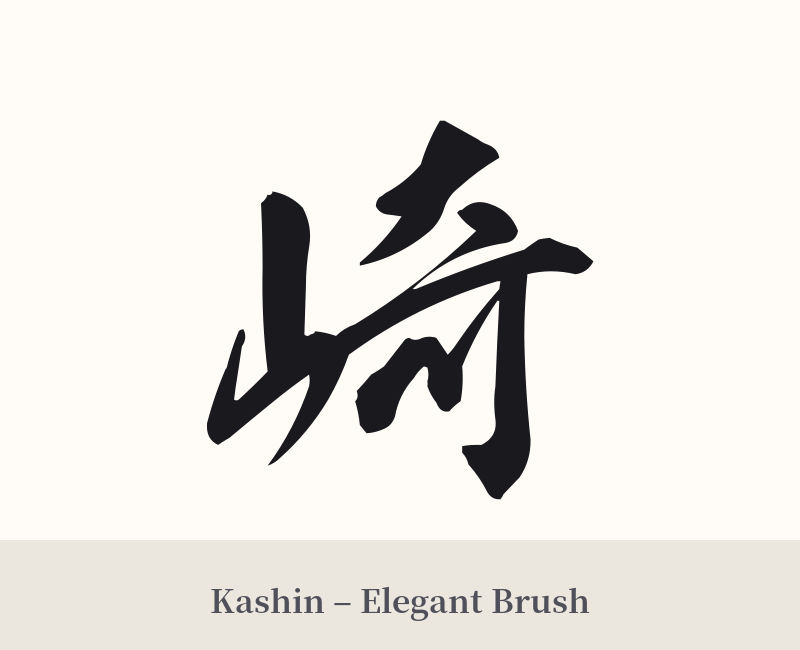
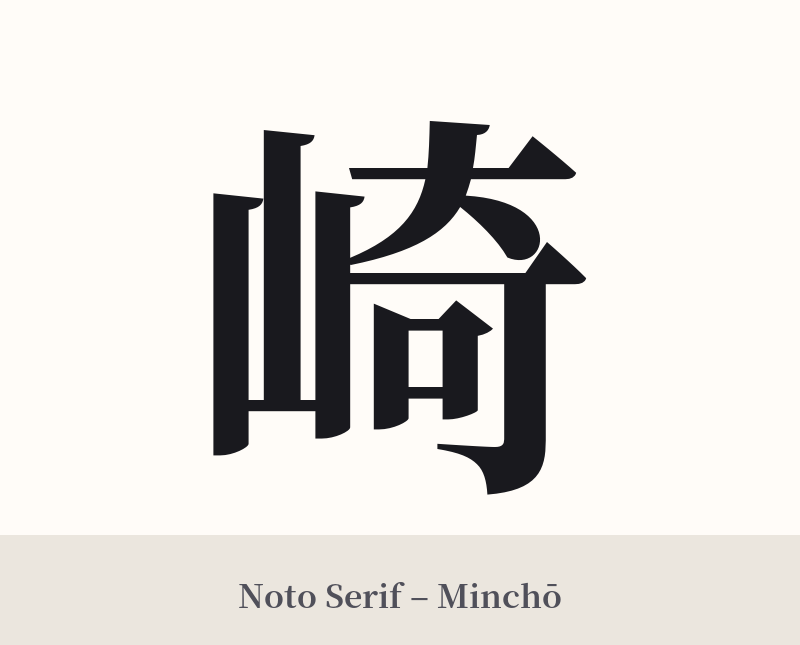
🖌️ Font Styles for 崎
The same kanji can look dramatically different depending on the calligraphy style. Choose a font that matches the mood you want for your tattoo or design.
🎨 Tattoo Suitability
📐 Tattoo Design Guide
For a tattoo of 崎, the design should emphasize its connection to nature and its unique visual form.
– Placement: Consider areas that complement its vertical structure, such as the forearm, the side of the calf, or along the spine. It also works well on the back of the shoulder, where it can follow the natural lines of the body.
– Font Style: A semi-cursive script (gyōsho) would beautifully render the flowing strokes of the right-side radical (奇), giving it a sense of movement like wind or water. For a more solid and grounded feel, a standard block script (kaisho) will emphasize the 'mountain' (山) radical, making it feel strong and stable.
– Visual Tips: To avoid the ambiguity of it being seen as just a name, consider integrating it with other imagery. Placing the kanji above a minimalist wave design, incorporating it into a landscape of a cliffside, or having a small lighthouse or pine tree nearby can clarify its intended meaning as 'cape.' This turns it from a simple character into a small, scenic vignette.
Comments