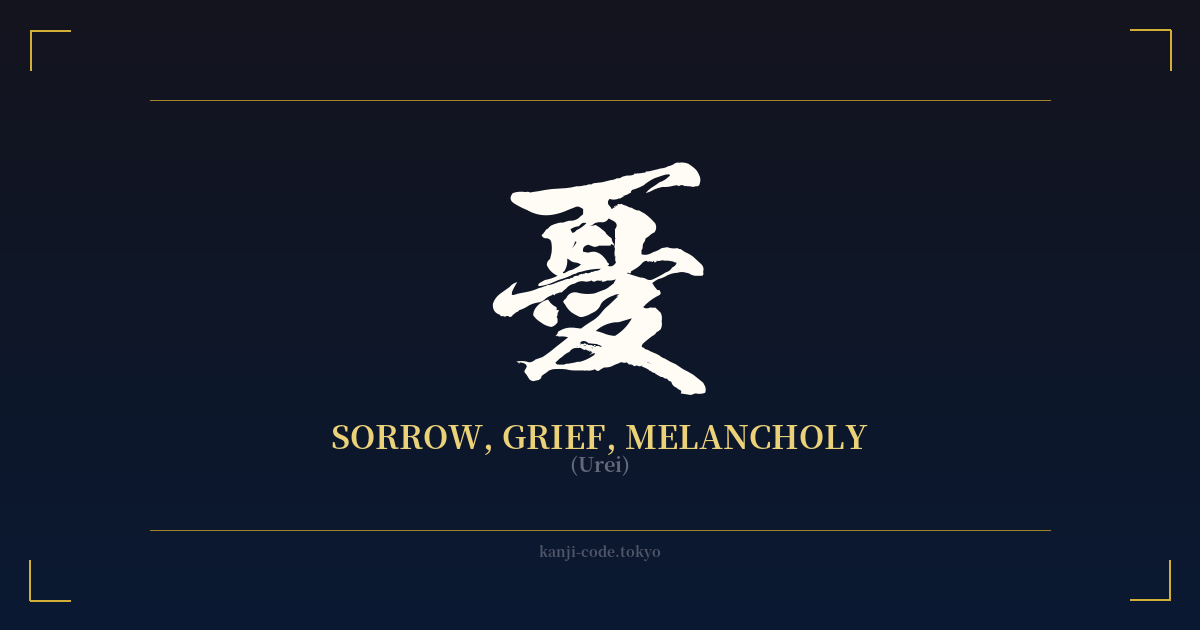
✍️ 憂 (Urei) — Cultural Context
The kanji 憂, read as 'urei,' is a profound character that encapsulates a state of sorrow, melancholy, and quiet anxiety. Its meaning goes beyond simple sadness, touching upon a deeper, more existential gloom. The visual construction of the kanji itself tells a powerful story. It is a composite of several elements: a stylized head at the top, a heart (心) in the middle, and a radical for walking slowly (夊) at the bottom. Together, they paint a picture of a person with a heavy head, a burdened heart, and feet that drag with weariness—a powerful ideogram for deep-seated worry and grief.
In Japanese culture, 'urei' is distinct from 'kanashimi' (悲しみ), which typically refers to sadness or grief stemming from a specific event, like a loss. 'Urei,' in contrast, is often a more forward-looking or internal state. It's the quiet worry about the future, the melancholy that colors one's perception of the world, or the gentle grief for the impermanence of things. This nuance connects it to the famous Japanese aesthetic concept of 'mono no aware' (もののあはれ), the beautiful, transient sadness found in the fleeting nature of life, like the falling of cherry blossoms.
Historically and in literature, 'urei' is a feeling of the pensive poet or the thoughtful warrior contemplating fate. It isn't necessarily a sign of weakness but rather of a sensitive and reflective soul. It appears in classic texts and poetry to describe the subtle sorrows of court life, the anxieties of love, or the weight of responsibility. This gives the character a certain poetic and philosophical gravity.
In modern Japanese, 憂 is a component in words that describe more serious emotional states. For example, 'yūutsu' (憂鬱) is the clinical term for depression or deep melancholy. This association reinforces the character's heavy, somber nature. While it can represent a beautiful, melancholic introspection, it is undeniably tied to feelings of distress and unhappiness. It speaks to a universal human experience, but one that resides firmly in the shadows of the emotional spectrum.
🖌️ Font Styles for 憂
The same kanji can look dramatically different depending on the calligraphy style. Choose a font that matches the mood you want for your tattoo or design.
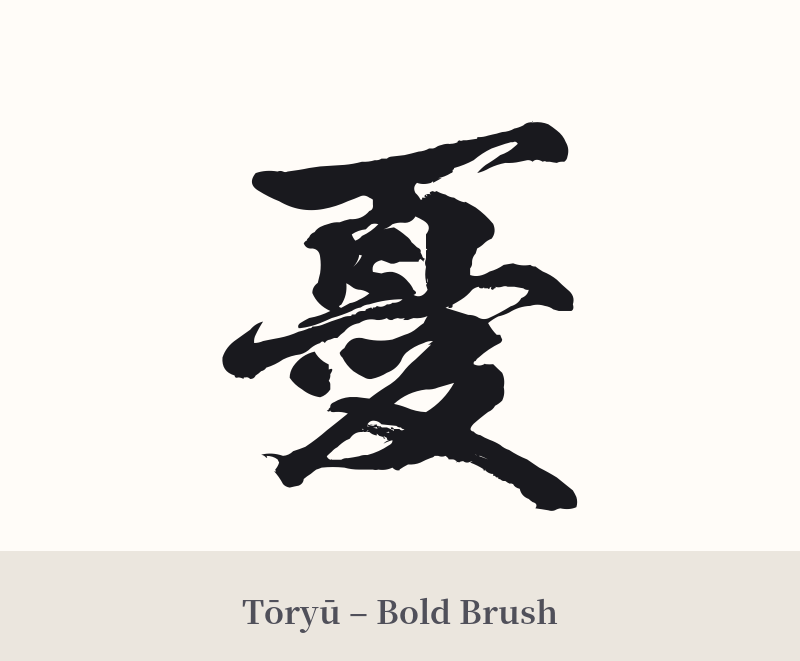
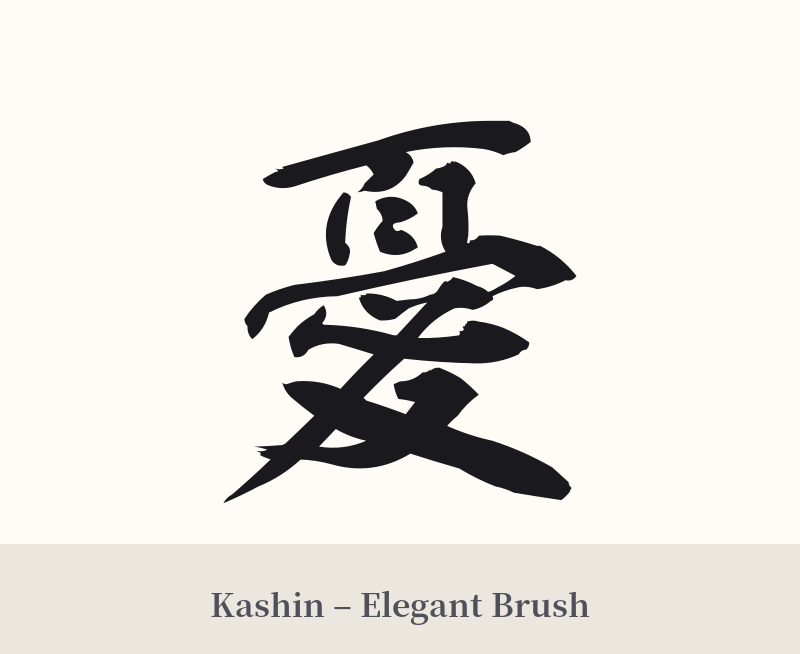
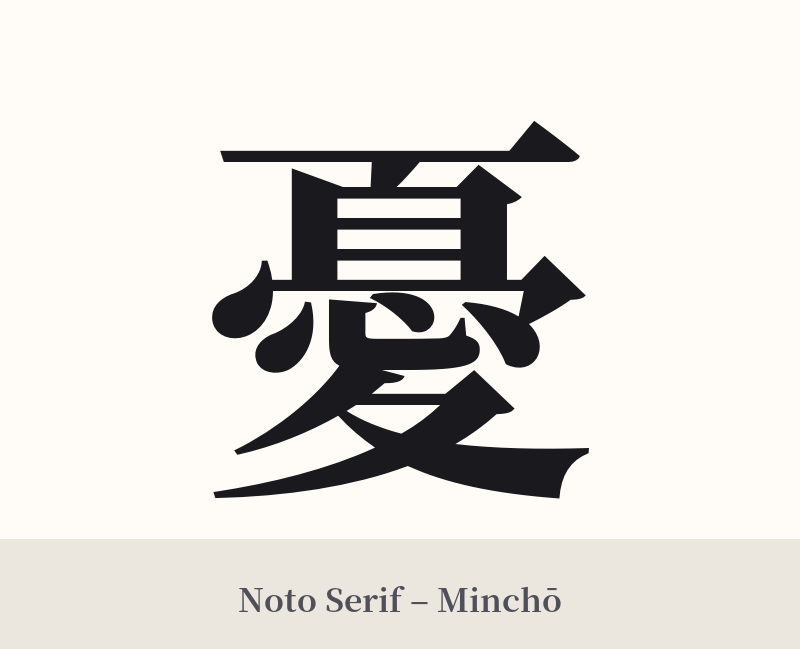
🎨 Tattoo Suitability
📐 Tattoo Design Guide
Due to its complexity, 憂 requires careful consideration in a tattoo design.
– Placement: This kanji works best as a vertical design. Consider the forearm, the calf, or along the spine where there is enough space to render the strokes clearly. Avoid small placements like the wrist or ankle, as the details can easily blur and become illegible over time.
– Font Style: The choice of font can dramatically alter its feeling. A dynamic, semi-cursive script (gyōsho) can express the flowing, emotional nature of sorrow. Conversely, a stark, angular, block-style font (kaisho) can emphasize the heavy, oppressive weight of the feeling.
– Visual Complements: While it stands alone powerfully, it can be paired with imagery to add context. Combining it with falling cherry blossoms (sakura) can evoke the concept of 'mono no aware.' Placing it alongside a cracked or mended object could symbolize sorrow that has been processed or lived with.
Comments