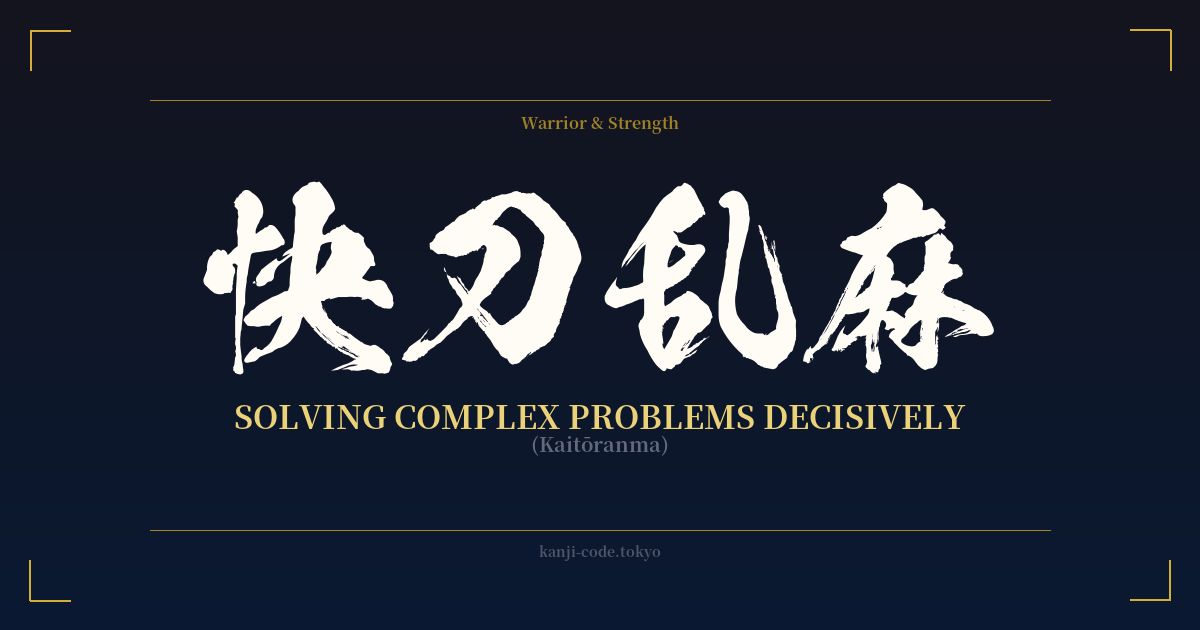
✍️ 快刀乱麻 (Kaitōranma) — Cultural Context
快刀乱麻 (Kaitōranma) is a powerful four-character idiom, or 'yojijukugo,' that translates literally to “sharp sword, tangled hemp.” Metaphorically, it describes the act of solving a complex, seemingly intractable problem with swift, decisive, and brilliant action. It’s the equivalent of “cutting the Gordian knot,” a moment of genius that slices through confusion to reveal a simple solution.
The origin of this phrase traces back to ancient China, specifically the historical text known as the Book of the Northern Qi. The story recounts how Emperor Wenxuan decided to test the intelligence of his sons. He presented them with a hopelessly tangled skein of hemp fibers and challenged them to unravel it. While most of his sons struggled futilely with the knots, one son, Gao Changgong, took a different approach.
Instead of trying to untangle the mess, he drew his sword and cleanly sliced the entire bundle in half. He declared, “A mess should be cut apart.” The emperor was not angered by this unorthodox method; instead, he praised his son’s sharp mind and decisive nature. This single act became the basis for the idiom, celebrating the wisdom of tackling a problem’s root cause rather than getting lost in its symptoms.
In Japan, this idiom is highly regarded. It’s often used in business, politics, and strategy to praise a leader who cuts through bureaucracy, a company that disrupts an industry with a simple innovation, or an individual who brings clarity to a chaotic situation. It embodies a philosophy that values clear thinking, courage, and the ability to act without hesitation when the path forward is clear.
Beyond its practical applications, 快刀乱麻 carries a certain warrior-like aesthetic, but one applied to intellectual and strategic battles. It represents the mind as a sword, capable of paring away the non-essential to find truth and resolution. It speaks to a desire for efficiency, clarity, and the power of a single, well-placed action to change everything.
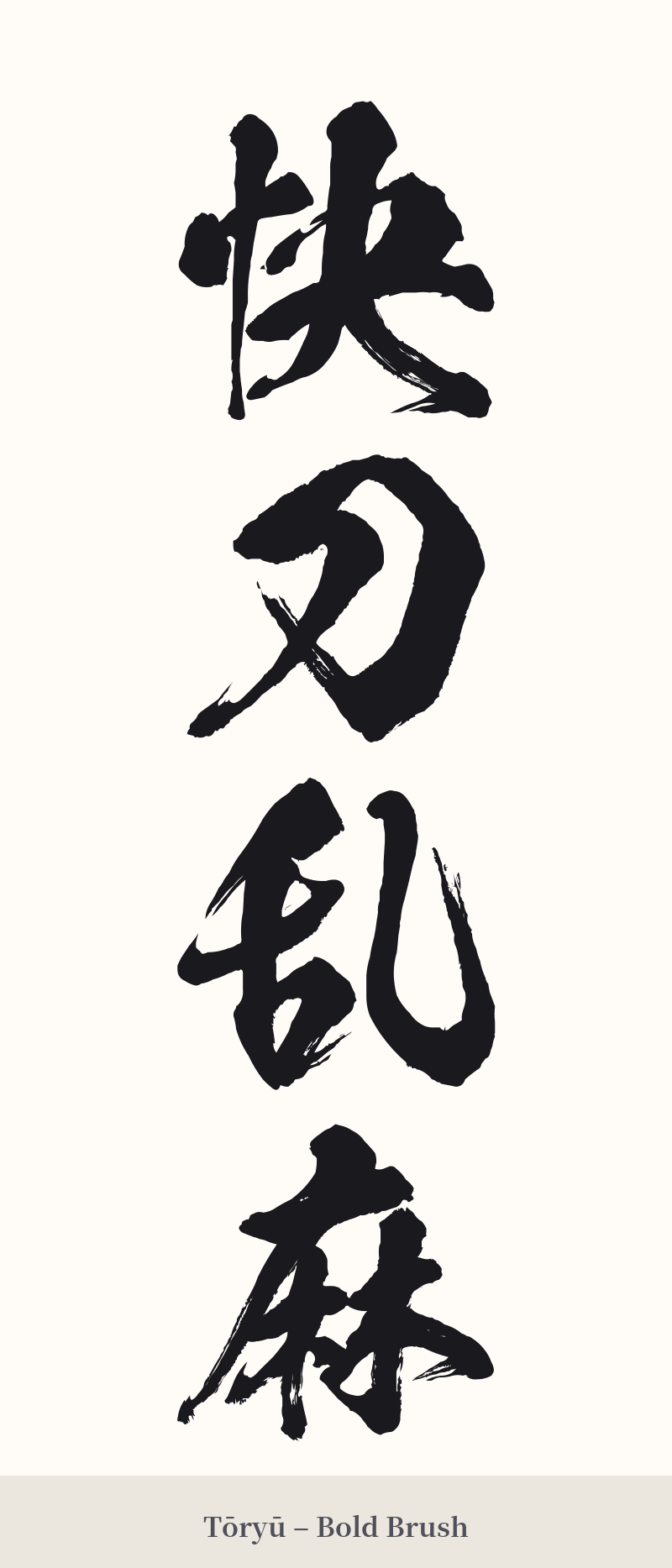
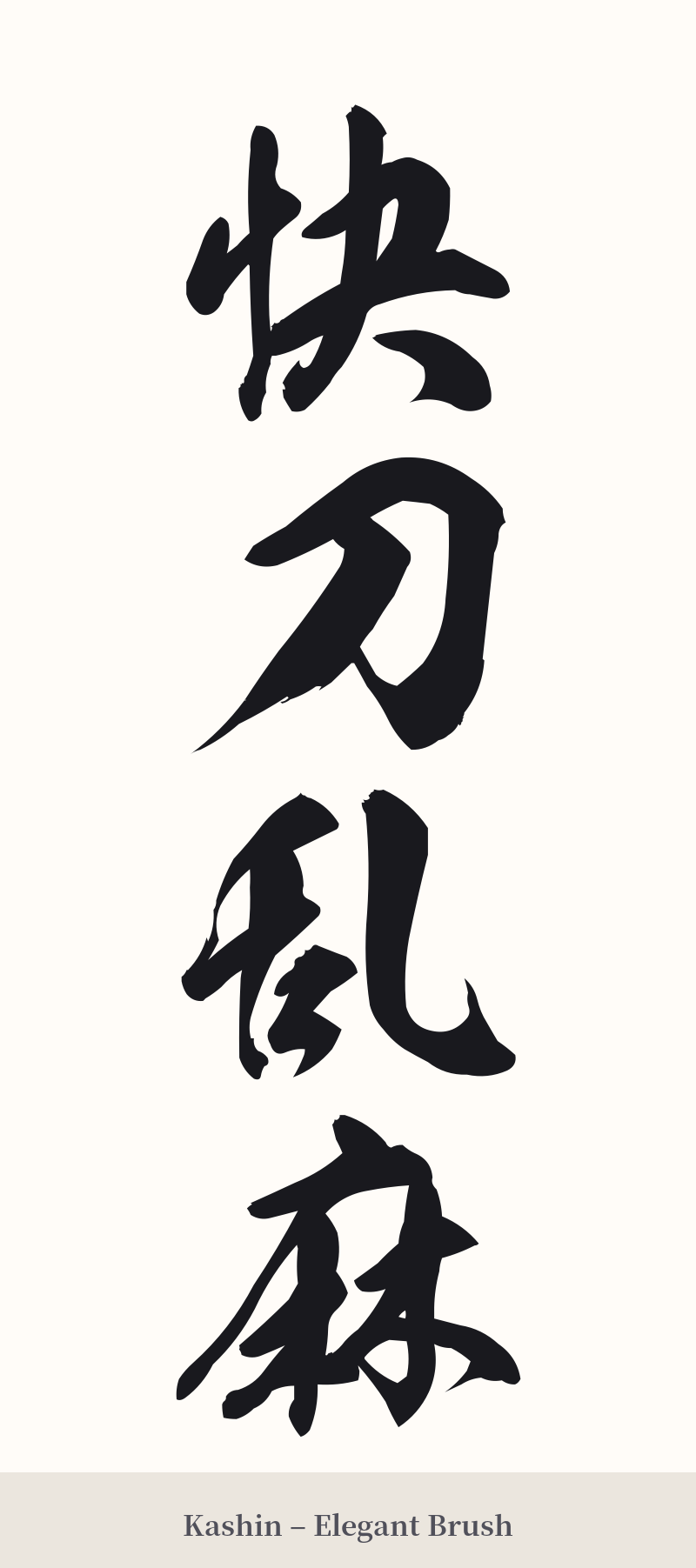
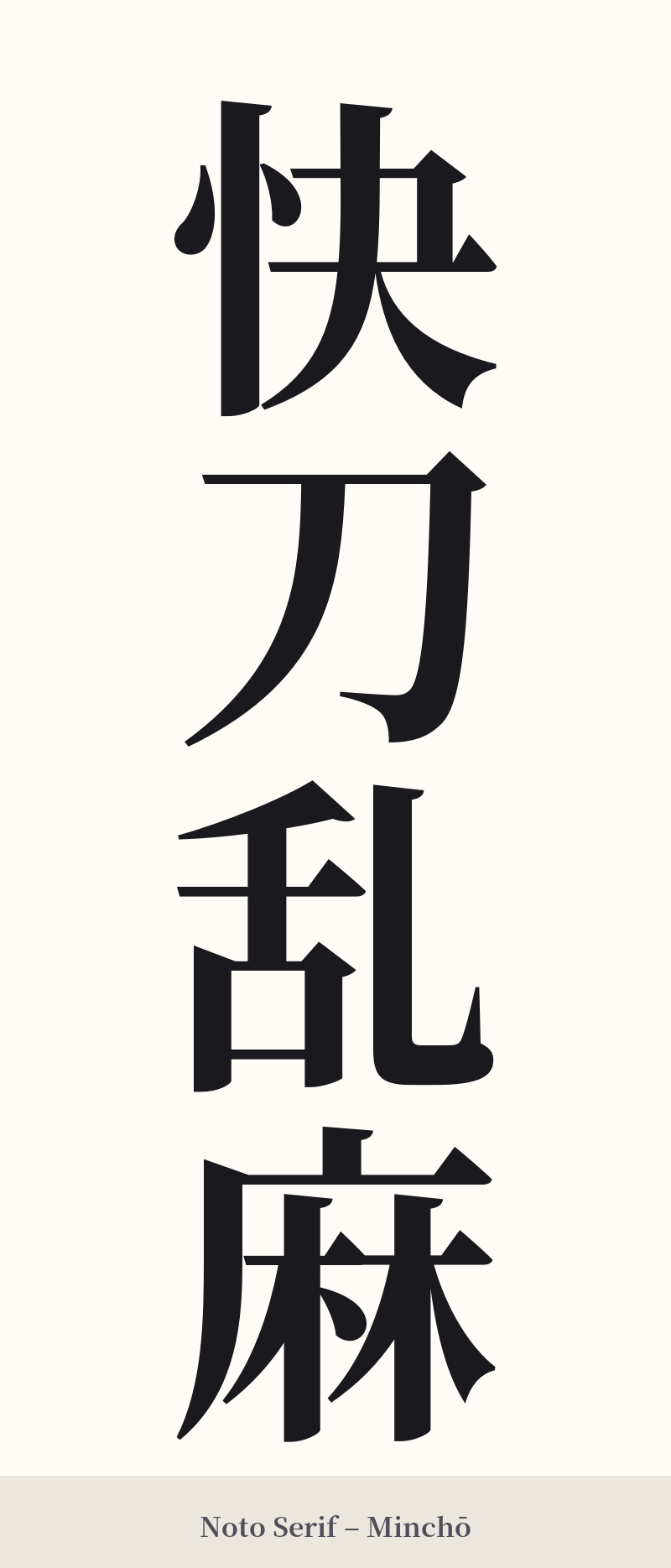
🖌️ Font Styles for 快刀乱麻
The same kanji can look dramatically different depending on the calligraphy style. Choose a font that matches the mood you want for your tattoo or design.
🎨 Tattoo Suitability
📐 Tattoo Design Guide
As a four-character idiom, 快刀乱麻 is visually impressive and lends itself well to certain tattoo placements and styles.
– Placement: A vertical orientation is classic for yojijukugo. Consider the spine, down the length of the forearm, or along the calf. This emphasizes the flow and downward 'cutting' motion implied by the phrase. A horizontal placement across the chest or upper back can also create a strong, stable look.
– Font Style: A dynamic, semi-cursive script like Gyosho can capture the energy and swiftness of the 'cut.' For a bolder, more impactful statement, a strong and clear block script like Kaisho works well, highlighting the decisiveness and clarity of the solution. Avoid overly thin or delicate fonts that might not convey the idiom's inherent power.
– Visual Elements: To enhance the meaning, consider incorporating subtle imagery. A single, clean line representing a sword's path could intersect the characters, or you could have abstract tangled lines at the top of the design that become clean and straight at the bottom. This visually tells the story of chaos being resolved into order.
Comments