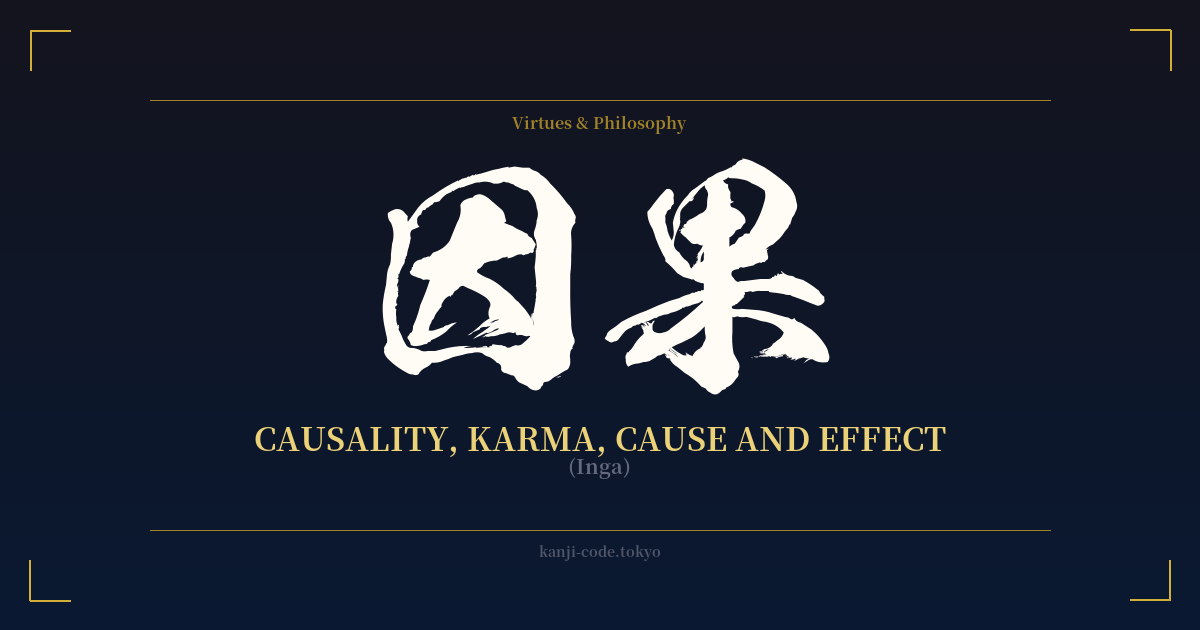
✍️ 因果 (Inga) — Cultural Context
因果 (Inga) is a cornerstone concept in Japanese philosophy, directly imported from Buddhism. It represents the universal law of cause and effect, the principle that every action, thought, and word (the 因, 'in' or cause) inevitably generates a corresponding result (the 果, 'ga' or effect/fruit). This is the Japanese equivalent of the Sanskrit term 'hetu-phala', and it forms the bedrock of karmic understanding in East Asia.
Unlike the often-simplified Western interpretation of karma as a system of cosmic reward and punishment, Inga is more neutral and impersonal, akin to a law of spiritual physics. It isn't a sentient force judging actions; it is the inherent mechanism of the universe where positive causes lead to positive effects and negative causes lead to negative ones. This chain of causality is not limited to a single lifetime but extends across past, present, and future existences through the cycle of reincarnation (輪廻, Rinne).
The concept is deeply woven into the Japanese cultural fabric. A very common related phrase is 因果応報 (Inga Ōhō), which translates to 'karmic retribution' or 'just deserts'. This expression carries a stronger moral tone, explicitly stating that good deeds are rewarded and evil deeds are punished, reflecting the consequences of one's Inga. This idea frequently appears in classic literature, folklore, and samurai tales, where a character's fate is sealed by their past actions.
In everyday language, Inga can also be used with a sense of resignation or fate. Someone might describe a difficult or thankless situation as 'inga na shōbai' (因果な商売), meaning a 'karmic business'—a job one feels fated to do, despite its hardships. It speaks to a feeling of being caught in a cycle of events that were set in motion long ago.
Therefore, Inga is not just a simple word for 'karma'. It is a profound and sometimes somber acknowledgment of the interconnectedness of all actions and their inescapable consequences. It reminds us that every moment is both a result of the past and a cause for the future, a powerful meditation on accountability and the flow of life.
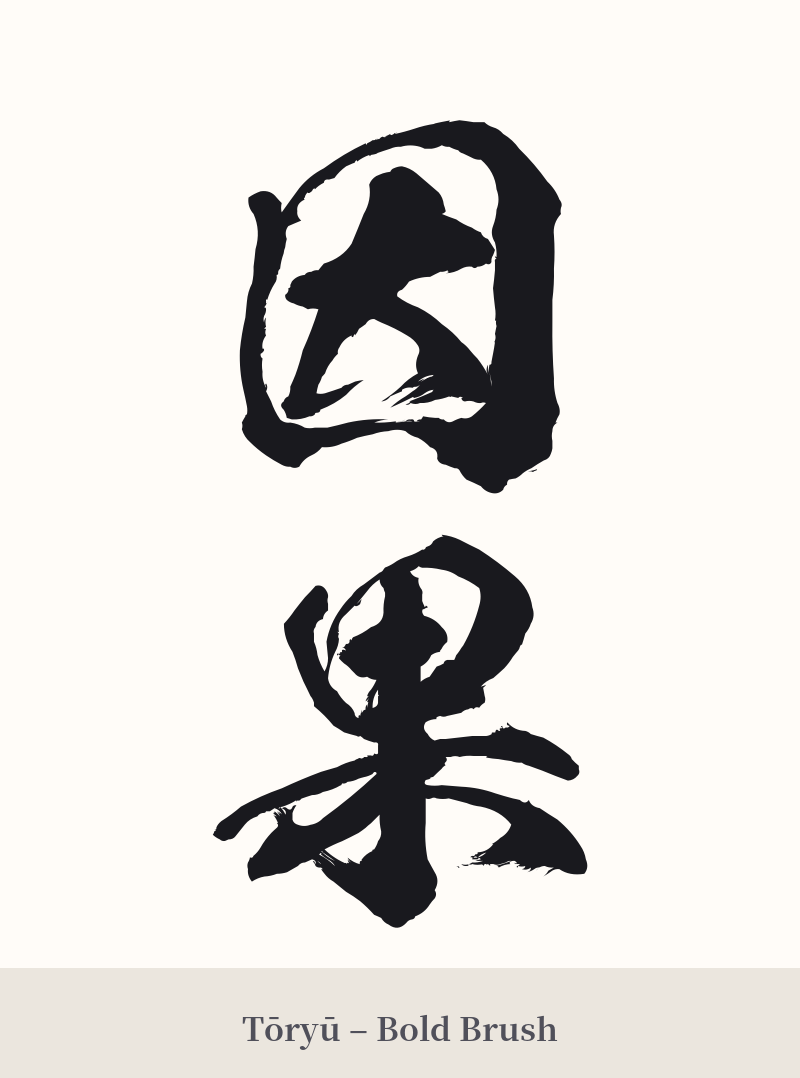
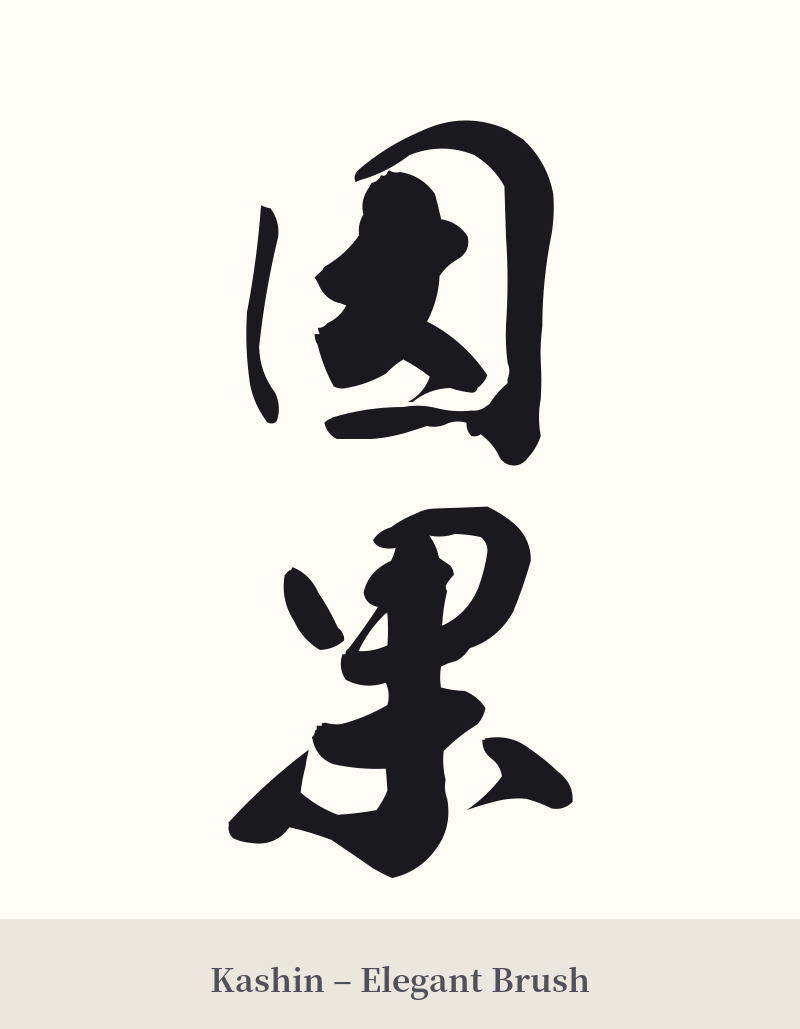
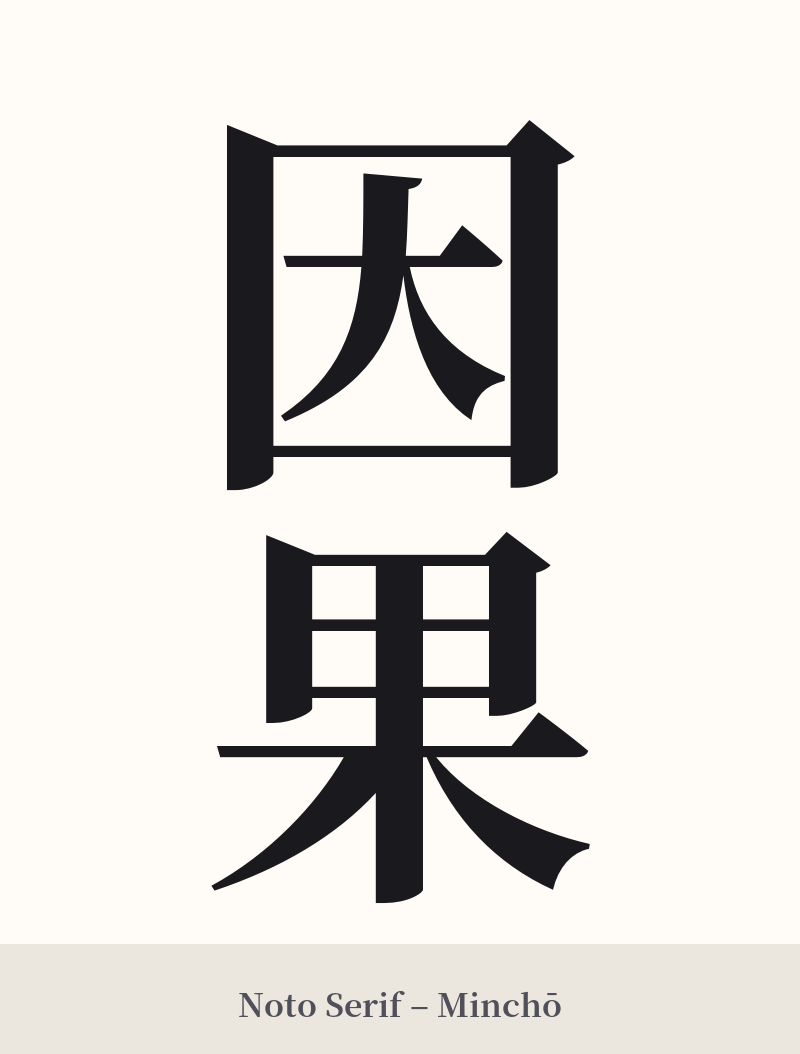
🖌️ Font Styles for 因果
The same kanji can look dramatically different depending on the calligraphy style. Choose a font that matches the mood you want for your tattoo or design.
🎨 Tattoo Suitability
📐 Tattoo Design Guide
The two-character structure of 因果 lends itself beautifully to classic tattoo compositions. A vertical alignment is traditional and elegant, making it ideal for the forearm, the back of the neck, down the spine, or along the ribs.
A horizontal placement works well across the chest, on the inner bicep, or above the collarbone. Due to the relatively low stroke count of each character, this design remains clear and legible even at smaller sizes.
– Font Style: A flowing, semi-cursive script like Gyosho (行書) can emphasize the natural, interconnected flow of cause and effect. For a stronger, more deliberate statement, a crisp Kaisho (楷書) block script is an excellent choice. An expressive, personal brushstroke style (shodo) can also capture the philosophical depth of the word.
– Visual Elements: Consider complementing the kanji with related imagery. An Enso circle, representing enlightenment and the cyclical nature of existence, can frame the characters. A lotus flower, symbolizing purity and enlightenment emerging from the mud of worldly existence, is another thematically appropriate addition.
Comments