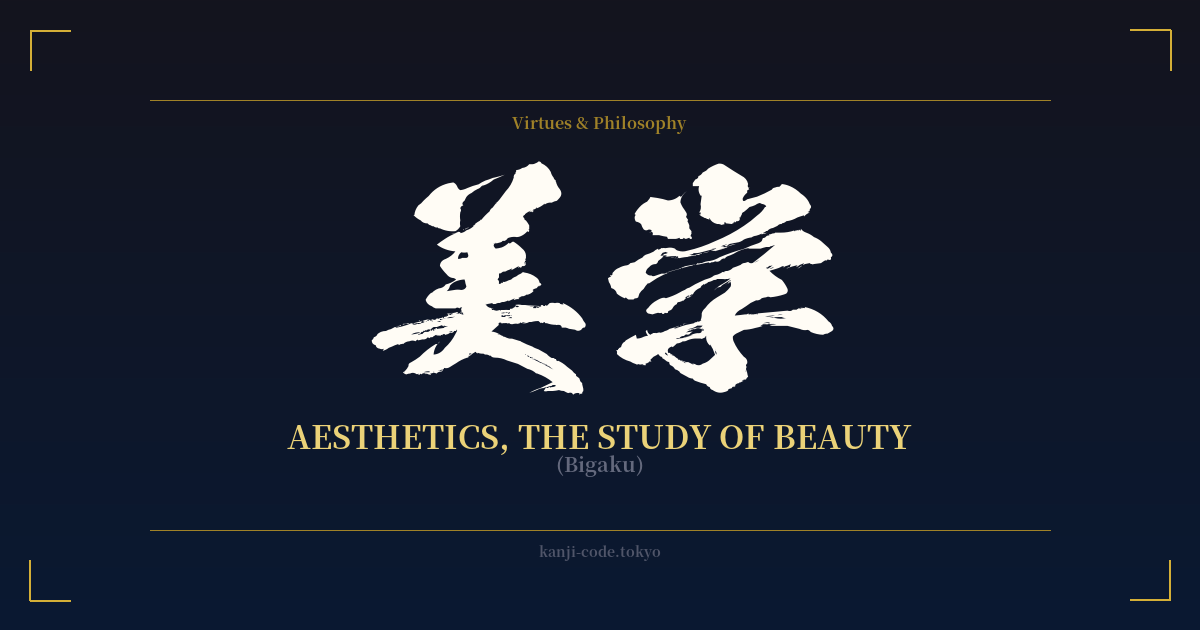
✍️ 美学 (Bigaku) — Cultural Context
美学 (Bigaku) translates directly to 'aesthetics,' the branch of philosophy concerned with the nature of beauty, art, and taste. While the word itself is a modern Meiji-era (1868-1912) creation, coined to translate the Western philosophical concept, its spirit is deeply intertwined with centuries of Japanese cultural sensibilities.
The term is a combination of 美 (bi), meaning 'beauty,' and 学 (gaku), meaning 'study' or 'learning.' This literal construction—'the study of beauty'—perfectly encapsulates its meaning. However, to truly understand Bigaku in a Japanese context, one must look beyond the dictionary definition and into the traditional aesthetic principles that have shaped the nation's art and worldview for generations.
These principles form the unspoken foundation of Japanese Bigaku. Concepts like 'Wabi-Sabi' (侘寂) celebrate the beauty found in imperfection, impermanence, and austerity, visible in rustic pottery and weathered wood. 'Mono no Aware' (物の哀れ) is the gentle, empathetic sadness for the transience of things, famously associated with the fleeting bloom of cherry blossoms.
Another key concept is 'Yūgen' (幽玄), which refers to a profound, mysterious, and subtle grace—a beauty that is felt rather than explicitly seen. It's the depth of a misty landscape in an ink wash painting or the unspoken emotion in a Noh theater performance. Similarly, 'Iki' (粋) represents an effortless, chic, and understated elegance, a sophisticated simplicity that is both bold and refined.
These ideas are not just abstract theories; they are woven into the fabric of Japanese life and arts. They guide the arrangement of flowers in 'Ikebana,' the mindful movements of the 'Chanoyu' (tea ceremony), the careful placement of rocks in a Zen garden, and even the philosophy behind martial arts ('Budō').
Therefore, choosing Bigaku is to embrace this entire ecosystem of thought. It represents more than just an appreciation for what is pretty; it signifies a deeper engagement with the nature of beauty itself, a commitment to finding and understanding the profound elegance in the world, in all its perfect and imperfect forms.
🖌️ Font Styles for 美学
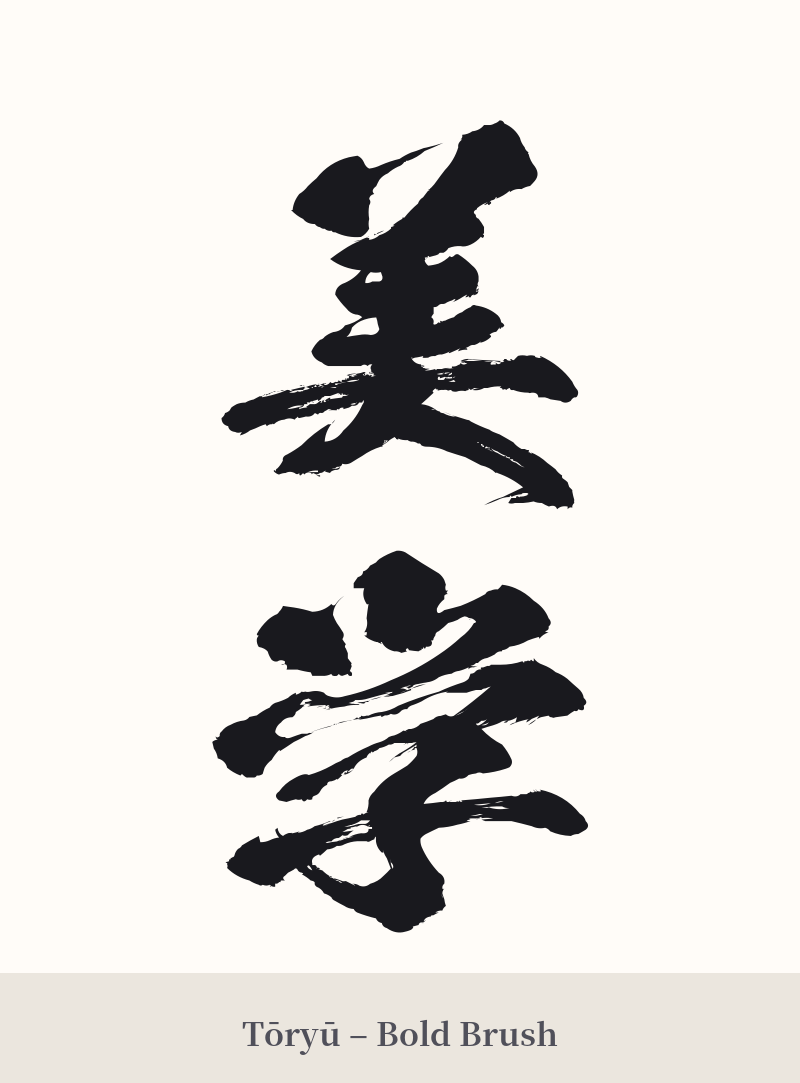
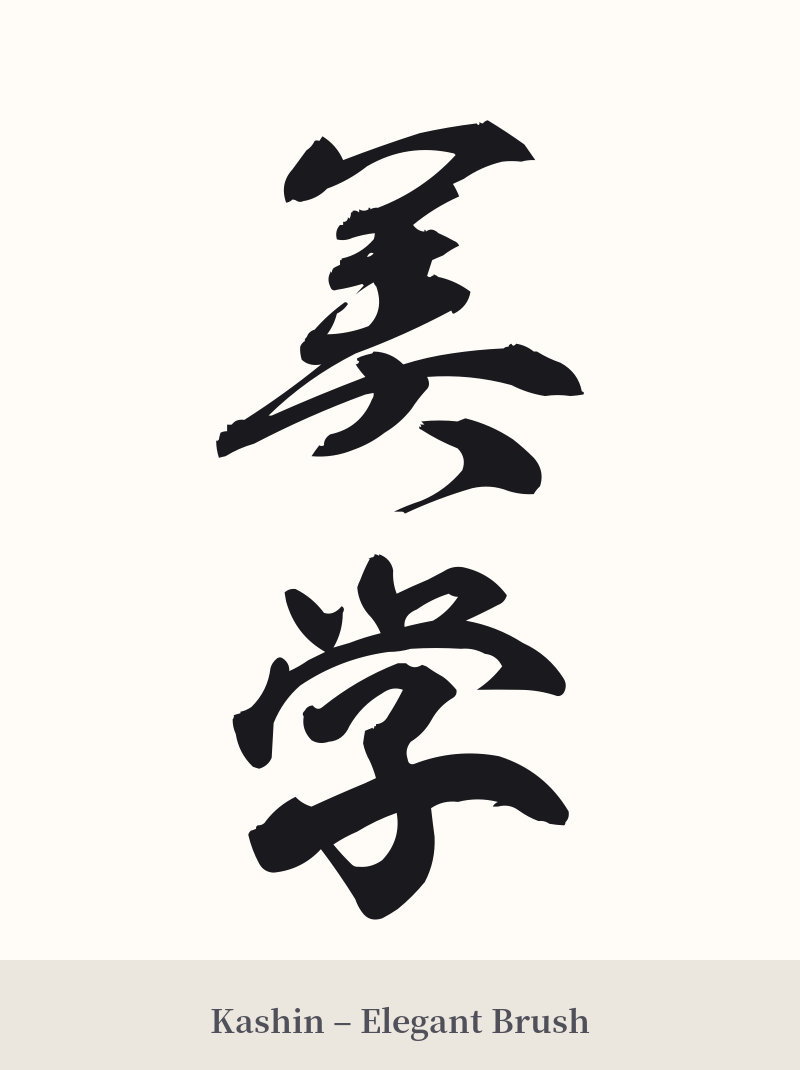
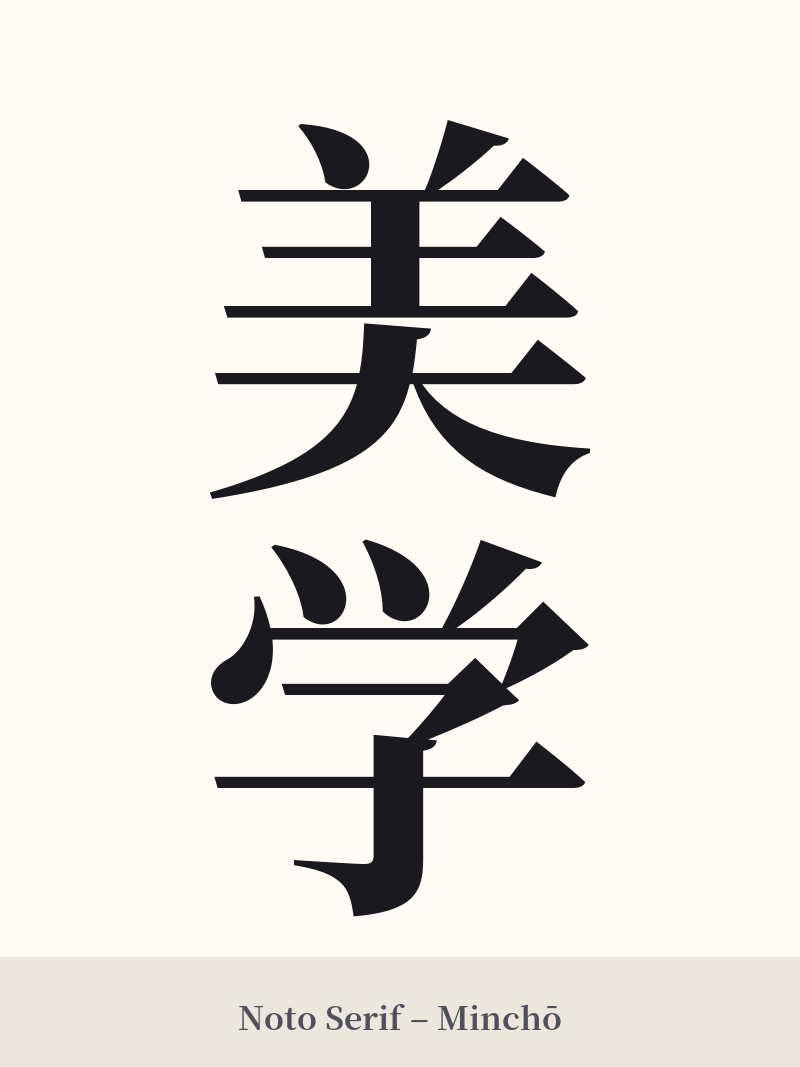
The same kanji can look dramatically different depending on the calligraphy style. Choose a font that matches the mood you want for your tattoo or design.
🎨 Tattoo Suitability
📐 Tattoo Design Guide
For a tattoo of 美学 (Bigaku), the design should reflect its intellectual and elegant nature. The two characters have a balanced structure that works well in both traditional and modern styles.
– Placement: A vertical alignment is classic and highly recommended. It looks excellent along the spine, down the forearm, on the side of the ribs, or along the calf. For a horizontal design, the back of the neck or across the chest are strong options.
– Font Style: Consider a semi-cursive 'Gyosho' script to give the characters an artistic, flowing quality that complements the theme of aesthetics. For a more formal and clear look, a standard 'Kaisho' (block) script provides structure and legibility. A minimalist 'Mincho' style can also be very effective, emphasizing the intellectual and refined aspect of the word.
– Visual Tips: To enhance the meaning, consider pairing the kanji with a subtle visual element that embodies a Japanese aesthetic principle. A single falling cherry blossom petal can represent 'Mono no Aware,' while a design mimicking a cracked 'kintsugi' line could evoke 'Wabi-Sabi.' An 'ensō' (Zen circle) drawn behind the kanji can also create a powerful, contemplative composition.
Comments