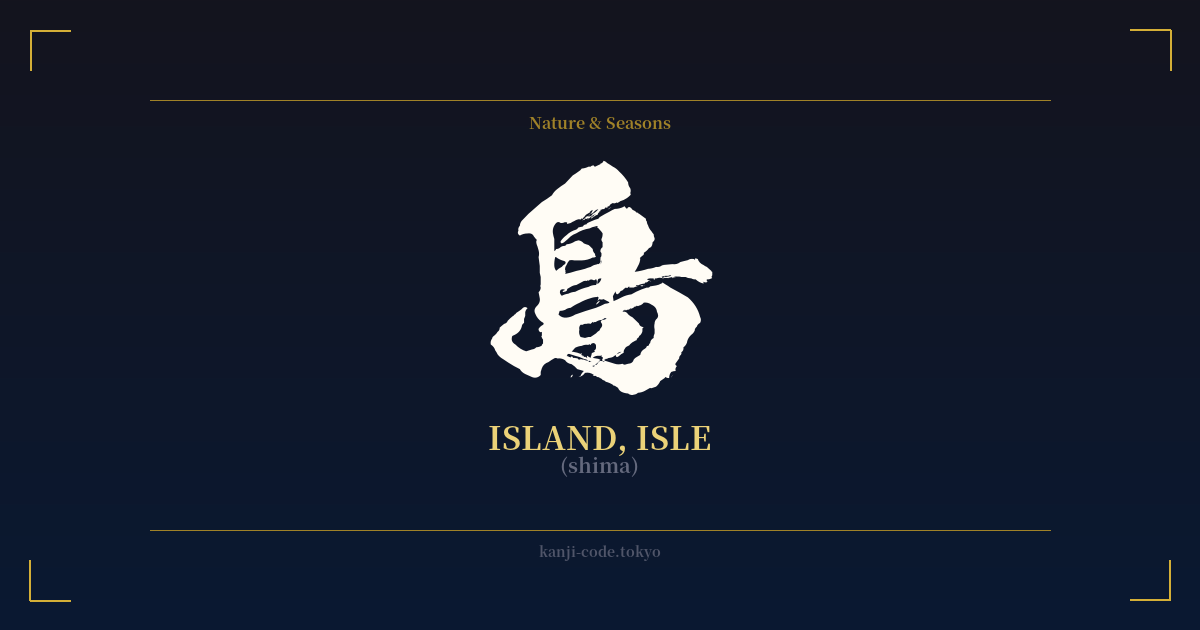
✍️ 島 (shima) — Cultural Context
The kanji 島 (shima), meaning 'island,' is more than just a geographical term in Japan; it's a cornerstone of the national identity. As an archipelago of thousands of islands, Japan's culture, history, and psyche are inextricably linked to this character. The very word for Japan in some contexts, 島国 (shimaguni), means 'island country,' highlighting a sense of uniqueness, and at times, isolation from the mainland continents.
The character's origin is visually descriptive. While modern folk etymology often points to the components 鳥 (tori, bird) and 山 (yama, mountain) to suggest 'a bird on a mountain,' its ancient form tells a different story. The earliest pictographs depicted a mountain (山) situated amidst flowing water or waves, a direct representation of an island. Over centuries, the depiction of water evolved and was replaced by the character for 'bird' (鳥), which was likely used for its phonetic value, a common practice in the development of kanji.
This duality of being surrounded by the sea has shaped a unique cultural perspective. Islands can be symbols of paradise—pristine, untouched natural havens like the southern islands of Okinawa, known for their beauty and longevity. They represent a retreat from the world, a place of peace and sanctuary. The Seto Inland Sea, dotted with countless small islands, is a classic image of Japanese scenic beauty.
Conversely, islands have also been historically associated with isolation and exile. Remote islands like Sado Island were used as places of banishment for political prisoners and disgraced nobles, becoming symbols of solitude and hardship. This gives the concept of 'shima' a profound duality: it can be a paradise or a prison, a sanctuary or a place of lonely introspection.
In Shintoism, Japan's indigenous religion, nature is revered, and many islands are considered sacred spaces, or 'shin-tō' (the way of the gods). Small, uninhabited islands are often home to shrines and are seen as the dwelling places of kami (gods). The famous 'floating' torii gate of Itsukushima Shrine on Miyajima Island is a perfect example of this sacred connection between land, sea, and spirituality. This deep reverence for nature makes 島 a character imbued with a sense of the sacred and the profound.
🖌️ Font Styles for 島
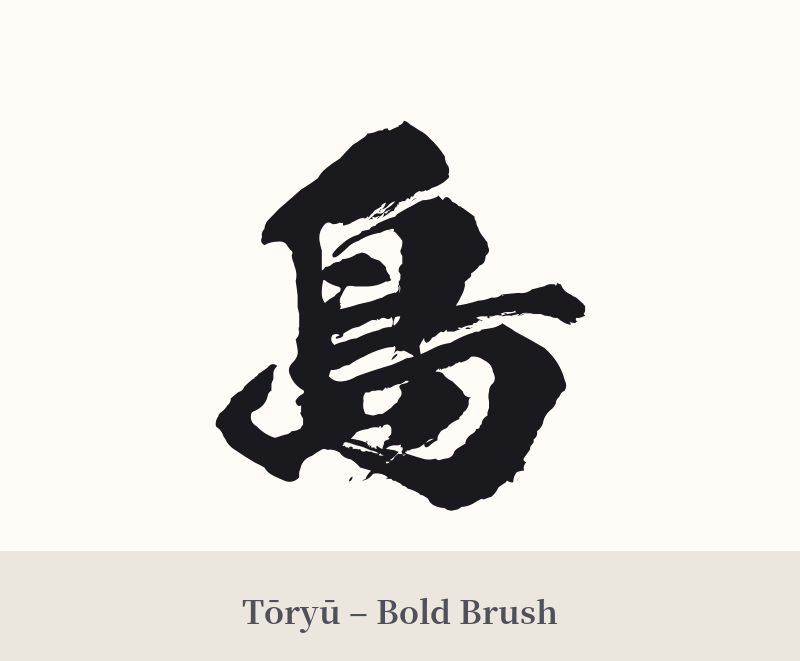
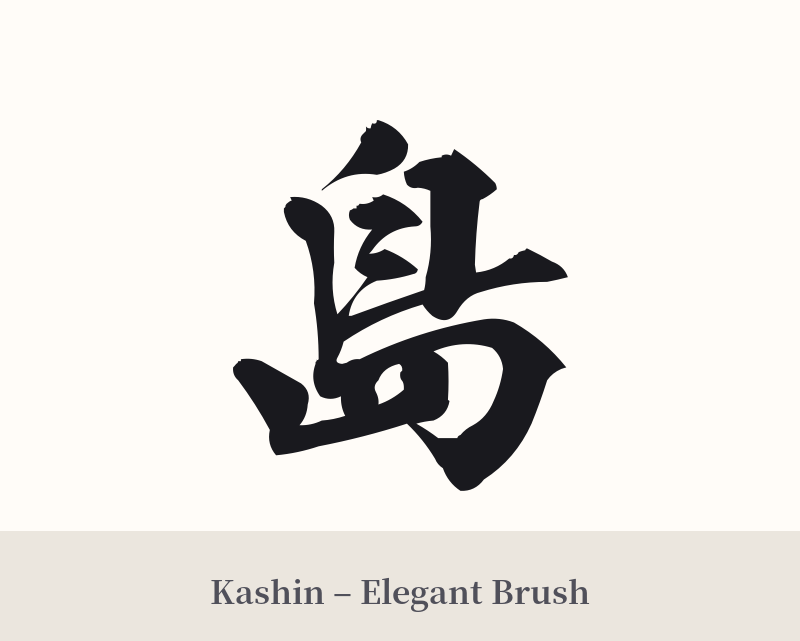
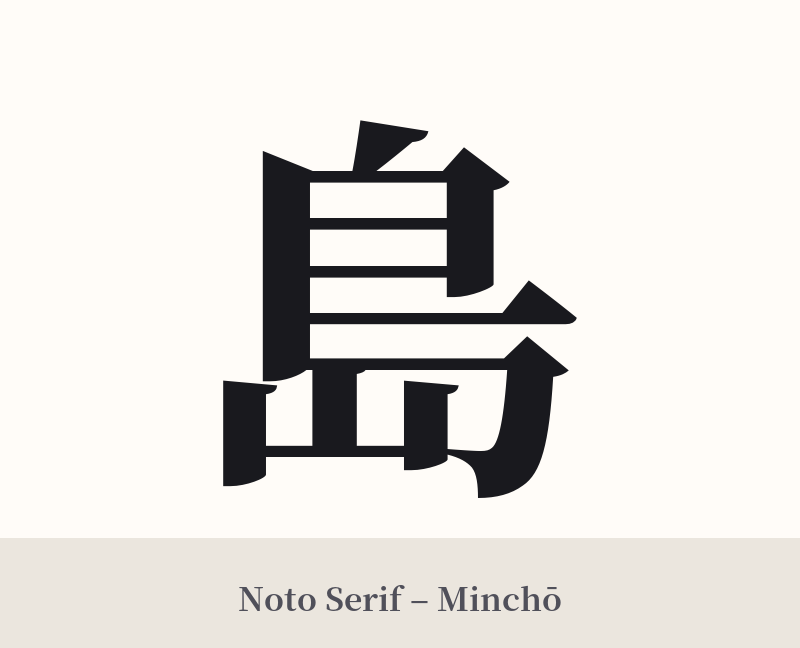
The same kanji can look dramatically different depending on the calligraphy style. Choose a font that matches the mood you want for your tattoo or design.
🎨 Tattoo Suitability
📐 Tattoo Design Guide
The kanji 島 offers wonderful flexibility for a tattoo design due to its balanced structure and inherent natural theme.
– Placement: It works well in both vertical and horizontal orientations. For a vertical placement, consider the forearm, calf, or spine. For a more compact, horizontal look, the back of the neck, wrist, or chest are excellent choices.
– Style: A traditional calligraphy (shodō) style with bold, flowing brushstrokes can emphasize the organic, natural feeling of an island. Alternatively, a clean and sharp Mincho or modern font can lend it a more stoic and refined feel, focusing on its strong form.
– Visual Elements: 島 pairs beautifully with other Japanese nature motifs. Consider integrating it with waves (nami) crashing at its base, a bird flying overhead to honor the folk etymology, or placing it within a larger landscape piece. The character itself can be stylized, with the 'mountain' part rendered more literally as a peak.
Comments