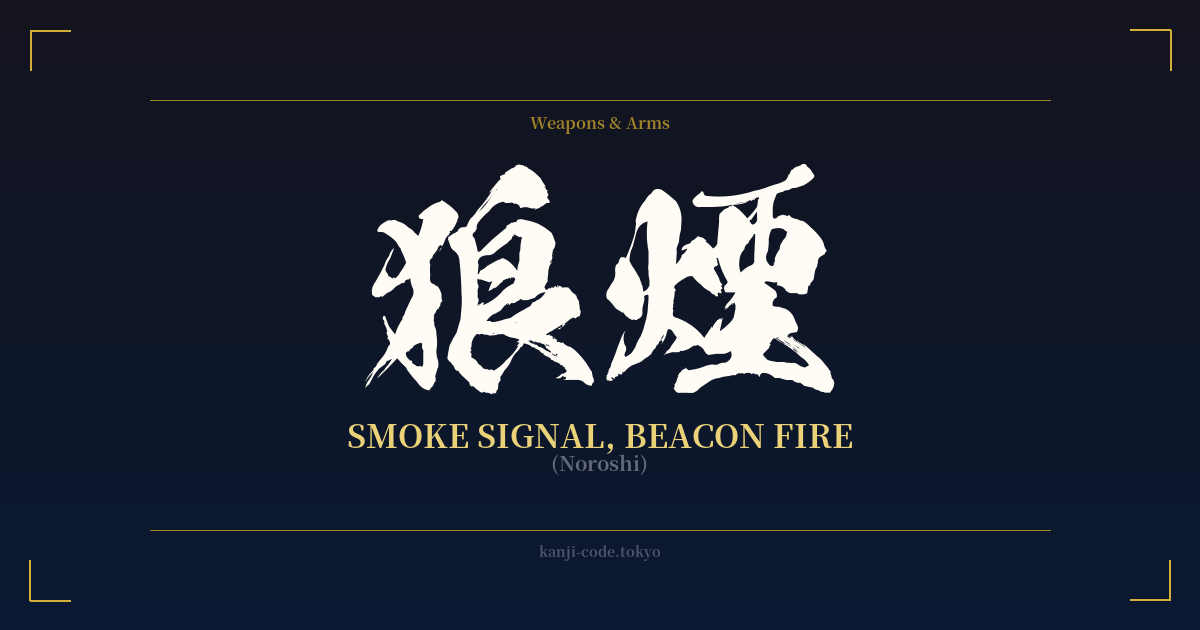
✍️ 狼煙 (Noroshi) — Cultural Context
The word 狼煙 (Noroshi) translates to 'smoke signal' or 'beacon fire,' but its story is far more evocative than a simple puff of smoke. It’s a term steeped in ancient military strategy, a powerful symbol of communication, warning, and the dawn of action.
The most fascinating aspect of this word lies in its characters: 狼 (wolf) and 煙 (smoke). Why 'wolf smoke'? The origin is believed to trace back to ancient China. Military strategists discovered that burning the dried dung of wolves produced a thick, dark smoke that rose in a remarkably straight column. This made it highly visible over long distances and less susceptible to being dispersed by wind, creating the perfect long-range signal.
This technology was indispensable in pre-modern Japan, particularly during the turbulent Sengoku Jidai, or the 'Warring States' period (1467-1615). Feudal lords established vast networks of signal posts on mountains and at castles. When enemy troops were sighted, a noroshi would be lit. This signal would be spotted by the next post in the chain, which would then light its own beacon. In this way, a message could travel across an entire province in a fraction of the time it would take a messenger on horseback, allowing for the rapid mobilization of armies.
Today, the practical use of noroshi has faded into history, but its symbolic meaning has grown even stronger. In modern Japanese, the phrase 'to raise a noroshi' (狼煙を上げる – noroshi o ageru) is a powerful metaphor. It means to signal the start of something big—a rebellion, a campaign, a revolution, or a major new project. It signifies the first public action that declares intent and rallies others to a cause.
For example, a small company launching a disruptive product might be said to be 'raising a noroshi' against the industry giants. A protest movement's first major demonstration is its noroshi. This metaphorical use transforms the word from a mere historical artifact into a living symbol of initiative, courage, and the moment that everything begins to change.
🖌️ Font Styles for 狼煙
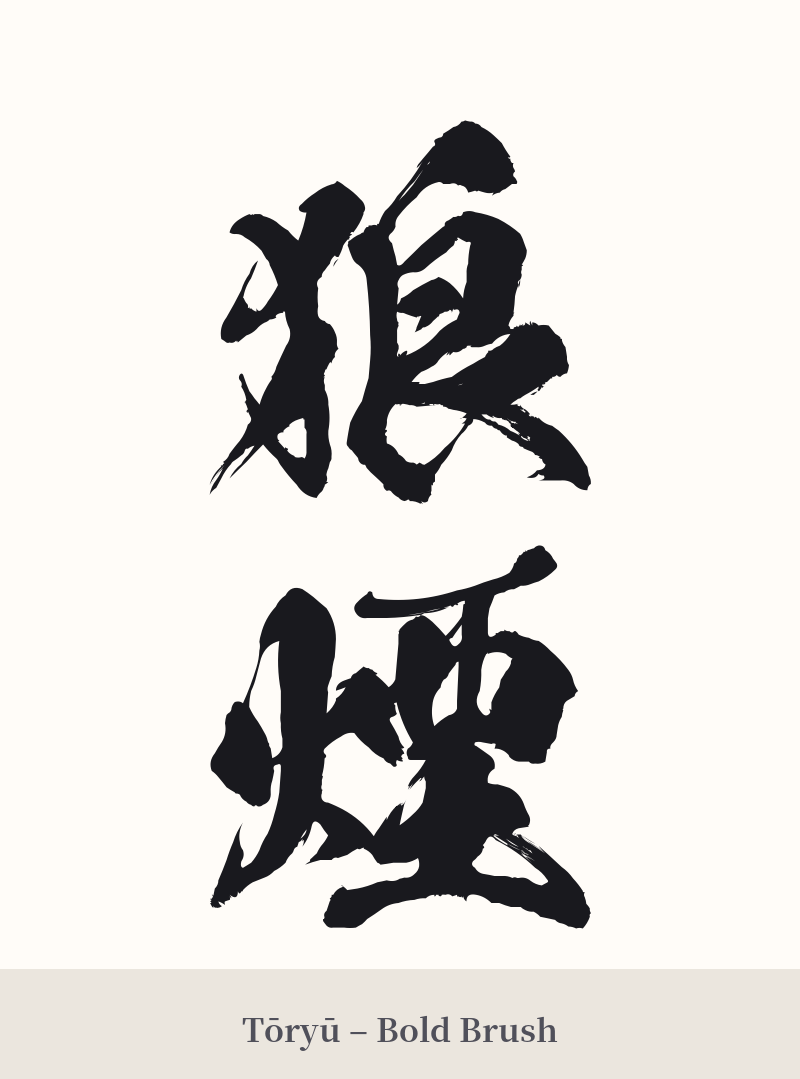
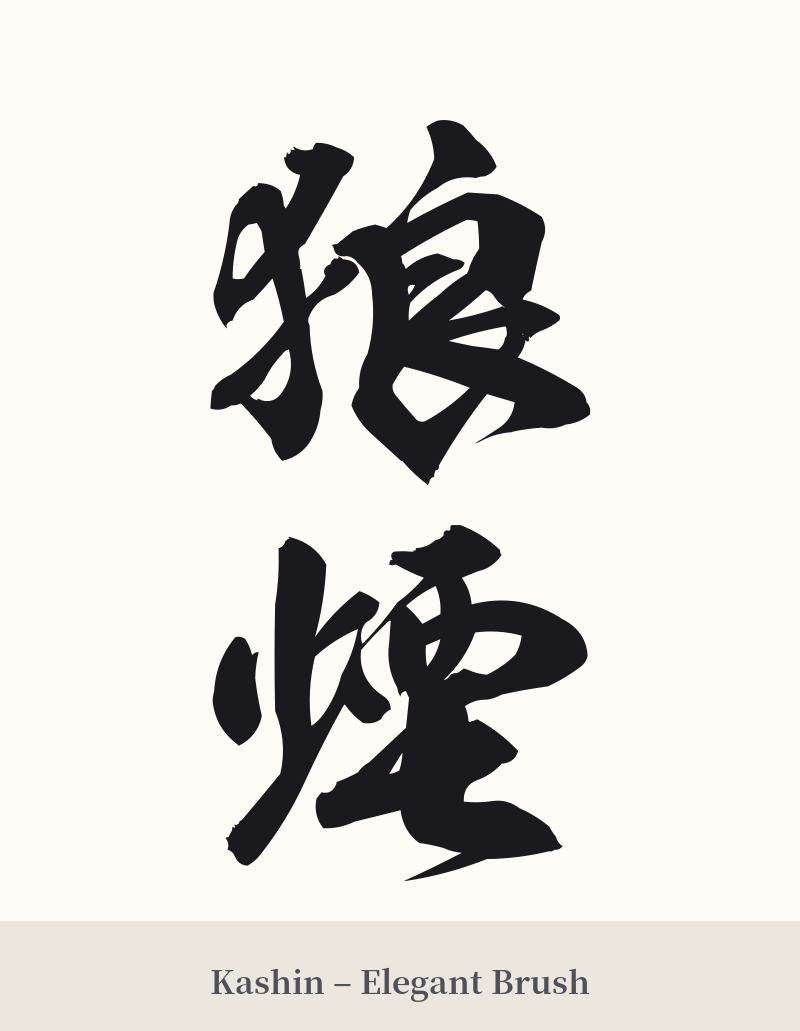
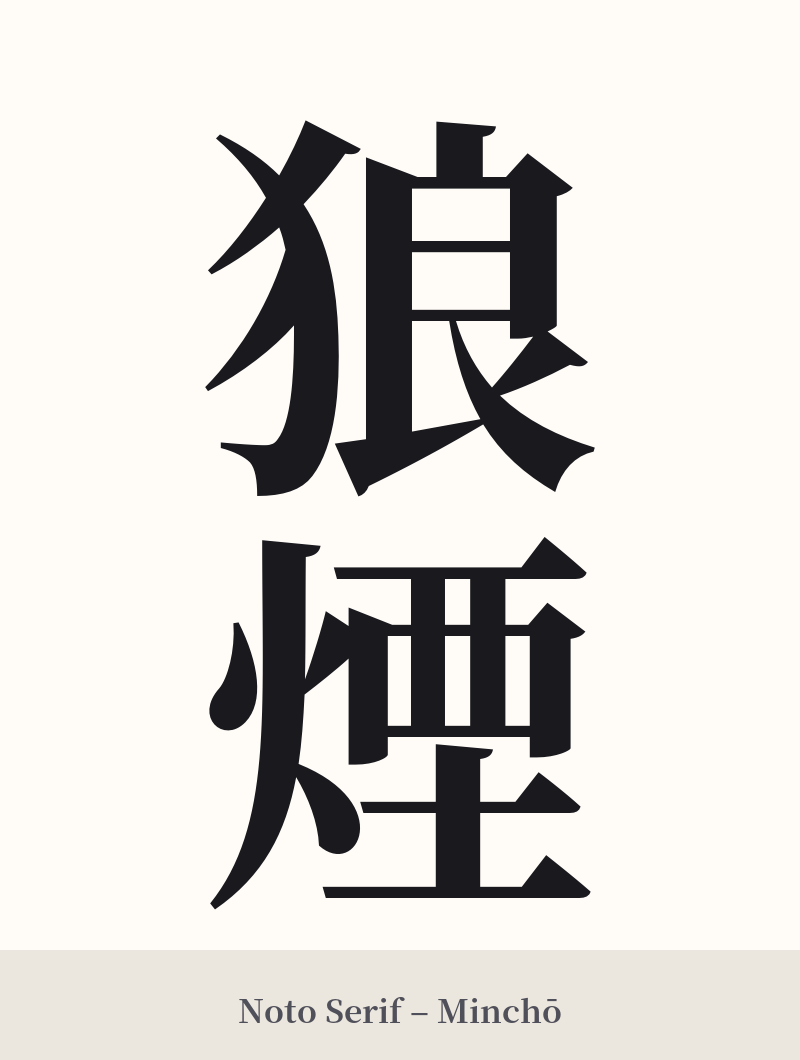
The same kanji can look dramatically different depending on the calligraphy style. Choose a font that matches the mood you want for your tattoo or design.
🎨 Tattoo Suitability
📐 Tattoo Design Guide
The kanji 狼煙 (Noroshi) offers rich visual potential for a tattoo, combining the fierce energy of the wolf with the ethereal nature of smoke. Its historical weight calls for a design that feels both powerful and deliberate.
– Placement: A vertical orientation is highly recommended to mimic the image of smoke rising into the sky. Placements like the forearm, calf, or along the spine work exceptionally well. For a horizontal design, the chest or upper back provides a strong canvas.
– Font Style: A dynamic, semi-cursive brush script (Gyōsho) can capture the movement of smoke and the wildness of the wolf. For a more resolute and impactful look, a bold, angular block script (Kaisho) emphasizes its military origins and the gravity of the signal.
– Visual Tips: Consider integrating artistic elements directly with the kanji. Wisps of black or grey smoke could be designed to rise from the top of the characters, or wrap around them. A small, stylized flame at the base of the kanji can also anchor the design and reinforce the 'beacon fire' meaning. The contrast between the sharp strokes of 狼 (wolf) and the more flowing form of 煙 (smoke) is a natural design element to highlight.
Comments