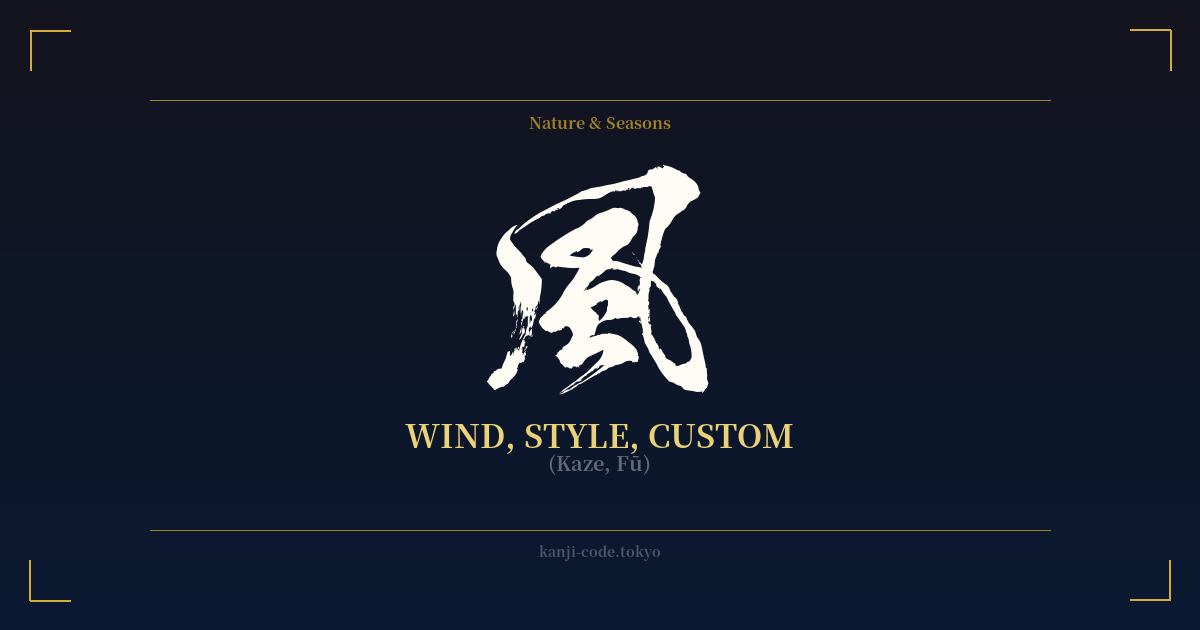
✍️ 風 (Kaze, Fū) — Cultural Context
The kanji 風 (kaze) is one of the most evocative and poetic characters in the Japanese language. At its core, it represents the wind—an invisible, yet powerful force of nature that shapes landscapes, signals the changing of seasons, and moves all things. It is an elemental symbol of freedom, movement, and the unstoppable passage of time.
In Japan's Shinto tradition, natural phenomena are often revered as kami, or deities. The wind is no exception, personified by Fūjin (風神), the fearsome god of wind, often depicted holding a large bag of air. This reverence highlights the deep respect and awe the Japanese culture holds for nature's power, seeing the wind not just as weather, but as a spiritual presence.
The character's influence permeates Japanese art and literature. It is a cornerstone of haiku poetry, where the whisper of the wind through bamboo or the chill of an autumn breeze can encapsulate a whole season of feeling. This connects to the aesthetic concept of 'mono no aware'—a gentle sadness for the transient, impermanent nature of life, which the ever-moving wind perfectly embodies.
Beyond its literal meaning, 風 evolves into a more abstract concept: 'fū' (the Chinese-derived reading), which means 'style,' 'manner,' or 'custom.' You see this in words like 和風 (wafū), meaning 'Japanese style,' or 家風 (kafū), 'family custom.' This dual meaning is beautiful; it suggests that style and culture are not static but are like the wind—a flowing, ever-present current that defines a group or an individual's way of being.
This sense of dynamic force is also central to martial philosophy. 風 is the first character in 風林火山 (Fūrinkazan), the battle standard of the famous daimyo Takeda Shingen. Here, 'wind' represents being 'as swift as the wind,' emphasizing speed and decisive action. It speaks to a strategic and philosophical approach to conflict and life itself.
Finally, one cannot discuss 風 without mentioning 神風 (kamikaze), or 'divine wind.' Historically, this term refers to the typhoons that famously destroyed the Mongol invasion fleets in the 13th century, saving Japan. While the term was later co-opted during World War II with a tragic new meaning, its origin lies in a story of natural, divine intervention, showcasing the wind's role as both a creator and a destroyer in the Japanese psyche.
🖌️ Font Styles for 風
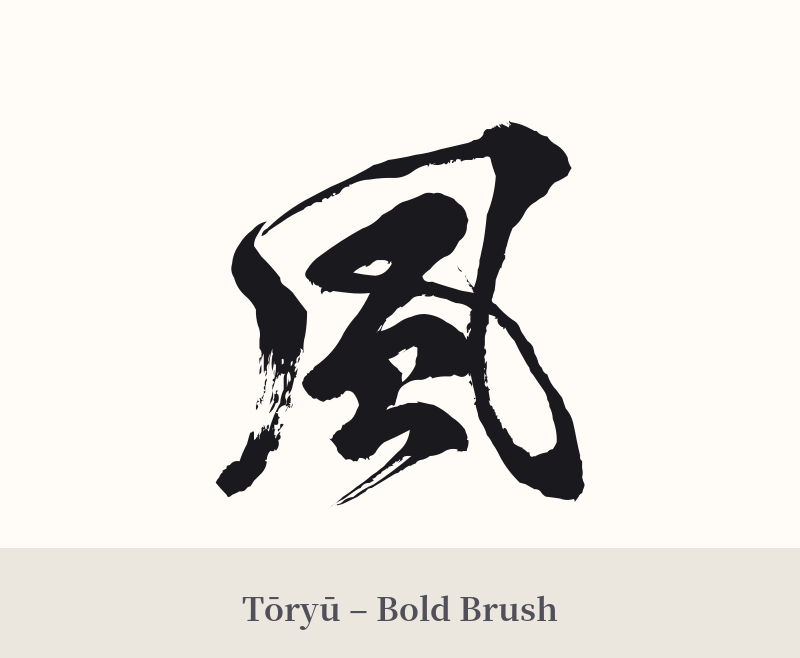
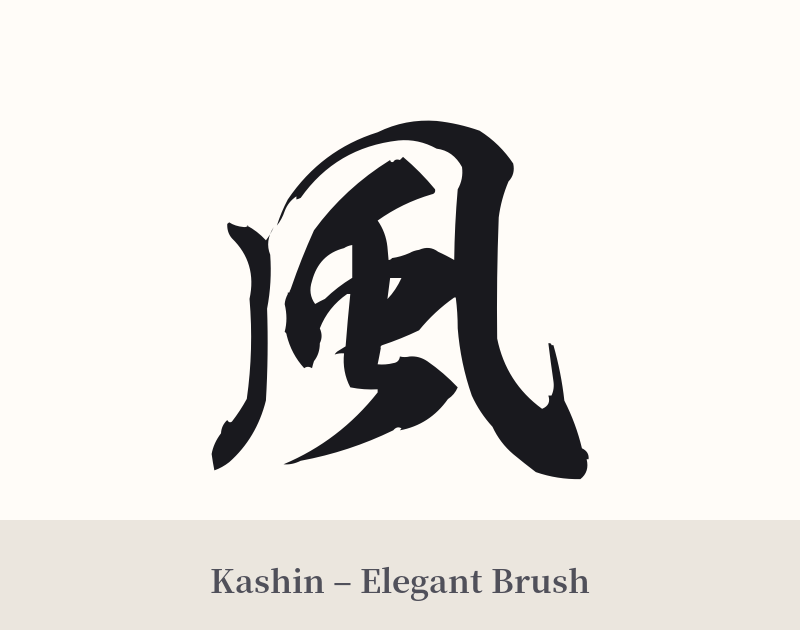
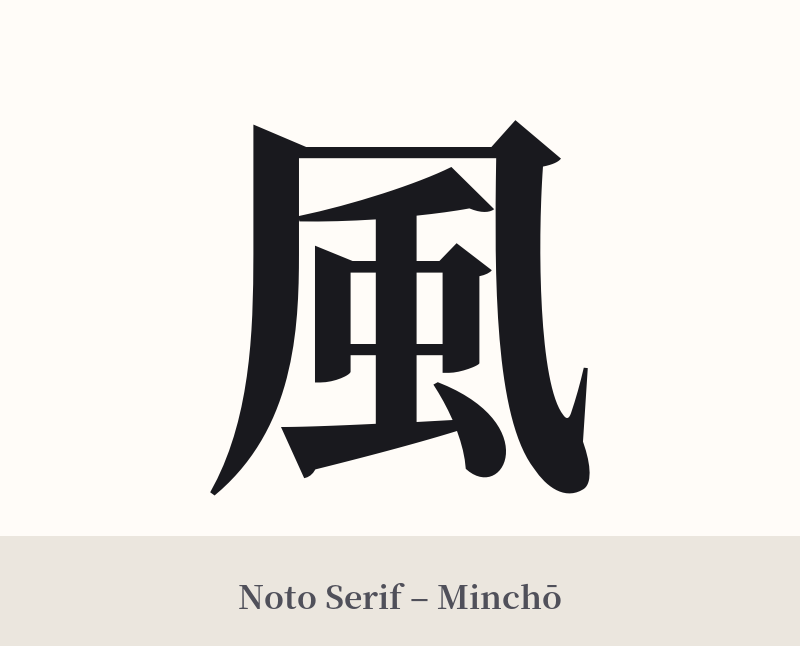
The same kanji can look dramatically different depending on the calligraphy style. Choose a font that matches the mood you want for your tattoo or design.
🎨 Tattoo Suitability
📐 Tattoo Design Guide
The kanji 風 offers fantastic versatility for a tattoo design, thanks to its dynamic shape and profound meaning.
– Placement Suggestions: For a flowing, vertical design, the spine, forearm, or along the calf are excellent choices. For a more compact statement, the back of the neck or the wrist work well. The ribs or side of the torso can also complement the character's natural movement.
– Font Style: To emphasize the 'wind' aspect, a cursive or semi-cursive calligraphy style (sōsho or gyōsho) is highly recommended. The fluid, connected strokes beautifully mimic the movement of air. For the 'style/manner' meaning, a more deliberate and balanced block script (kaisho) can convey a sense of stability and tradition.
– Visual Tips: While 風 is powerful on its own, it can be integrated with other elements. Consider faint, swirling lines around the character, or have it appear as if it's being formed by scattering leaves or cherry blossom petals. A minimalist approach, focusing solely on the brushstroke texture and energy, is often the most impactful.
Comments