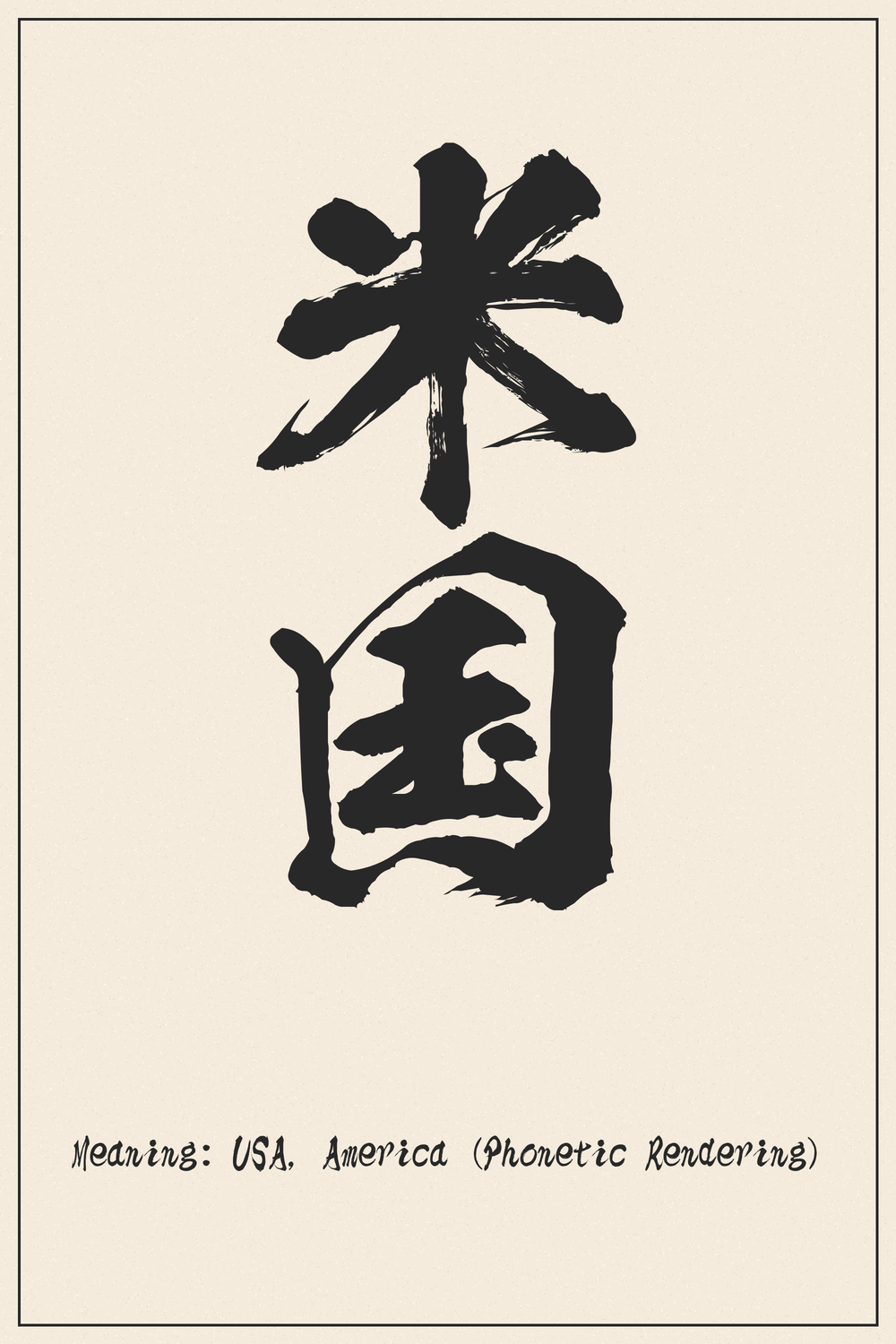
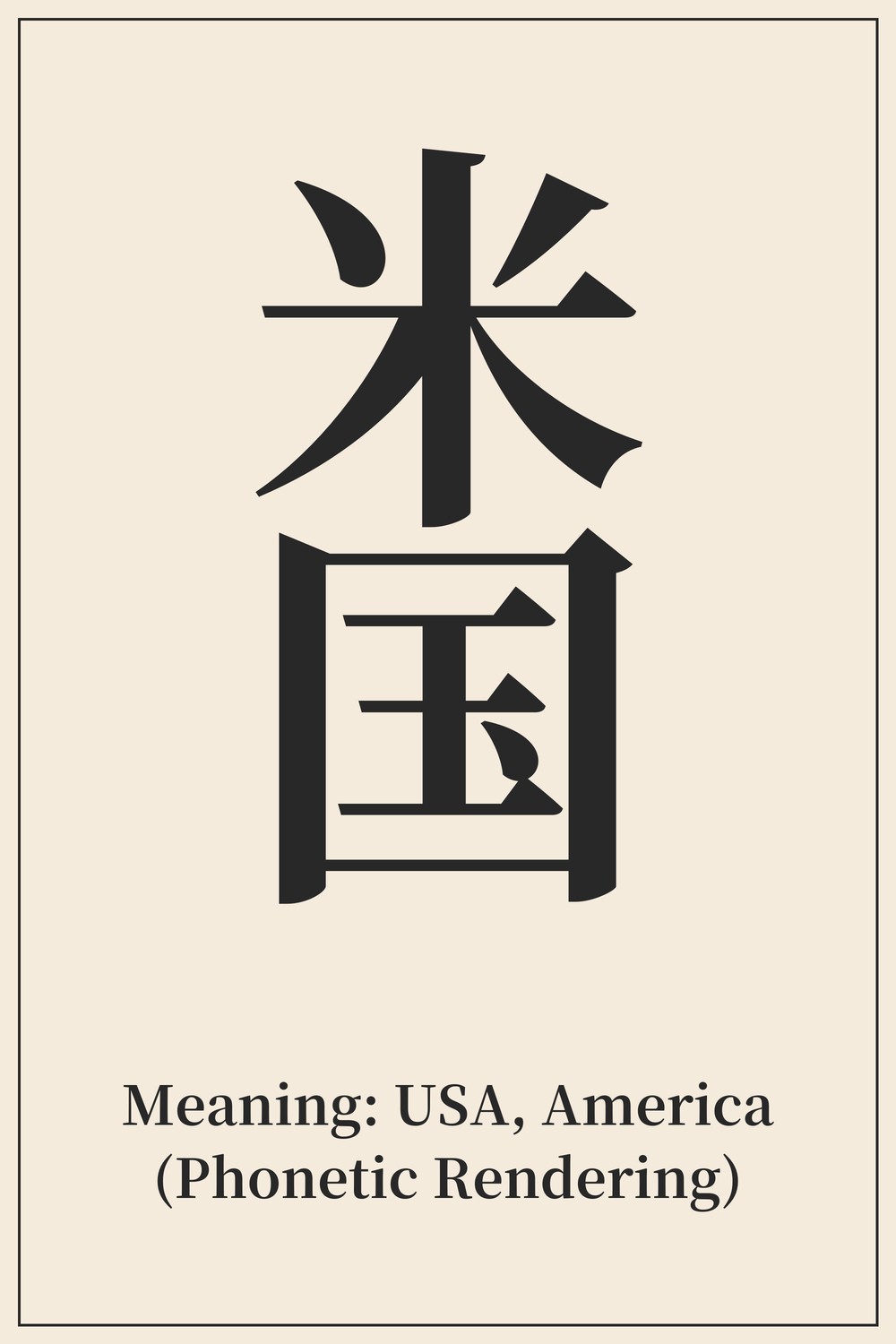
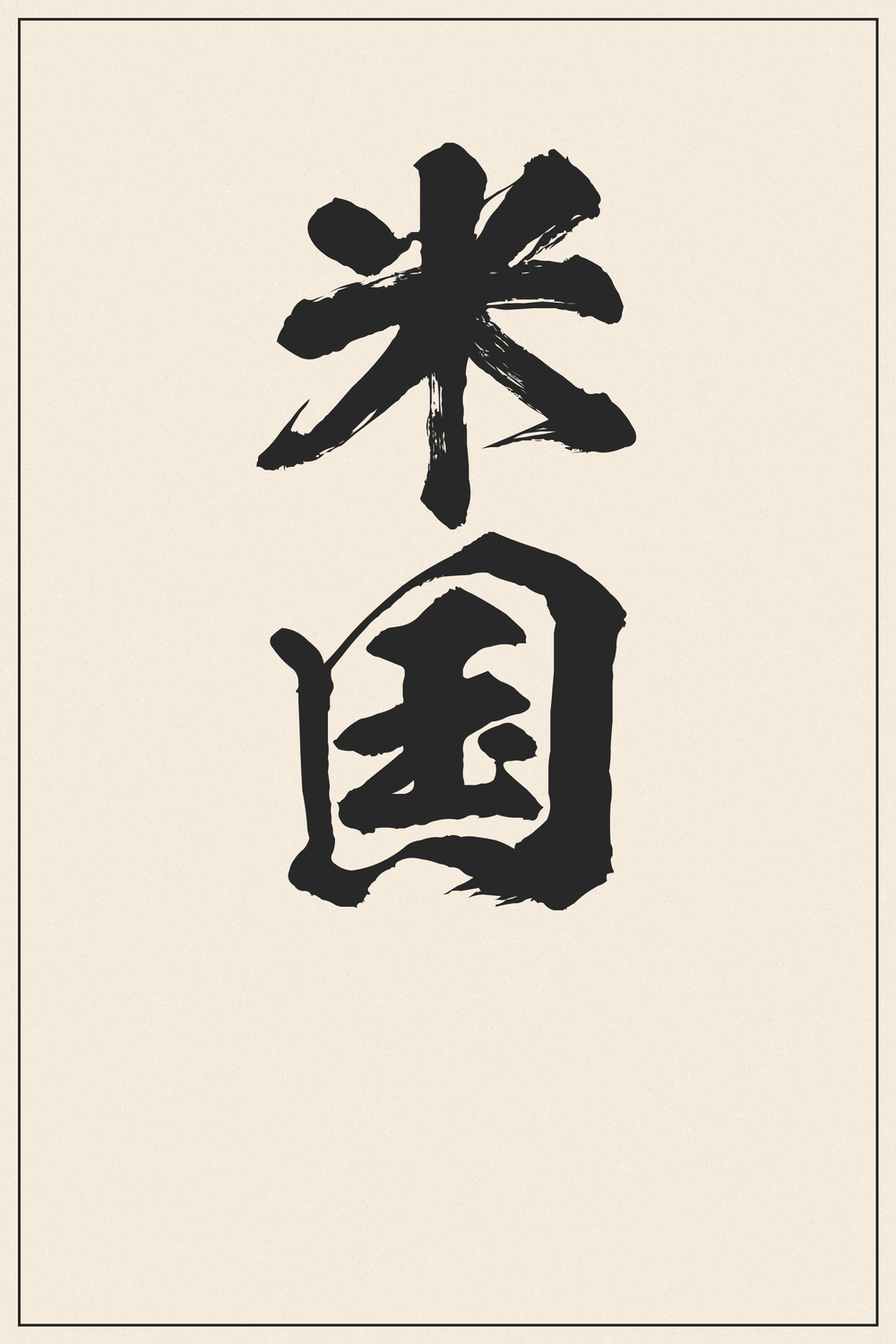
The Kanji 米国 (Beikoku) offers a fascinating glimpse into how foreign names are adopted into Japanese. Representing the United States of America, it exemplifies the concept of Ateji, where characters are chosen primarily for their phonetic value.
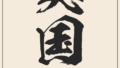
The atmosphere of a Kanji character changes dramatically depending on the font style. A character that looks elegant in a brush style might look bold and modern in a different font.
Recommendation: Since a tattoo is permanent, we strongly recommend comparing various font styles beyond what is shown here. Use our designs as a trusted reference for the correct structure, but feel free to explore different artistic variations to find the perfect match for your vision.
The Deep Meaning Behind 米国
The term 米国 (Beikoku) serves as an Ateji, a phonetic approximation, for ‘America’ or ‘USA’. The first character, 米 (bei), literally means ‘rice’, but here it is used phonetically to approximate the ‘me’ or ‘a-me’ sound from ‘America’. The second character, 国 (koku), straightforwardly means ‘country’ or ‘nation’.
Thus, while the literal translation would be ‘Rice Country’, this combination is not meant to convey a symbolic meaning related to rice. Instead, it is a historical linguistic choice to represent the foreign name ‘America’ through Japanese characters. In Japanese culture, 米国 is the standard and widely understood term for the United States. Its usage is purely practical, serving as a direct and unambiguous reference to the nation. Understanding 米国 involves appreciating the sophisticated system of Ateji, where the visual form of Kanji is leveraged for its sound rather than its inherent meaning to integrate foreign concepts.
Kanji Breakdown
The Kanji 米国 is composed of two distinct characters, each contributing to its unique phonetic and semantic role in representing the United States.
Meaning: This character originally depicts grains of rice, reflecting its primary meaning. In the context of 米国, however, its role is primarily phonetic, chosen for its sound ‘bei’ to approximate part of ‘America’.
Meaning: The Kanji 国 is composed of the radical 囗 (kunigamae), meaning ‘enclosure’ or ‘border’, surrounding 玉 (tama), which means ‘jewel’ or ‘king’. This structure symbolizes a territory defined by its borders, ruled or treasured within, thus forming the concept of a ‘country’ or ‘nation’.
Conclusion
In summary, 米国 (Beikoku) is the established Kanji representation for the United States of America. It is a prime example of Ateji, where the characters 米 (rice) and 国 (country) are combined for their sounds rather than their individual meanings to phonetically render a foreign name.
For those considering 米国 for a tattoo, it is an authentic and widely recognized Kanji for ‘USA’. It carries the weight of linguistic history in its phonetic adaptation. While its literal meaning of ‘Rice Country’ is not symbolic of the USA, its use demonstrates a unique aspect of Japanese language in adopting foreign terms, making it a distinctive choice for representing American identity in a Japanese script.
Comments