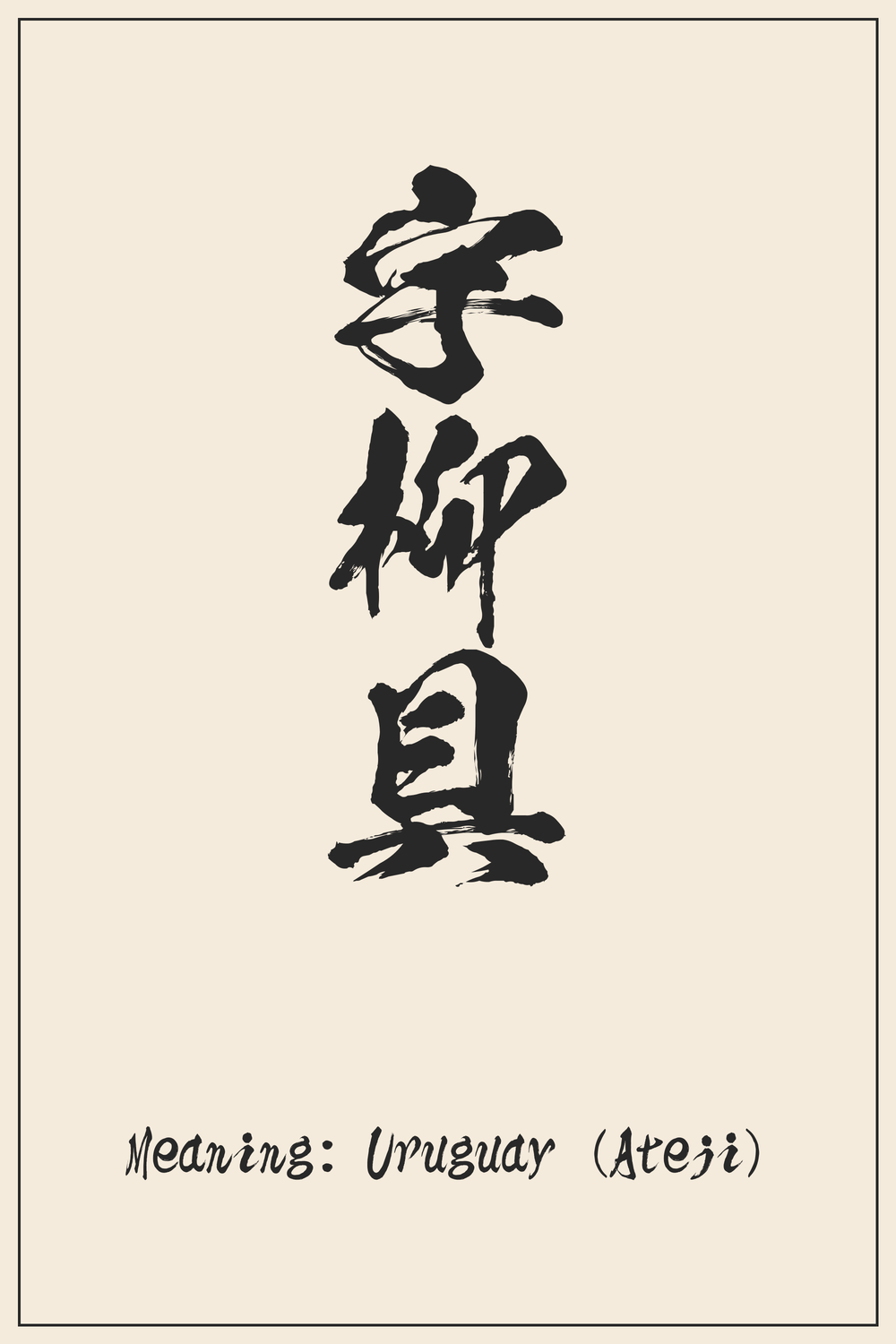
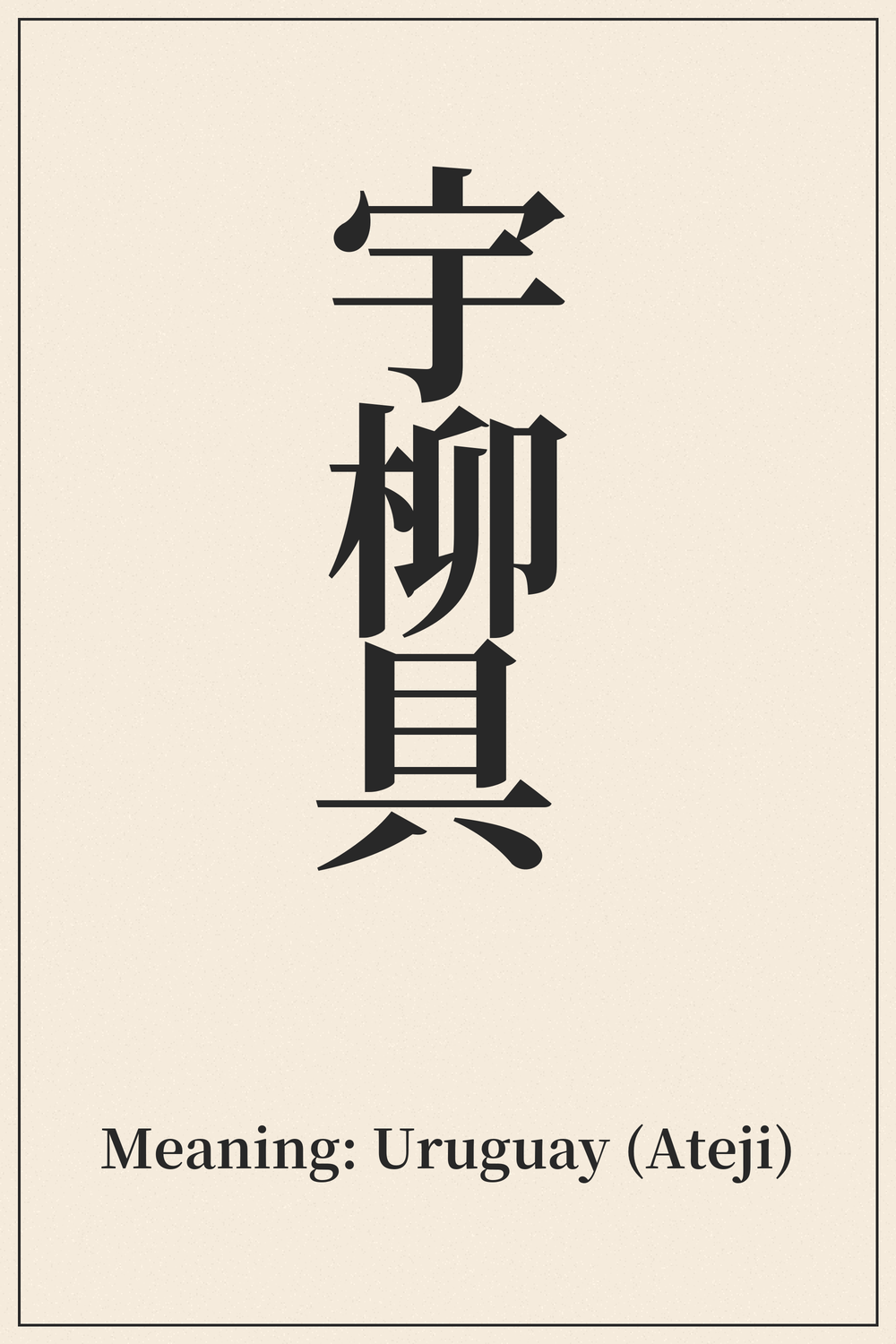
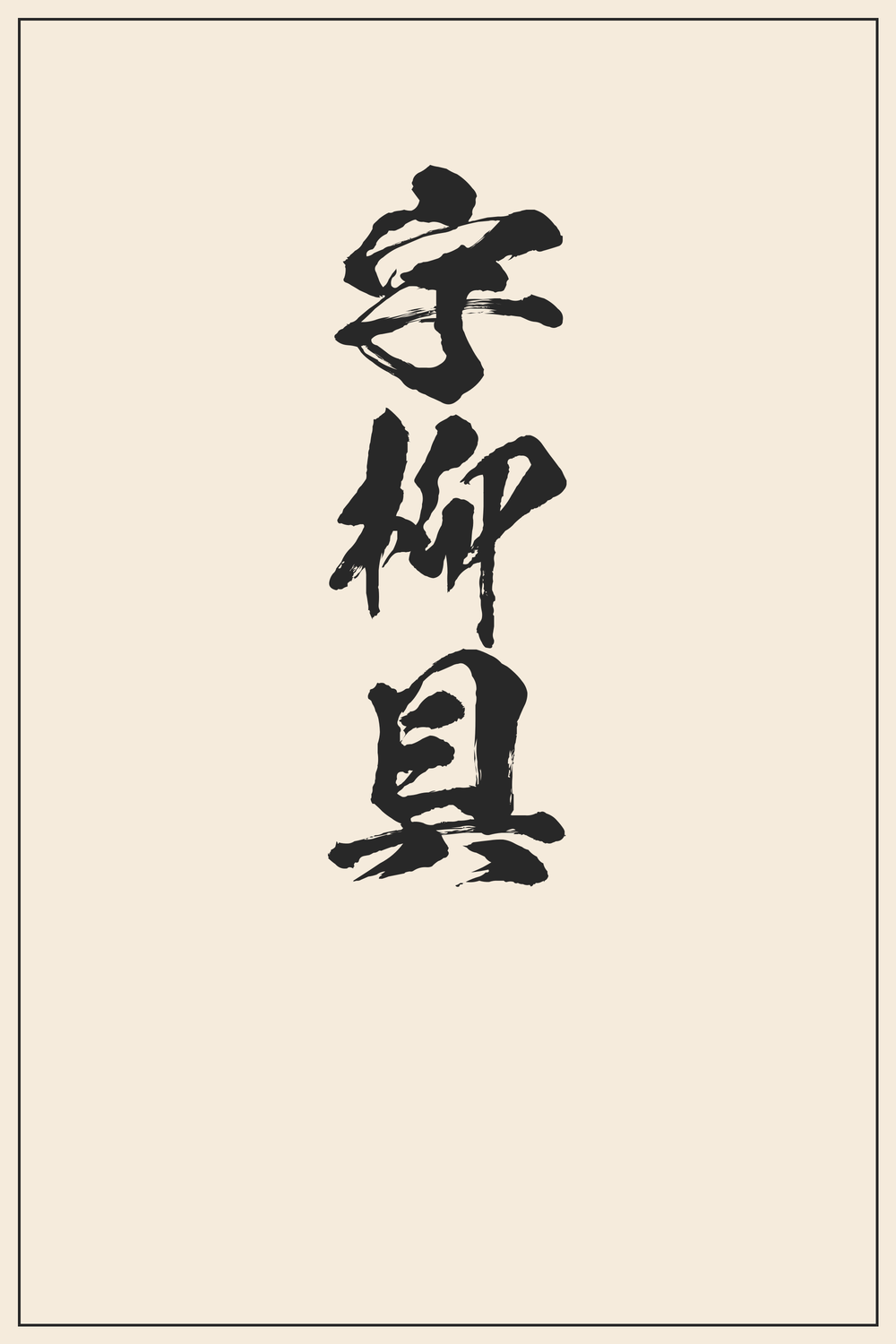
The Kanji combination 宇柳具 represents Uruguay, a fascinating example of how Japanese characters are sometimes used phonetically to spell out foreign names. This unique application showcases the adaptability of Kanji beyond their inherent meanings.
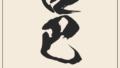
The atmosphere of a Kanji character changes dramatically depending on the font style. A character that looks elegant in a brush style might look bold and modern in a different font.
Recommendation: Since a tattoo is permanent, we strongly recommend comparing various font styles beyond what is shown here. Use our designs as a trusted reference for the correct structure, but feel free to explore different artistic variations to find the perfect match for your vision.
The Deep Meaning Behind 宇柳具
“宇柳具” is a prime example of *ateji* (当て字), a Japanese term for Kanji used solely for their phonetic value to represent foreign words or concepts. In this case, the characters are chosen to approximate the sounds of “Uruguai,” the Japanese pronunciation of Uruguay. It does not carry a direct symbolic meaning related to the nation itself.
While each character possesses its own individual meanings – 宇 (u) for “eaves, cosmos,” 柳 (ryū) for “willow tree,” and 具 (gu) for “tool, ingredients” – these meanings are largely secondary when “宇柳具” is used to denote the South American country. Its primary function in this context is to provide a recognizable written form for “Uruguay” within the Japanese language.
Kanji Breakdown
The combination 宇柳具 is an example of *ateji*, where Kanji are chosen for their sounds rather than their meanings. Here’s a look at the individual characters:
Meaning: Eaves, house, universe, sky.
Meaning: Willow tree.
Meaning: Tool, implement, ingredients, provide.
Conclusion
This Kanji combination, 宇柳具 (Uruguai), beautifully illustrates the phonetic versatility of Japanese characters as *ateji*. It serves as the standard written form for the country Uruguay in Japanese, chosen entirely for its pronunciation rather than the literal meanings of its constituent parts.
While culturally interesting as an example of *ateji* in Japanese, its individual characters do not inherently combine to form a deeply symbolic or profound representation of the country “Uruguay.” Its primary significance is linguistic, functioning as a phonetic rendering for a foreign name.
Comments