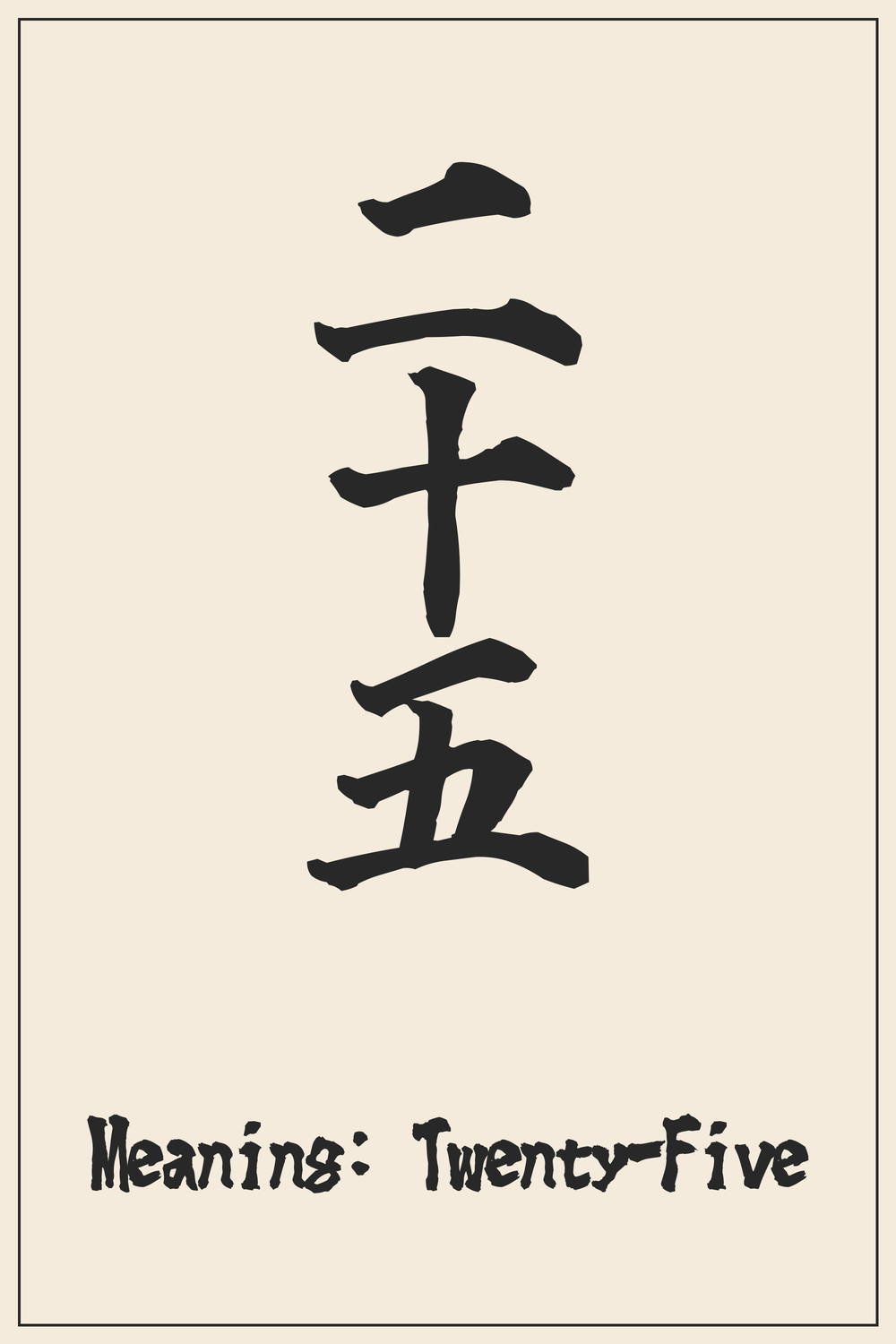
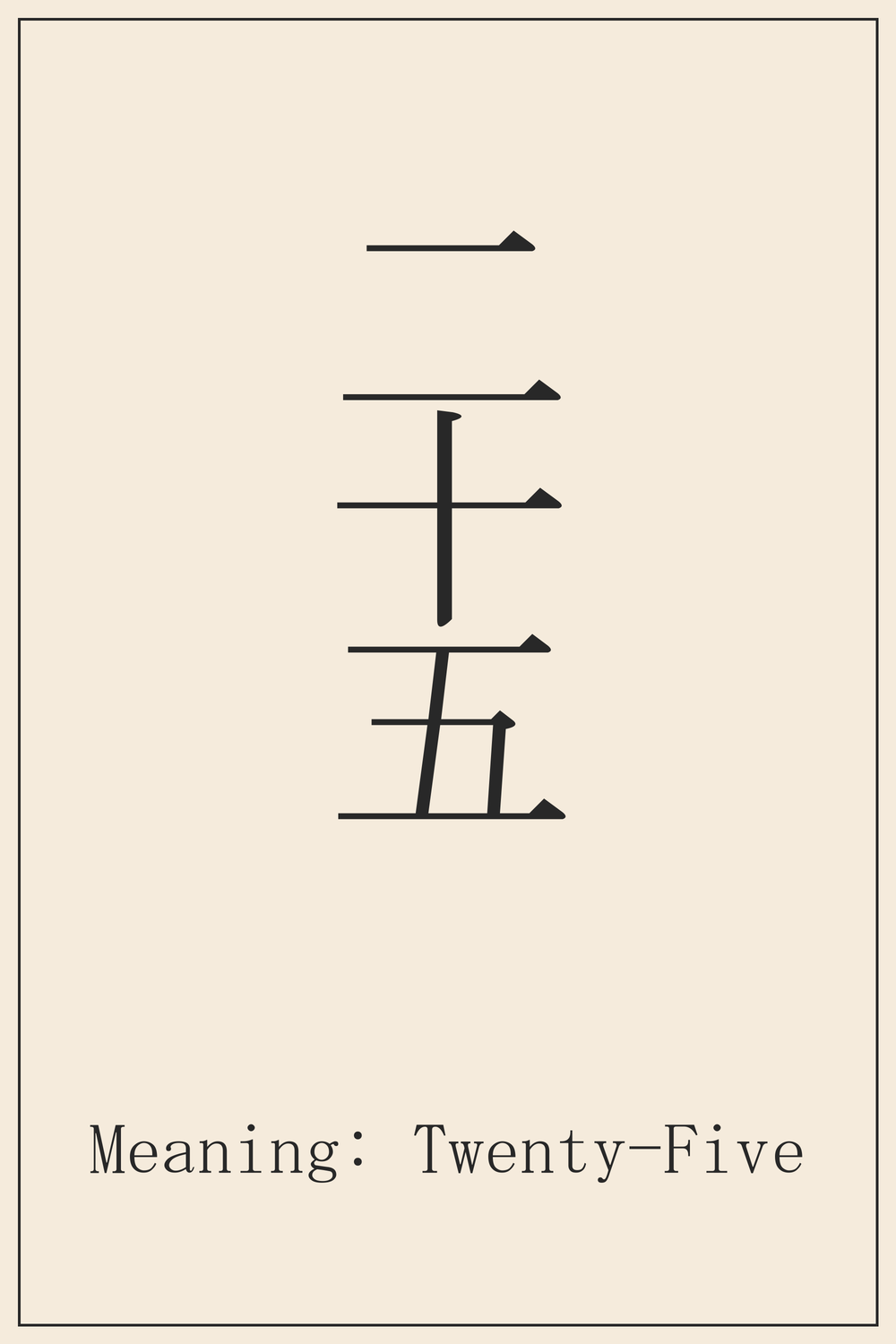
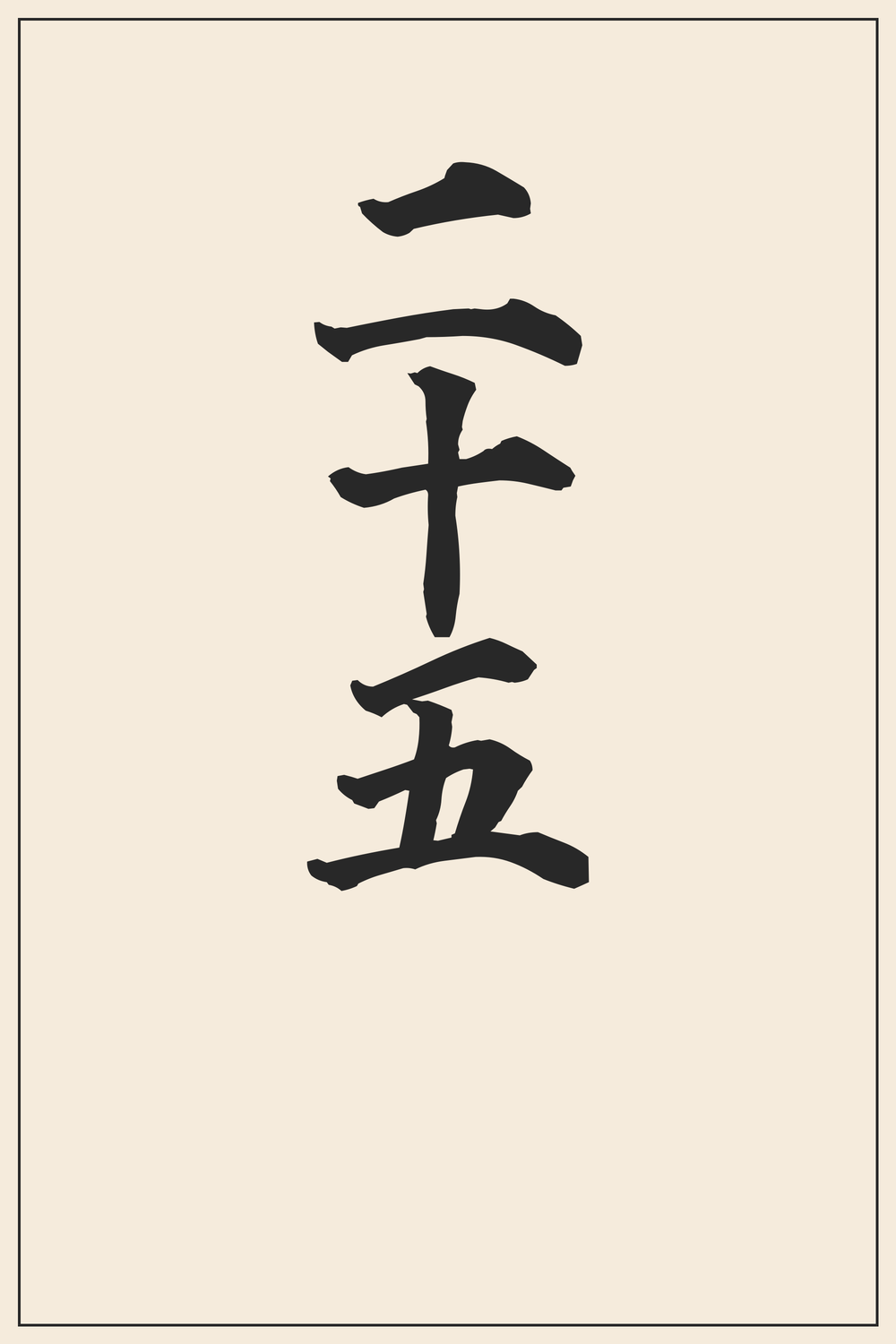
Numbers are universal symbols that carry personal significance, marking milestones, dates, or quantities that define our experiences. The Kanji ‘二十五’ succinctly expresses the concept of twenty-five, a number often associated with youthful prime or significant quarter-century marks.
The atmosphere of a Kanji character changes dramatically depending on the font style. A character that looks elegant in a brush style might look bold and modern in a different font.
Recommendation:
Since a tattoo is permanent, we strongly recommend comparing various font styles beyond what is shown here. Use our designs as a trusted reference for the correct structure, but feel free to explore different artistic variations to find the perfect match for your vision.
The Deep Meaning Behind 二十五
The Kanji compound 二十五 (nijuugo) literally means ‘twenty-five’ and is formed by three fundamental numeral characters. 二 (ni) represents ‘two’, a pictograph of two horizontal lines. 十 (juu) signifies ‘ten’, originally depicting a vertical line intersecting a horizontal one. 五 (go) denotes ‘five’, believed to have evolved from a symbol representing crossing or a hand with five fingers, although its ancient form is complex.
In Japanese culture, as in many others, numbers are integral to daily life, from counting and dates to traditional ceremonies and age milestones. While ‘twenty-five’ does not carry the deep symbolic weight of numbers like seven or eight in some contexts, it often marks a quarter-century, a significant point in one’s life often celebrated as an ‘age of maturity’ or a personal landmark.
Kanji Breakdown
The meaning of 二十五 is derived from the simple yet powerful combination of three individual numeral Kanji.
Two, Pair: This Kanji is a simple representation of ‘two’ through two horizontal strokes. It signifies duality and partnership.
Ten, Complete: Originally a pictograph of a needle or a cross, 十 denotes ‘ten’, often symbolizing completeness or an entire set in East Asian numerology.
Five, Center: The Kanji 五 represents ‘five’. Its ancient form suggests a balance or a central point, though primarily it functions as a cardinal number.
Conclusion
The Kanji 二十五 (nijuugo) is a direct and unambiguous representation of the number twenty-five. It serves as a clear linguistic marker for a specific quantity, age, or sequence, embodying straightforward numerical precision.
For those seeking a tattoo that denotes a significant age, a memorable date, or a precise count, 二十五 offers a clean, legible, and culturally authentic choice. Its simplicity allows for versatile aesthetic integration while carrying personal resonance.
Comments