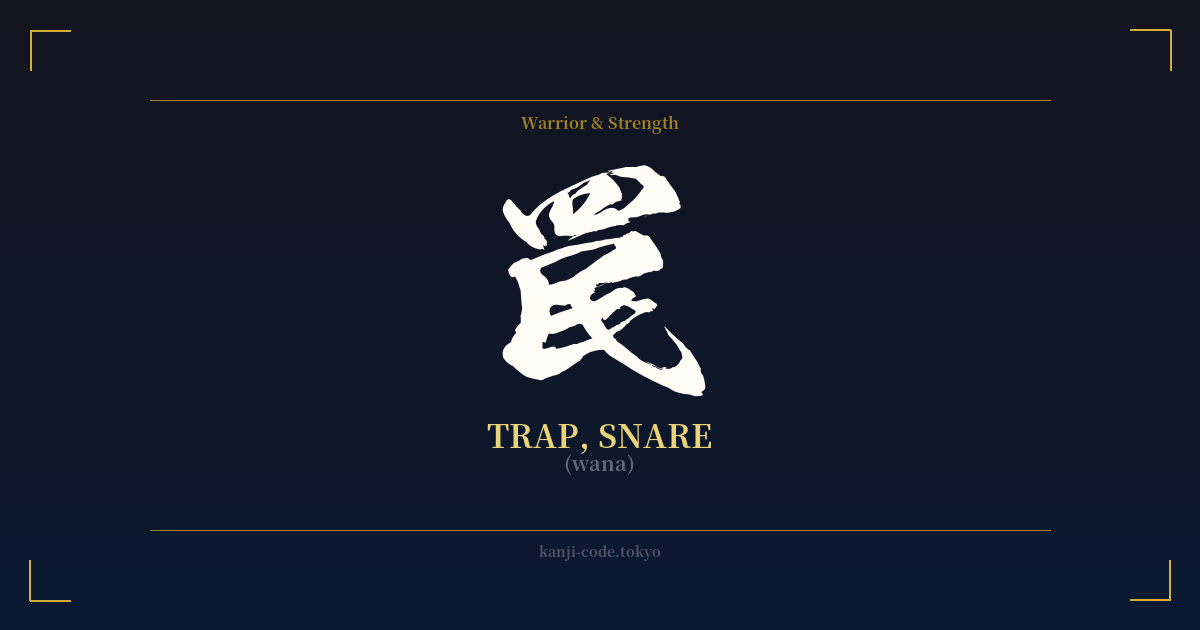
✍️ 罠 (wana) — Cultural Context
The Japanese kanji 罠 (wana) translates to 'trap' or 'snare,' but its meaning extends far beyond a simple physical device. It embodies a potent duality, representing both the ingenuity of the hunter and the grim fate of the captured. This character is a powerful symbol of strategy, deception, and the inescapable forces of circumstance.
Etymologically, the character tells its own story. The top radical, 罒 (a variant of 网), clearly depicts a 'net.' This visual anchor immediately grounds the kanji in the act of ensnaring or catching. Historically, this points to the practical traps used by hunters, known as 'matagi,' in the mountains of Japan, as well as the more sinister devices employed in warfare by samurai and shinobi (ninja) to gain a tactical advantage.
In Japanese culture, the concept of the 'wana' is deeply embedded in language and folklore. The common phrase 「罠を仕掛ける」(wana o shikakeru) means 'to set a trap,' while 「罠にかかる」(wana ni kakaru) means 'to fall into a trap.' These expressions are used constantly in a metaphorical sense to describe everything from business schemes and political intrigue to romantic ploys and psychological manipulation. It speaks to a world where one must be wary of hidden intentions and deceptive appearances.
This theme is a cornerstone of Japanese storytelling, from classic literature to modern anime and manga. Characters are often defined by their ability to either devise clever traps or to perceive and escape them. A 'trap' in these narratives is rarely just physical; it's a test of wits, a moral dilemma, or a psychological puzzle. The kanji 罠, therefore, becomes a symbol not just of cunning, but of the intellectual battle between opponents.
Furthermore, the concept can be turned inward. In a Buddhist context, a 'wana' can represent the snares of worldly desire and attachment that keep one from enlightenment. It can symbolize the internal struggles and self-sabotaging behaviors that trap us in cycles of our own making. It is a reminder of the unseen forces, both external and internal, that can dictate the course of our lives.
Choosing 罠 is to embrace this complexity. It is not a simple statement of strength, but a nuanced acknowledgment of the world's hidden dangers and the intelligence required to navigate them. It can represent a warning, a personal history of being ensnared and overcoming, or the sharp mind of a strategist who is always three steps ahead.
🖌️ Font Styles for 罠
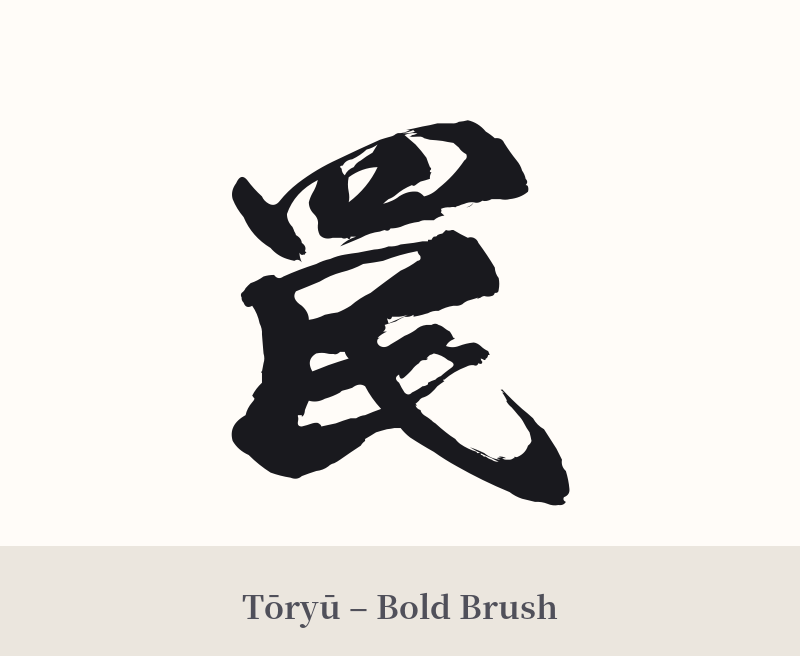
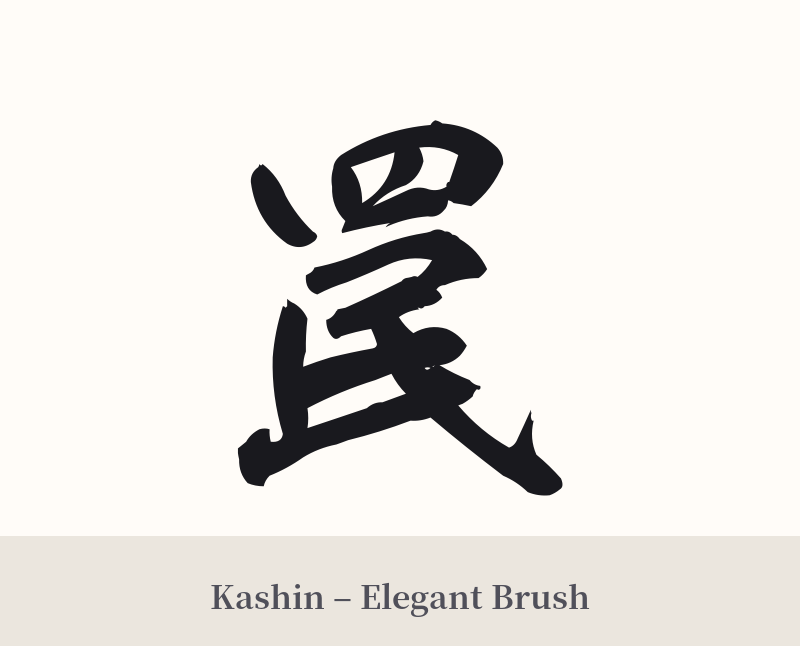
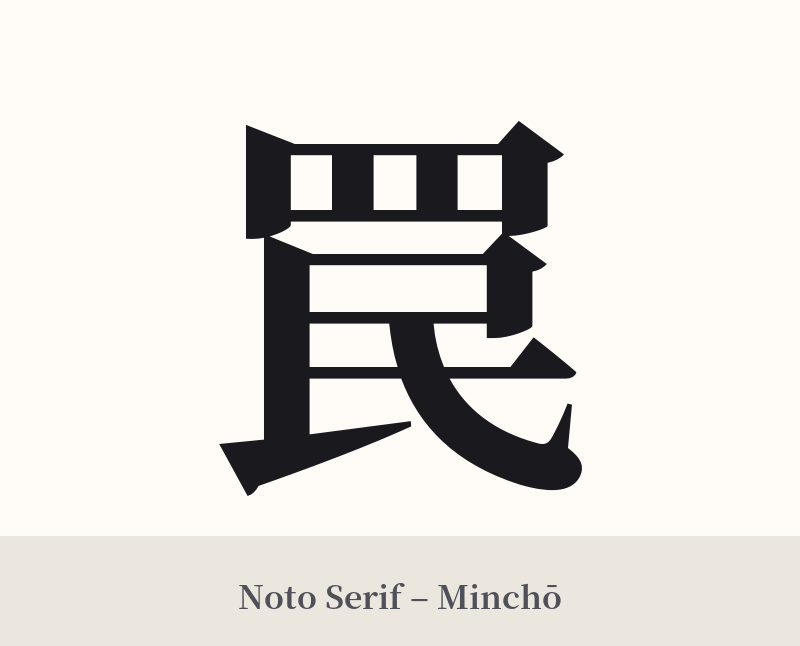
The same kanji can look dramatically different depending on the calligraphy style. Choose a font that matches the mood you want for your tattoo or design.
🎨 Tattoo Suitability
📐 Tattoo Design Guide
The kanji 罠 offers compelling design possibilities due to its symbolic weight. Its meaning can be amplified or clarified through careful choices in style and placement.
– Placement: Consider areas that align with the intended meaning. The forearm or hand suggests the wearer is the one setting the trap, a master of their domain. Placement on the back of the neck or ankle could symbolize a vulnerability or a past experience of being ensnared. On the chest, it can represent an internal, psychological trap.
– Font Style: The style can drastically alter the mood. A rough, aggressive calligraphy (shodō) style can emphasize the primal, dangerous nature of a physical trap. A clean, sharp, geometric font like Mincho or a modern san-serif can evoke the feeling of a cold, calculated, psychological scheme.
– Visual Elements: While 罠 stands strong on its own, it can be combined with other imagery. Incorporating elements of a spider web can visually echo the 'net' radical within the kanji itself. Chains or broken bars can further the narrative of being trapped or breaking free. A splash of red, perhaps in the style of a hanko seal, can add a focal point symbolizing danger or activation.
Comments