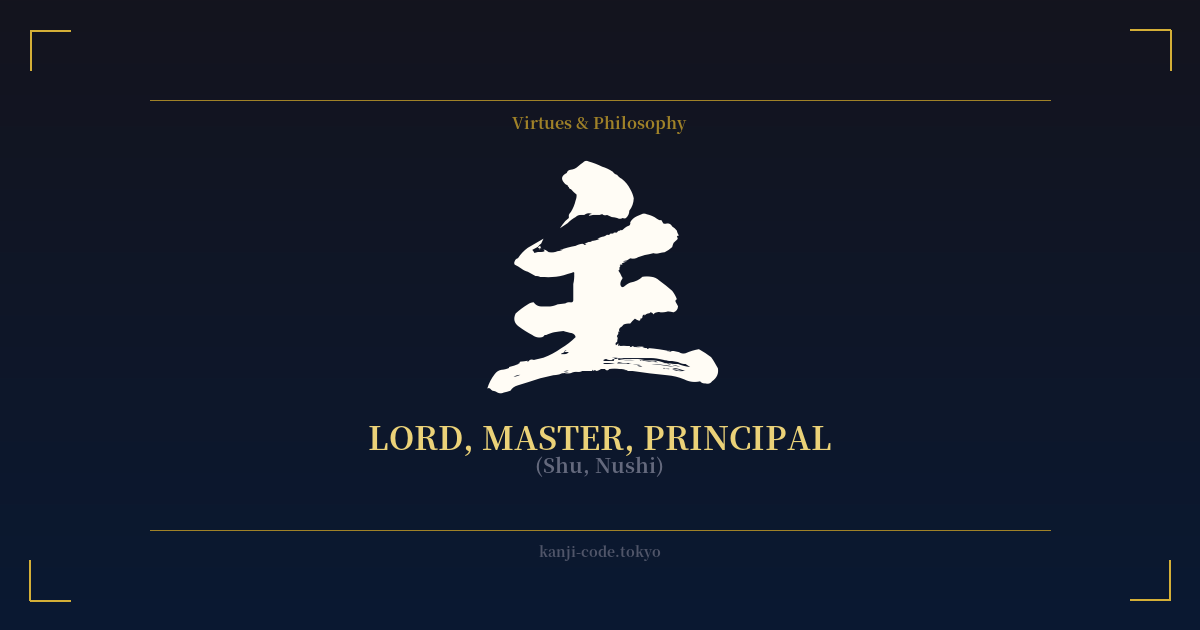
✍️ 主 (Shu, Nushi) — Cultural Context
The kanji 主 is a cornerstone of Japanese language and thought, embodying concepts of authority, ownership, and centrality. Its origin is a simple yet beautiful pictograph of a lampstand with a flame on top. This image perfectly captures its essence: to be the central, illuminating source around which everything else revolves.
In modern Japanese, this sense of 'main' or 'principal' is its most common usage. For example, a 主人公 (shujinkō) is the protagonist or 'main character' of a story. A 主義 (shugi) is a 'principle' or '-ism,' the main tenet of a belief system. This highlights a key aspect of 主: it defines the core element, the most important part of a whole.
Historically, the character took on a more feudal connotation. A 主君 (shukun) was the lord a samurai served, demanding absolute loyalty and dedication. This usage connects 主 to the world of Bushido, the warrior code, where the relationship between lord and vassal was paramount. To serve one's 主 was the highest calling.
Beyond the social and martial, 主 also holds spiritual significance. In Shintoism, a shrine's primary deity is referred to as the 主祭神 (shusaishin). In Japanese Christian contexts, 主 (Shu) is the word used for 'the Lord,' referring to God or Jesus Christ. This demonstrates the character's capacity to denote ultimate authority, both earthly and divine.
As a personal statement, embodying 主 is about taking ownership. It can signify being the 'master of one's own destiny' (我が人生の主, waga jinsei no nushi), asserting autonomy (自主, jishu), and being the principal agent in your own life. It’s a declaration of sovereignty over oneself, a commitment to being the central, guiding force in your own story.
🖌️ Font Styles for 主
The same kanji can look dramatically different depending on the calligraphy style. Choose a font that matches the mood you want for your tattoo or design.
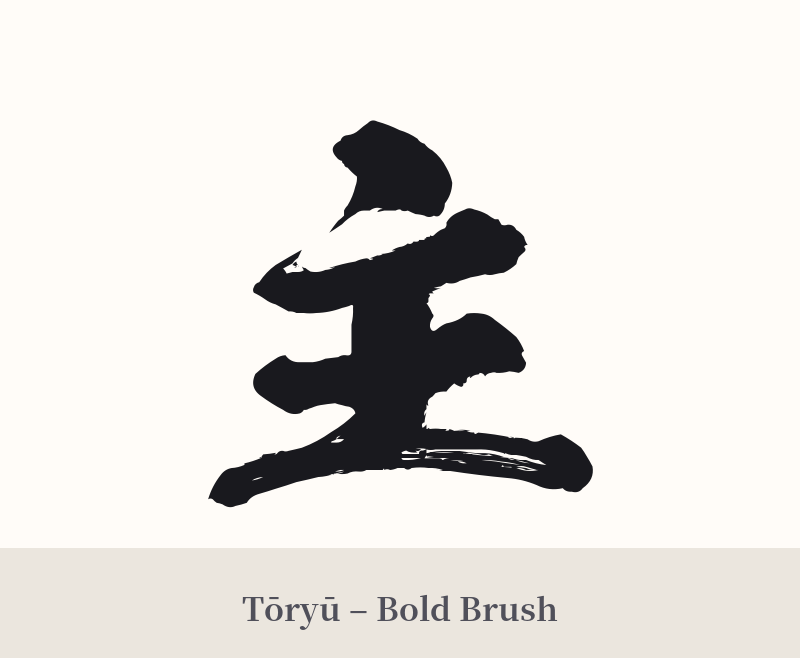
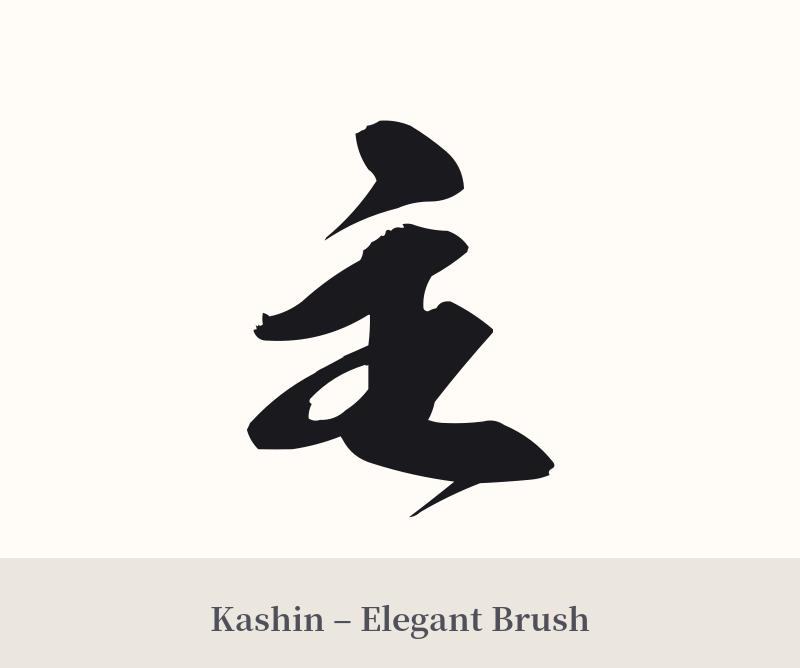
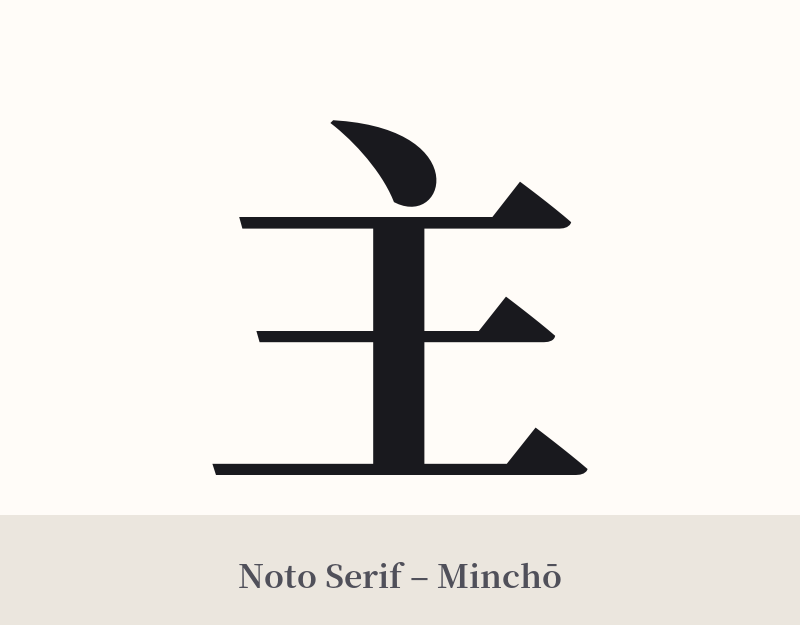
🎨 Tattoo Suitability
📐 Tattoo Design Guide
The simple, balanced structure of 主 lends itself to a variety of design approaches. Its clean lines and minimal strokes make it versatile for placement.
– Placement: For a personal and central meaning, consider the chest over the heart or the center of the back. The forearm or the back of the neck are also strong choices that emphasize its role as a guiding principle.
– Font Style: A minimalist, serif font like Mincho will highlight its elegance and traditional roots. For a more modern and bold statement, a clean Gothic-style font works well. To add energy and dynamism to its simple form, an expressive calligraphy script like Gyosho (semi-cursive) is an excellent choice.
– Visual Tips: Because of its origin as a lampstand, consider a design that subtly incorporates a flame or a point of light above the character. This adds a unique layer of meaning and connects the design to its ancient roots. The simplicity of the character means it can be rendered small without losing legibility, but a larger, bolder execution gives it a powerful sense of authority.
Comments