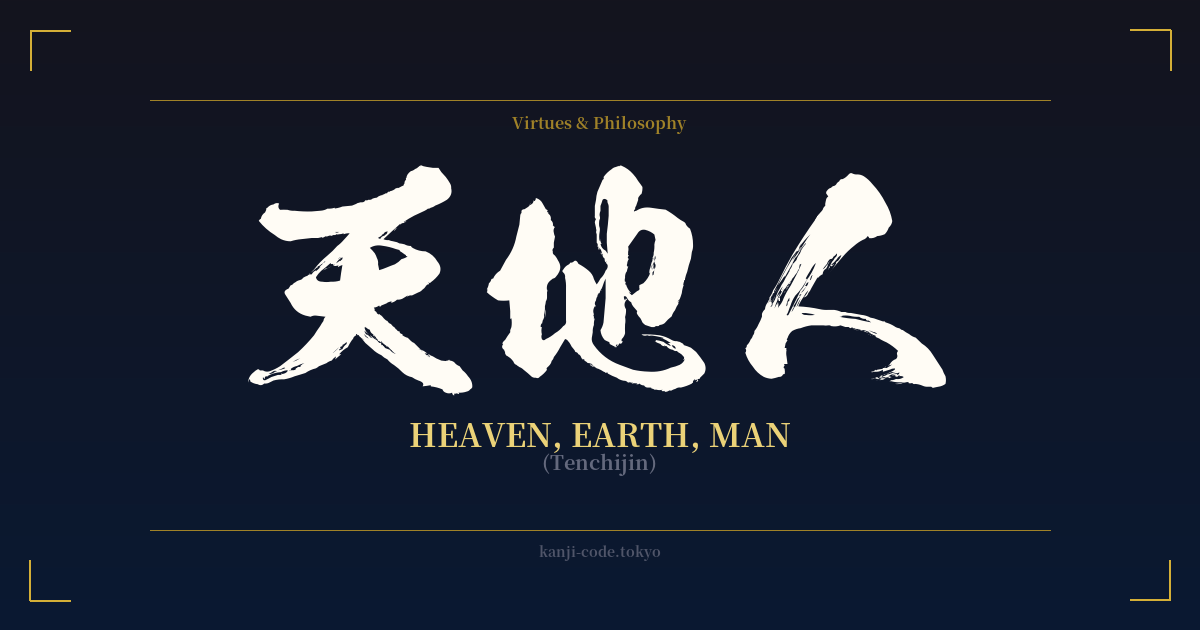
✍️ 天地人 (Tenchijin) — Cultural Context
天地人 (Tenchijin) is a profound and ancient concept in East Asian philosophy, representing the three fundamental realms of the cosmos: Heaven, Earth, and Humanity. It's not merely a list of three things but a holistic worldview that encapsulates the interconnectedness of existence. This idea, known as the 'Three Powers' (三才, Sansai), originates from classical Chinese thought and was deeply integrated into Japanese culture, influencing everything from martial arts to strategic thinking and art.
At its core, Tenchijin describes a universal order. 天 (Ten) represents the celestial realm—the sky, fate, divine principles, and the intangible forces that govern the universe. It is the source of time, weather, and cosmic law. 地 (Chi) is the terrestrial realm—the earth, the ground, nature, and the physical world we inhabit. It provides the foundation, resources, and environment for life to flourish.
人 (Jin), humanity, is positioned as the crucial link between these two realms. Humans are not seen as separate from nature but as an integral part of this cosmic trinity. We receive the will of Heaven while being sustained by the bounty of Earth. In this view, humanity has a unique role and responsibility: to live in harmony with the natural and celestial orders, to cultivate wisdom, and to create a just society. To understand Tenchijin is to understand one's place in the universe.
This philosophy is deeply embedded in Japanese martial arts. Many schools of Budo use Tenchijin as a foundational principle for strategy and movement. For a warrior, 'Ten' could mean understanding timing and weather; 'Chi' could mean knowing the terrain; and 'Jin' represents understanding human nature, both in oneself and the opponent. Achieving victory meant harmonizing these three elements.
The concept was famously highlighted in the NHK Taiga drama "Tenchijin," which chronicled the life of the 16th-century samurai Naoe Kanetsugu. His story was framed through the lens of this philosophy, showcasing how a leader must balance righteousness (a heavenly principle), care for the land and its people (an earthly duty), and wisdom in human affairs. This brought the ancient philosophy to a modern audience, cementing its place in the popular imagination as a powerful code of conduct.
🖌️ Font Styles for 天地人
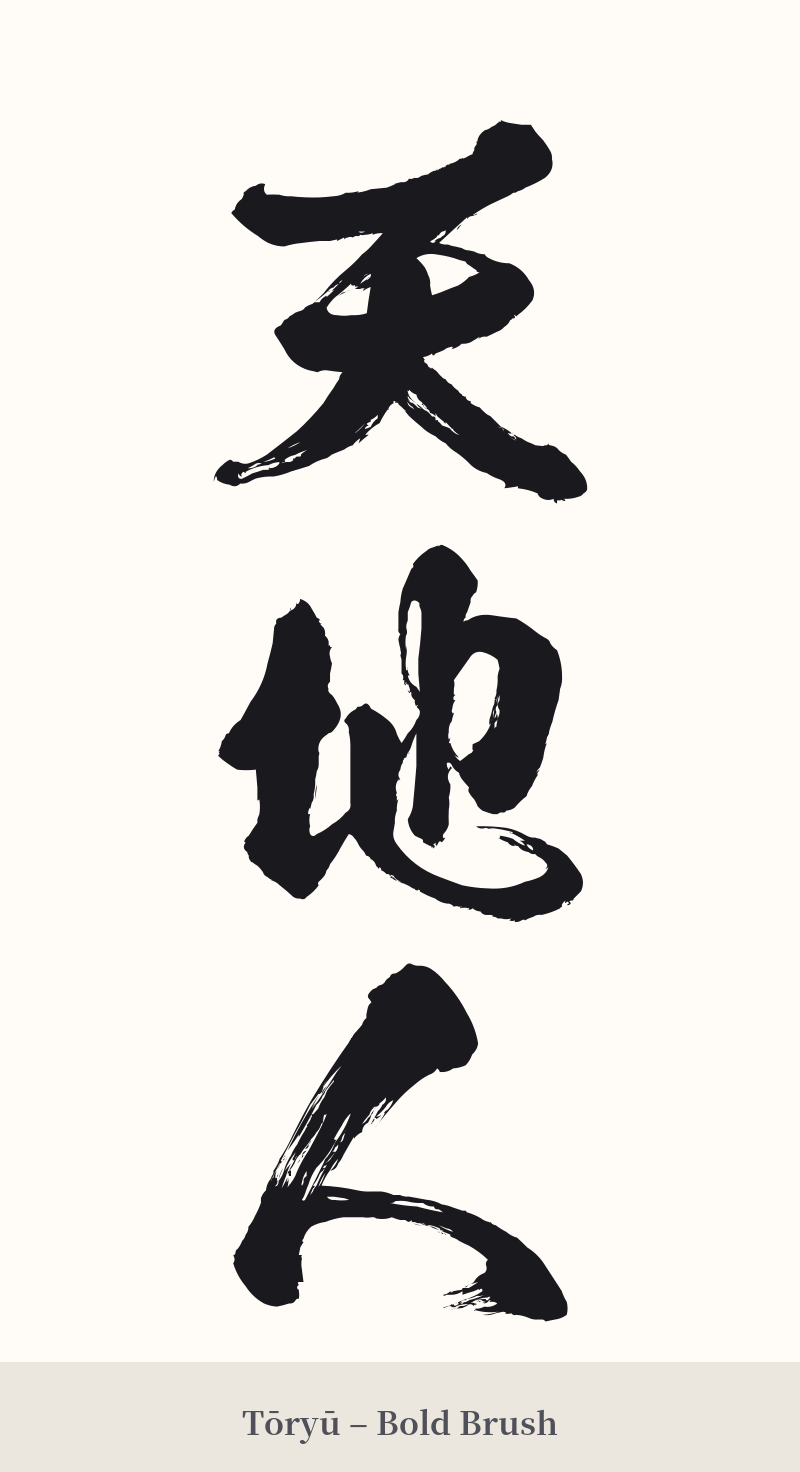
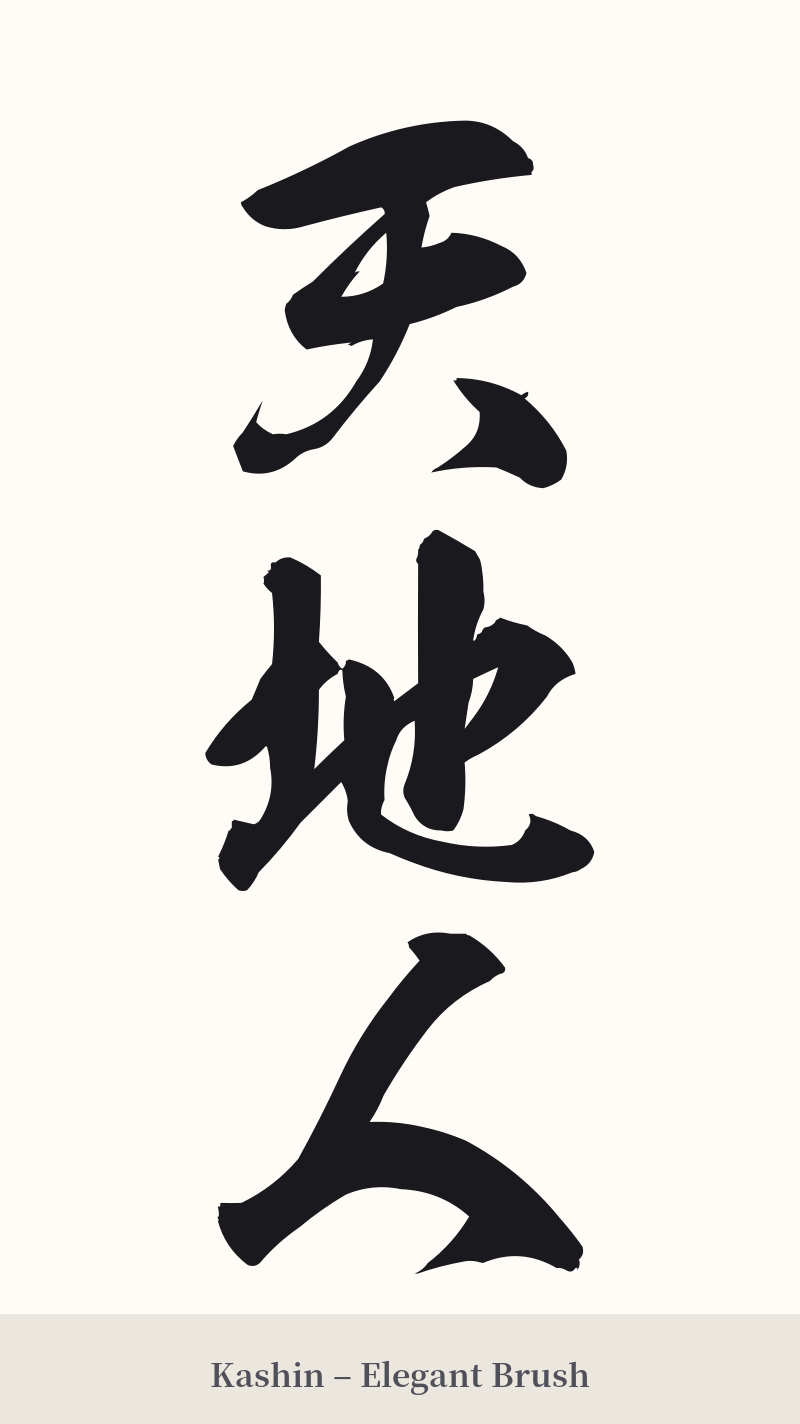
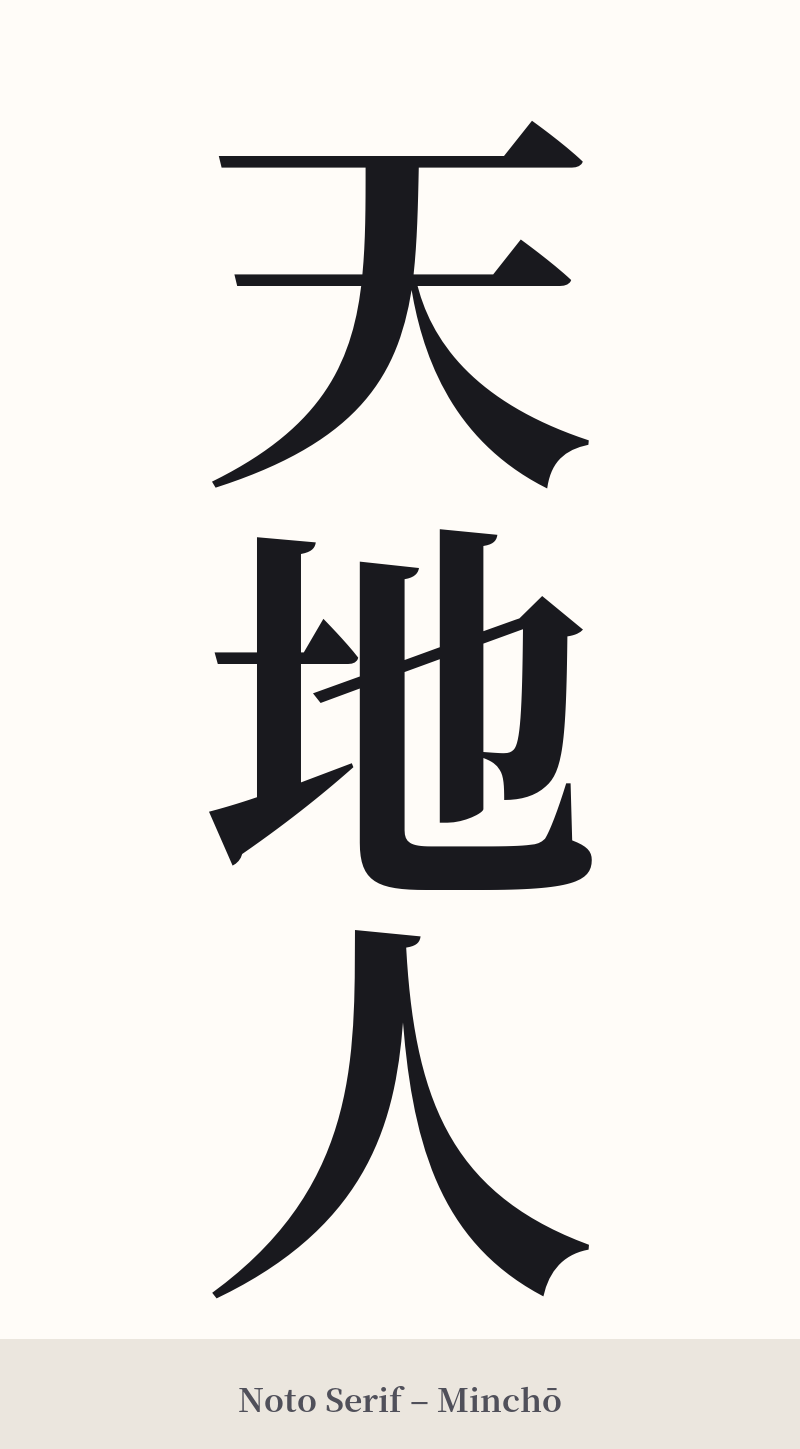
The same kanji can look dramatically different depending on the calligraphy style. Choose a font that matches the mood you want for your tattoo or design.
🎨 Tattoo Suitability
📐 Tattoo Design Guide
A 天地人 tattoo is a statement of philosophical depth, and its design should reflect that. The arrangement is almost universally vertical to represent the hierarchy from the heavens down to humanity.
– Placement: A vertical orientation is essential. The spine is a powerful and symbolic choice, tracing the central axis of the body. The forearm (inner or outer) or the side of the calf also provides a great canvas for a vertical script.
– Font Style: The choice of font dramatically affects the feel. For a strong, clear, and timeless look, a standard block script (Kaisho) is perfect. For a more artistic and dynamic feel, a semi-cursive (Gyosho) or fully cursive (Sosho) calligraphic style can capture the flow and interconnectedness of the three elements.
– Visual Tips: Let the characters speak for themselves. This is a concept where simplicity is key. Avoid adding extra elements like dragons or clouds, which can detract from the profound statement of the kanji alone. The beauty of Tenchijin lies in its minimalist and complete representation of the cosmos.
Comments