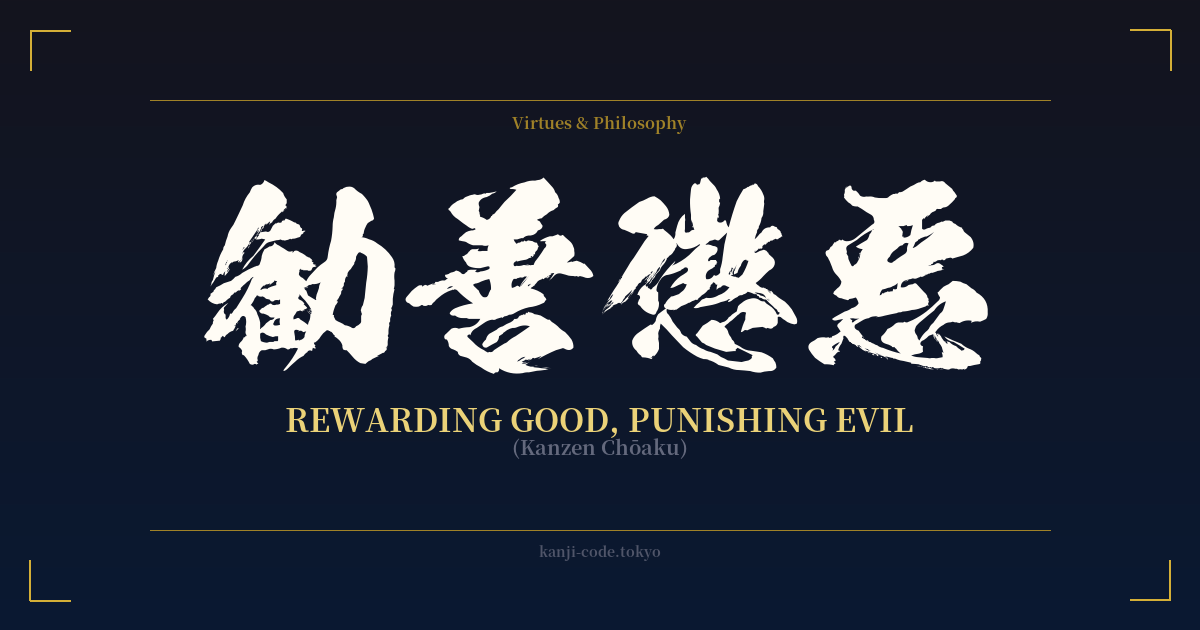
✍️ 勧善懲悪 (Kanzen Chōaku) — Cultural Context
Kanzen Chōaku is a four-character idiom (yojijukugo) that encapsulates a cornerstone of traditional Japanese narrative and morality: the principle that good deeds should be rewarded and evil deeds must be punished. It is the Japanese equivalent of poetic justice, a deeply satisfying and culturally ingrained concept that has shaped storytelling for centuries.
While its philosophical roots can be traced to Confucian and Buddhist teachings from mainland Asia, Kanzen Chōaku has been thoroughly assimilated into the fabric of Japanese culture. It serves as the moral engine for countless stories, from folk tales told to children to the high drama of kabuki theater. The structure is simple and powerful: a virtuous hero suffers at the hands of a corrupt villain, but through perseverance and moral fortitude, the hero ultimately triumphs, and the villain receives their just deserts.
Perhaps the most famous embodiment of Kanzen Chōaku in popular culture is the long-running television series 'Mito Kōmon.' Each episode follows the shogun's retired vice-chancellor who travels the land disguised as a commoner. He witnesses injustice, gathers evidence against corrupt officials, and in the climactic final scene, reveals his true identity by flashing his 'inrō' (a lacquered case bearing the Tokugawa crest). The villains, suddenly faced with the ultimate authority, are brought to justice. This predictable yet immensely satisfying conclusion is the very essence of Kanzen Chōaku.
This principle isn't limited to period dramas (jidaigeki). It forms the narrative backbone of many modern manga and anime, where heroes fight against overwhelming evil, fueled by a righteous sense of justice. It speaks to a fundamental human desire to see order restored and for morality to be a guiding force in the universe.
However, it's also important to understand that Kanzen Chōaku represents a clear, black-and-white worldview. It stands in contrast to other Japanese aesthetic and philosophical concepts like 'mono no aware' (the pathos of things), which finds beauty in ambiguity and impermanence. Kanzen Chōaku is didactic; it's meant to teach a clear lesson. For this reason, while universally understood, some in modern Japan might see it as a slightly simplistic or old-fashioned ideal, a moral compass for a bygone era of samurai and shoguns.
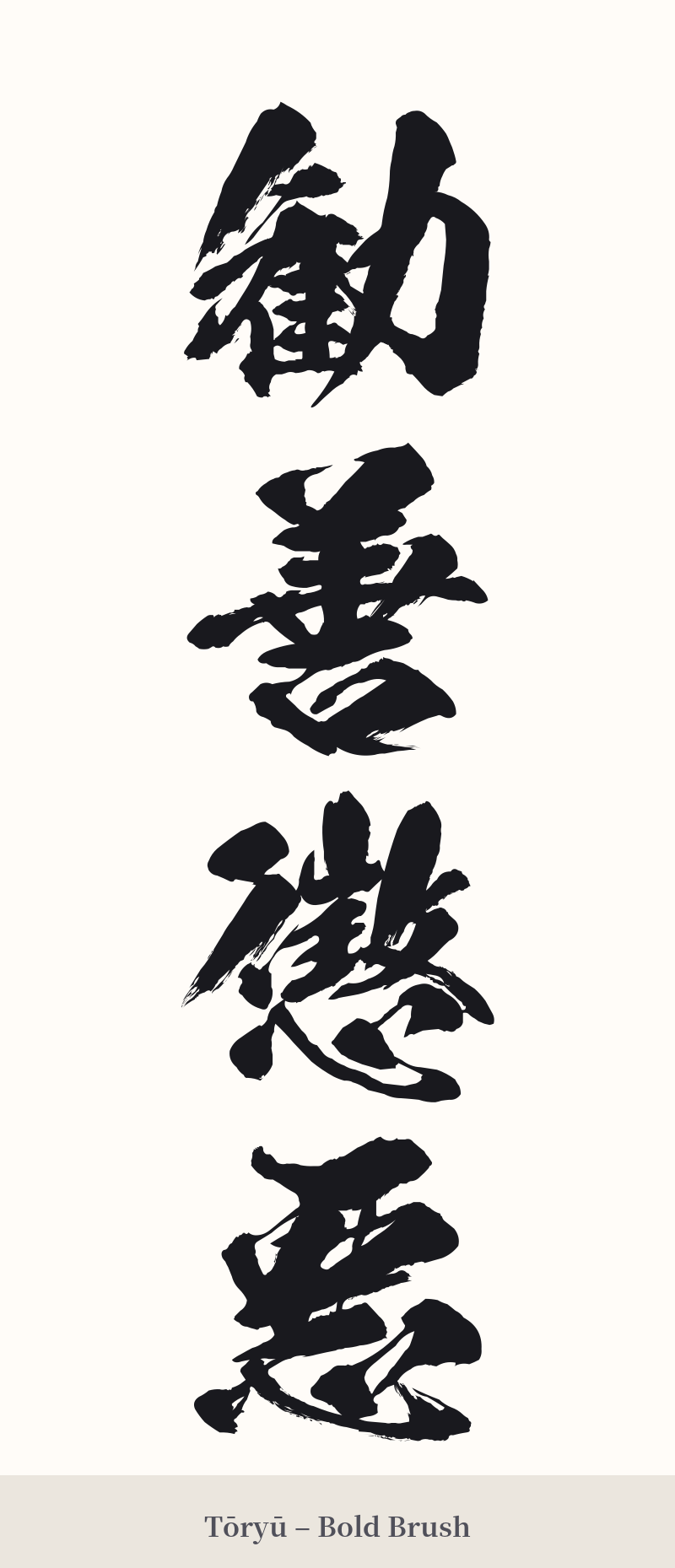
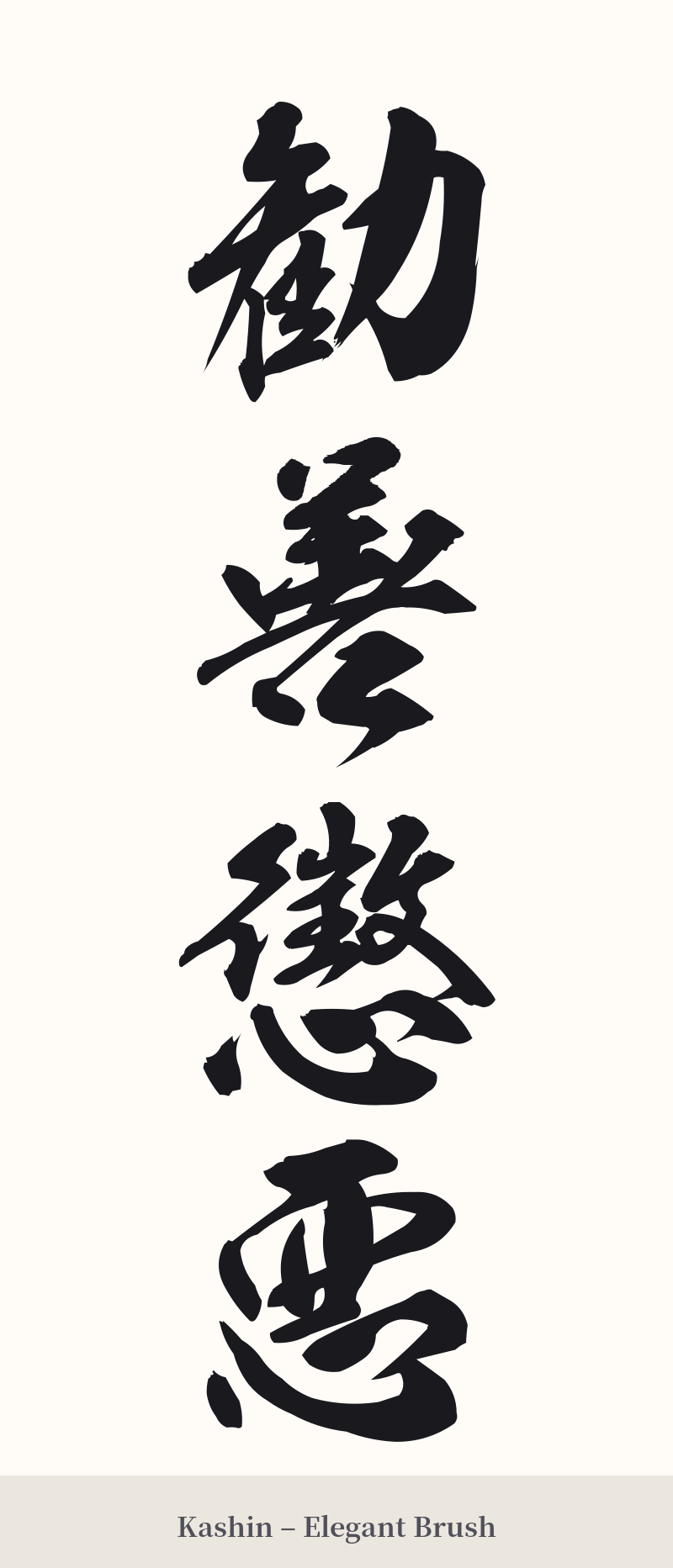
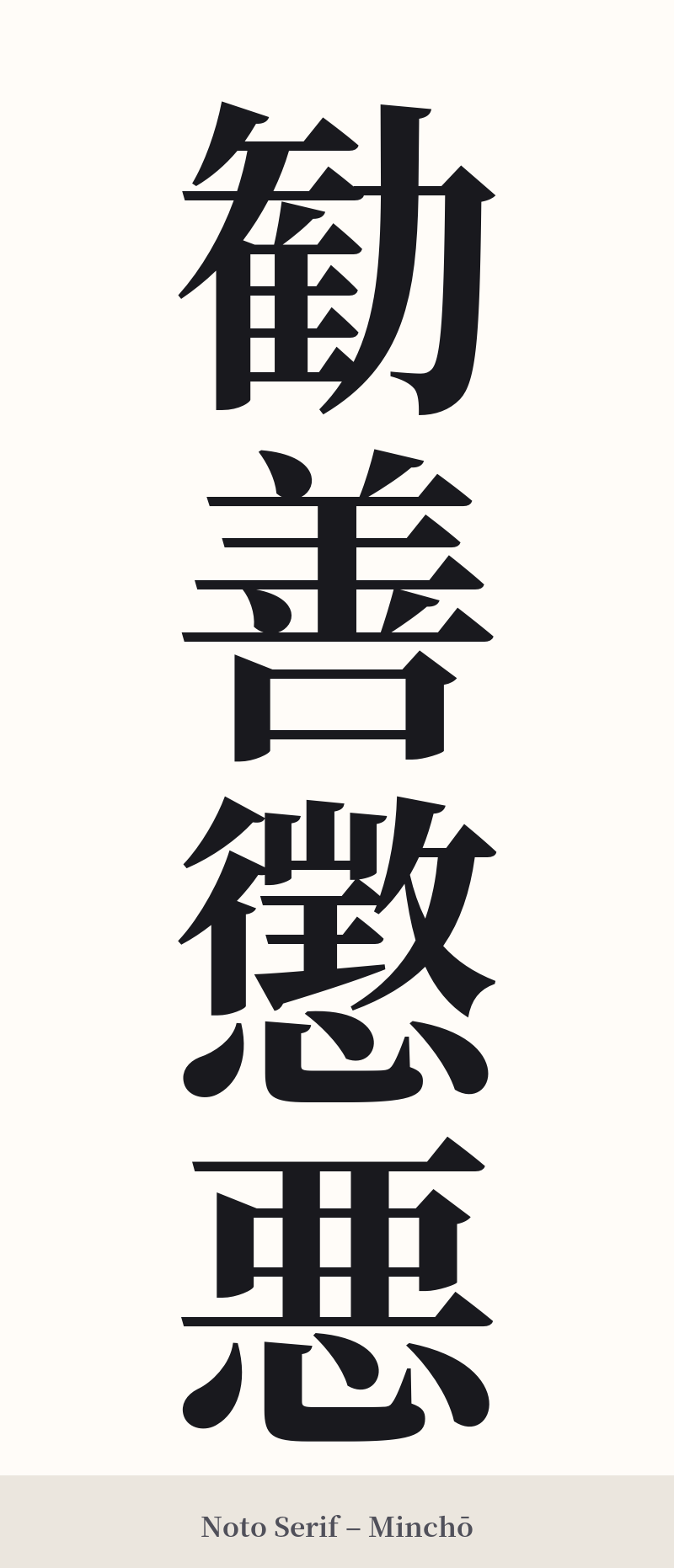
🖌️ Font Styles for 勧善懲悪
The same kanji can look dramatically different depending on the calligraphy style. Choose a font that matches the mood you want for your tattoo or design.
🎨 Tattoo Suitability
📐 Tattoo Design Guide
The vertical orientation is paramount for a four-character idiom like Kanzen Chōaku. It honors the traditional Japanese writing style and creates a powerful pillar of text. Ideal placements include the spine, the length of the forearm, or down the calf, as these areas provide the necessary vertical space.
– Font Style: A bold, clear script is highly recommended. Kaishotai (standard block script) is an excellent choice, conveying strength and clarity. For a more artistic and classic feel, Gyōshotai (semi-cursive script) can add flow, but ensure the artist is skilled in Japanese calligraphy to maintain legibility.
– Size and Detail: Do not get this tattoo small. The character 懲 (chō) alone contains 18 strokes. To ensure the design ages well and remains readable, it must be large enough for each stroke to have its own space. A skilled artist will understand how to manage ink spread over time.
– Visual Balance: The four characters should be evenly spaced and sized to create a single, unified column. Avoid adding extraneous elements; the power of this phrase lies in its stark, textual presentation. The meaning is the art.
Comments