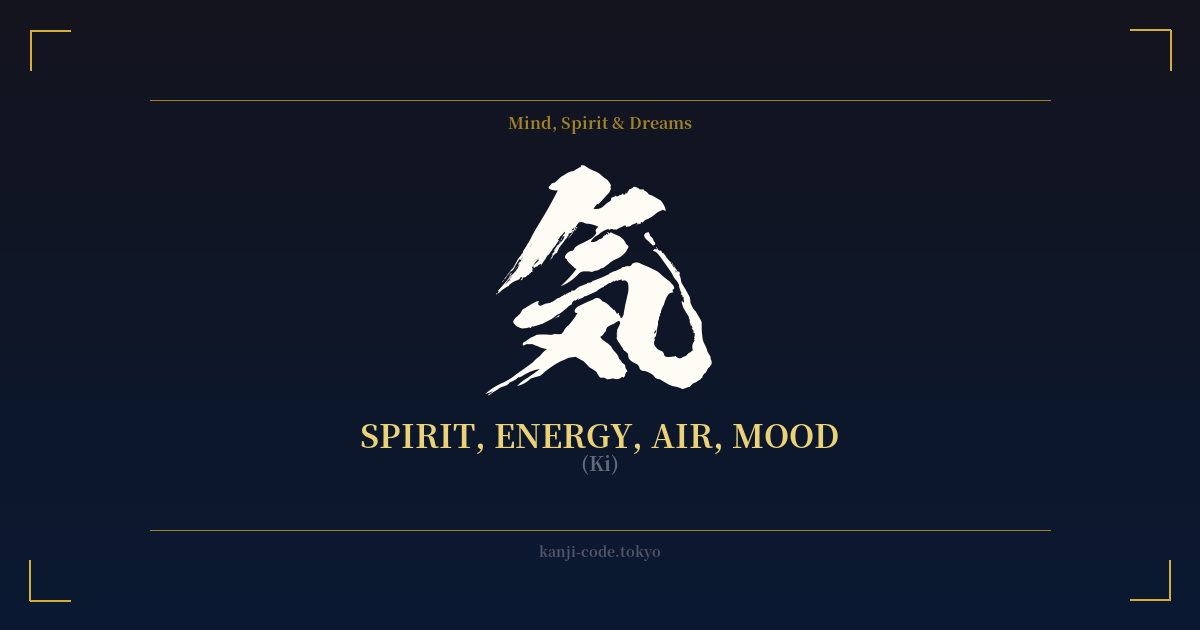
✍️ 気 (Ki) — Cultural Context
The kanji 気 (Ki) is one of the most profound and ubiquitous characters in the Japanese language, representing a concept so fundamental it defies simple translation. At its core, Ki is the life force, the universal energy that animates all things. It is the Japanese equivalent of the Chinese 'Qi,' the Indian 'Prana,' and the ancient Greek 'Pneuma'—an invisible, flowing power that connects the mind, body, and spirit.
The origin of the character itself offers a beautiful insight into its meaning. The older form of the kanji, 氣, is a pictograph of steam (气) rising from cooking rice (米). This image perfectly captures the essence of Ki: a nourishing, essential energy being released. It is both sustenance and spirit, something tangible yet ethereal.
In Japanese philosophy and spirituality, Ki is the bedrock of existence. It permeates everything, from the atmosphere to the human body. A healthy person is said to have good Ki, or 'Genki' (元気), which literally translates to 'original spirit.' Sickness, conversely, is 'Byōki' (病気), or a 'sick spirit,' implying a disruption or imbalance in one's Ki.
This concept is perhaps most famously expressed in Japanese martial arts. In Aikido (合気道), 'The Way of Harmonizing Energy,' practitioners learn to blend with an opponent's Ki rather than clashing with it. The 'Kiai' (気合), a spirited shout used in many martial arts like Karate, is not just a yell; it's a focused projection of one's internal Ki to overwhelm an opponent or center oneself.
The influence of Ki extends deep into everyday language and thought. 'Kimochi' (気持ち) means 'feeling,' but its characters mean 'holding Ki.' The weather is 'Tenki' (天気), or 'heaven's Ki.' To be concerned about something is 'Ki ni naru' (気になる), to 'become Ki.' To pay attention is 'Ki o tsukeru' (気をつける), to 'attach Ki.' These expressions show how deeply the state of one's spirit is woven into the fabric of daily life and perception.
From the healing art of Reiki (霊気, 'spiritual energy') to the simple act of breathing deeply to calm oneself, the principle of cultivating and balancing Ki is a cornerstone of Japanese well-being. It is not just an abstract idea but a lived reality, a constant flow of energy that one can learn to sense, nurture, and direct.
🖌️ Font Styles for 気
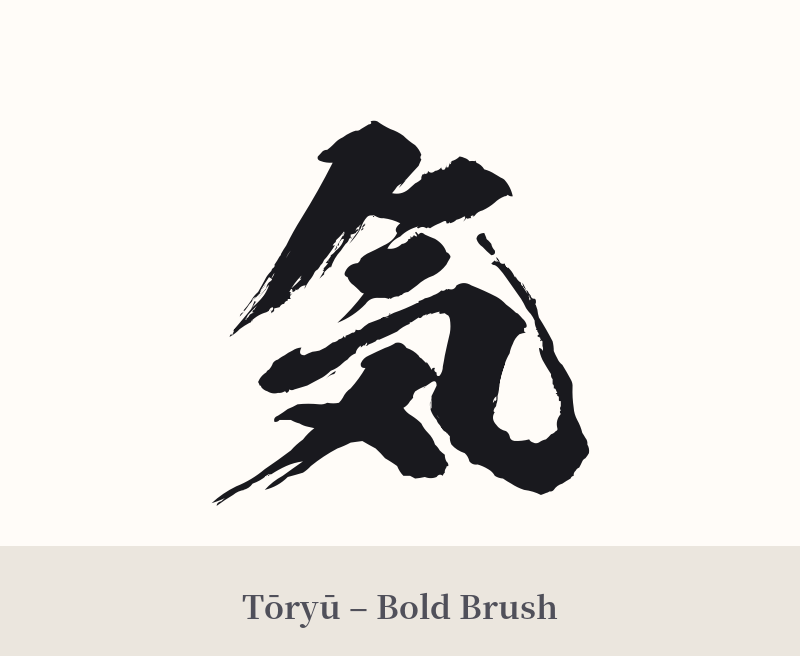
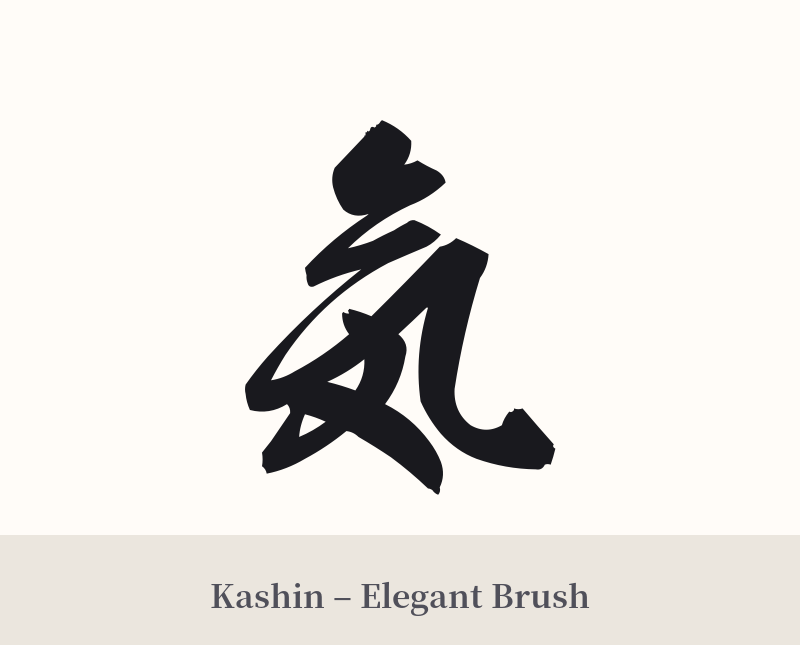
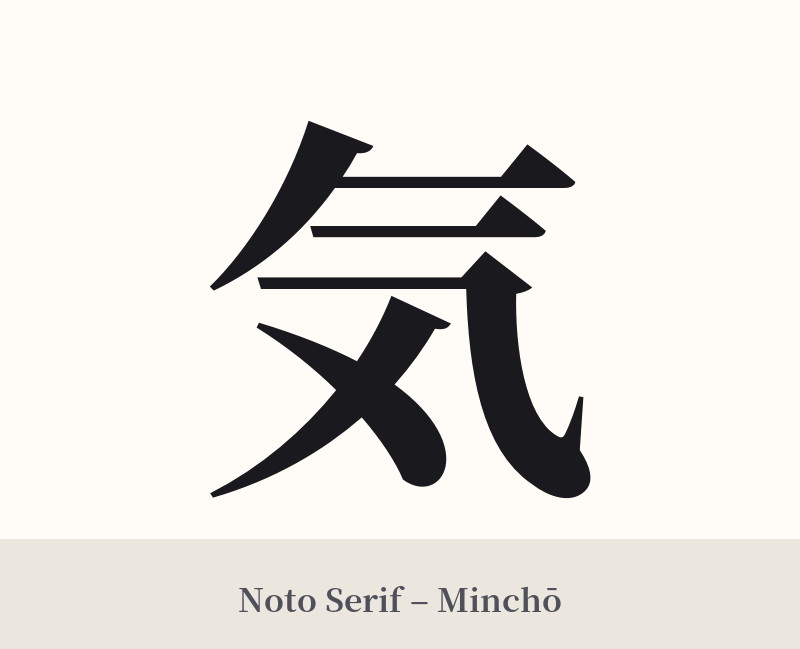
The same kanji can look dramatically different depending on the calligraphy style. Choose a font that matches the mood you want for your tattoo or design.
🎨 Tattoo Suitability
📐 Tattoo Design Guide
The kanji 気 is versatile and its design should reflect the specific nuance you wish to convey—be it power, flow, or tranquility.
– Placement: For a sense of personal energy, consider places that align with the body's core or flow, such as the chest, back of the neck, forearm, or calf. The wrist is a popular spot for a smaller, more subtle design.
– Font Style: A dynamic, flowing calligraphy style like Gyosho (semi-cursive) or Sosho (cursive) can beautifully capture the feeling of moving energy. For a statement of strength and stability, a bold, clean Kaisho (block script) or a powerful brushstroke font works exceptionally well.
– Visual Tips: While 気 is powerful on its own, it can be integrated with other elements. Pairing it with an Enso circle (Zen circle of enlightenment) can frame it within a larger spiritual context. Incorporating subtle wind bars, water ripples, or smoke-like wisps can visually represent the 'flow' of energy that the character embodies.
Comments