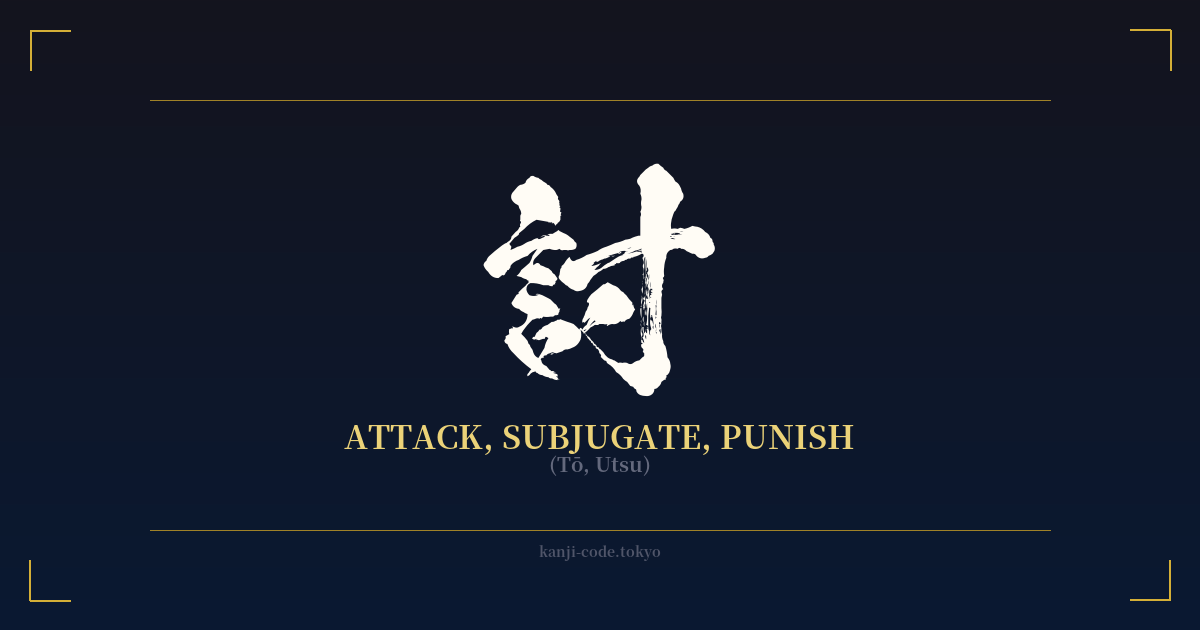
✍️ 討 (Tō, Utsu) — Cultural Context
The kanji 討 (tō) is a character steeped in the history of conflict, justice, and retribution in Japan. Its meaning goes far beyond a simple 'attack'; it carries the heavy nuance of a punitive strike, a righteous subjugation, or a justified act of punishment against those who have transgressed.
The character's construction offers a clue to its origin. It is composed of the radicals 言 (gon), meaning 'word' or 'speech,' and 寸 (sun), meaning 'measure' or 'inch,' which originally depicted a hand. This combination suggests a formal declaration or decree (言) being carried out by force of hand (寸), implying a planned and authorized action, not a chaotic brawl.
This concept was central to the world of the samurai. A key term is 討伐 (tōbatsu), which translates to a 'punitive expedition' or 'subjugation.' This was not just a war, but a formal campaign sanctioned by a higher authority—like the Shogun or a powerful daimyo—to quell a rebellion, defeat a rival clan, or punish an enemy of the state. The act was framed as a restoration of order and justice, with 討 at its heart.
Perhaps the most famous cultural touchstone for 討 is 仇討ち (adauchi), the act of vendetta or revenge. During the Edo period, this was a complex social institution. If a samurai's lord or parent was unjustly killed, they had a right, and often a duty, to avenge them. The story of the Forty-seven Rōnin is the ultimate tale of 仇討ち, where the loyal retainers carry out a raid (討ち入り, uchiiri) to kill the official who caused their master's death. Their act was seen as a righteous fulfillment of their duty, embodying the spirit of 討.
Compared to other kanji for 'attack' like 攻 (kō, offense) or 撃 (geki, strike), 討 is unique. While 攻 might be used in sports or general strategy, and 撃 describes the physical act of striking, 討 almost always implies a moral or legal justification for the violence. It's the difference between a skirmish and an execution of a sentence.
In modern Japanese, the character retains some of this confrontational spirit in a metaphorical sense. The word 検討 (kentō) means 'examination' or 'consideration,' as if one is 'attacking' a problem with scrutiny. Similarly, 討論 (tōron) means 'debate,' where participants 'attack' each other's arguments with words. This evolution shows how the core idea of a focused, purposeful strike has adapted over time.
🖌️ Font Styles for 討
The same kanji can look dramatically different depending on the calligraphy style. Choose a font that matches the mood you want for your tattoo or design.
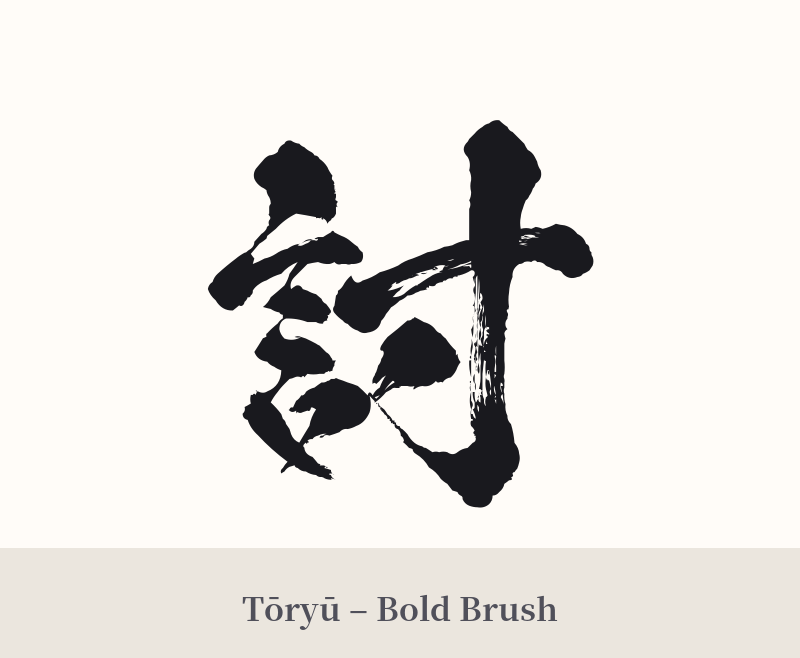
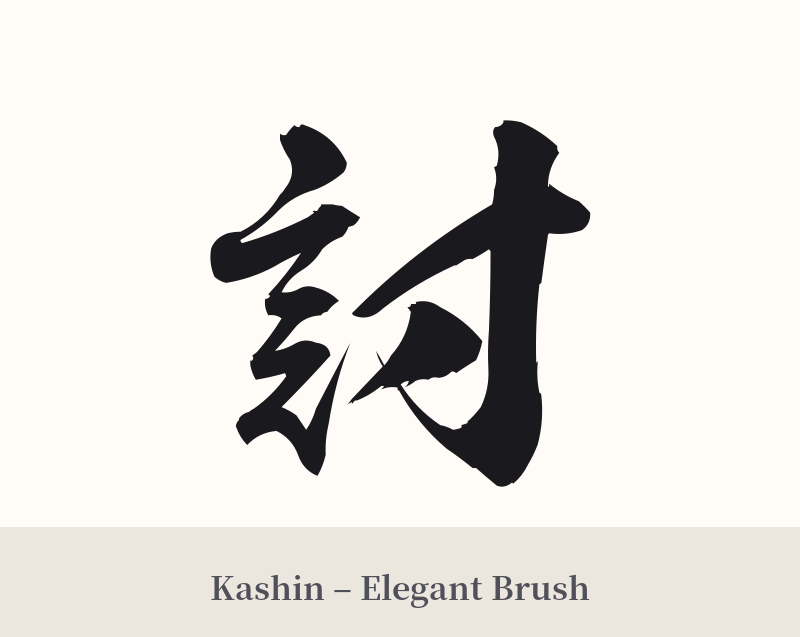
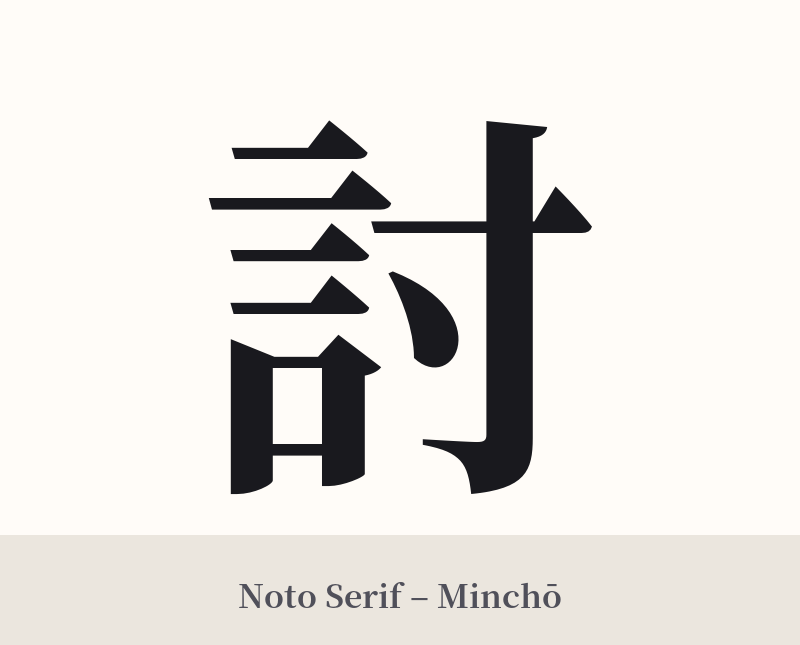
🎨 Tattoo Suitability
📐 Tattoo Design Guide
The kanji 討 carries an air of authority and action, which can be reflected in its design.
– Placement: This character works well in vertical orientations. Consider the forearm, the calf, or along the spine. For a more prominent piece, the back of the shoulder or chest provides a solid canvas.
– Font Style: A bold, sharp Kaisho (block script) style can emphasize the kanji's formal, punitive nature. For a more dynamic and fluid feel that captures the 'action' of the strike, a Gyosho (semi-cursive) or even a dramatic Sosho (cursive) script would be highly effective.
– Visual Elements: While 討 is strong enough to stand alone, it can be paired with symbolic imagery. Consider combining it with elements from the 47 Rōnin story, like a specific family crest (mon) or a motif of snow. It could also be integrated into a larger design featuring a samurai warrior or a dragon to amplify its powerful, martial theme.
Comments