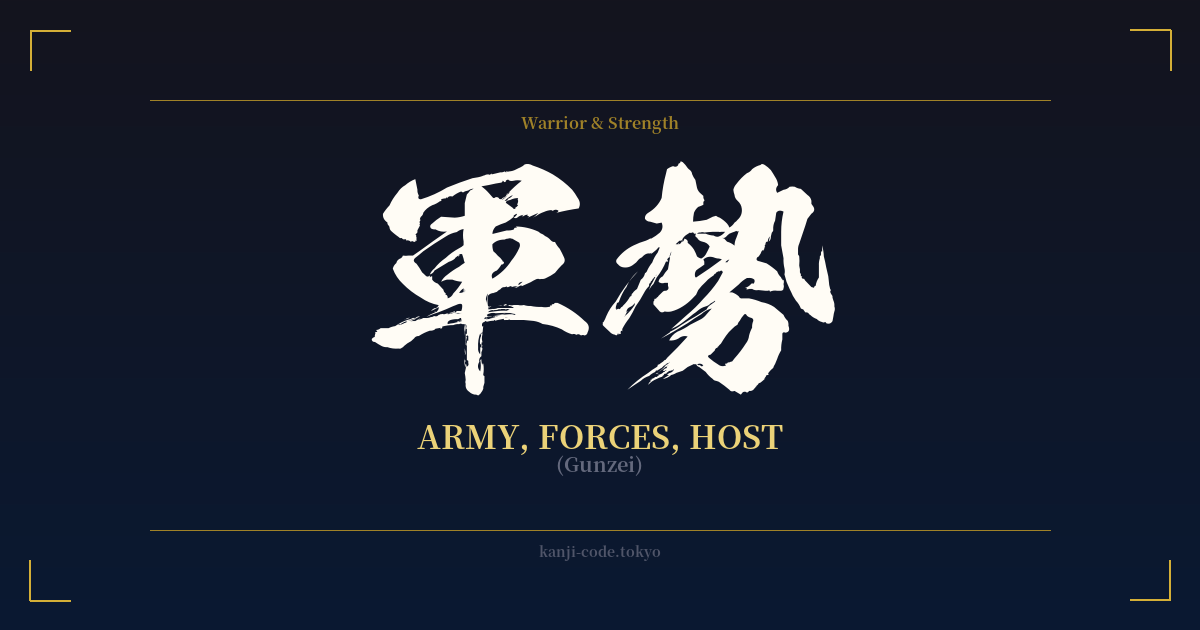
✍️ 軍勢 (Gunzei) — Cultural Context
軍勢 (Gunzei) translates to 'army,' 'forces,' or 'a host of troops.' While the direct meaning is straightforward, the word is deeply embedded in the historical and cultural tapestry of Japan, particularly the age of the samurai.
This term isn't just a clinical count of soldiers; it carries the weight and momentum of a massive, organized force on the move. The second character, 勢 (sei), is key here. It means 'power,' 'energy,' and 'momentum.' Therefore, Gunzei doesn't just mean 'army'—it implies an army with impetus, a powerful current of warriors sweeping across a battlefield. It conjures vivid imagery from Japanese history, especially the Sengoku period (Warring States period, c. 1467–1615), a century of near-constant civil war.
Imagine the great armies of daimyō (feudal lords) like Oda Nobunaga, Toyotomi Hideyoshi, or Tokugawa Ieyasu clashing at legendary battles like Sekigahara. The sight of thousands of soldiers—samurai cavalry and ashigaru foot soldiers—marching under colorful banners (sashimono and nobori) is the very essence of Gunzei. It represents not just the physical bodies, but the collective will, discipline, and strategic intent of a unified military power.
In modern Japanese, Gunzei is less common in everyday conversation and is largely reserved for historical contexts, literature, or metaphorical use. You'll frequently encounter it in historical dramas (taiga), movies by Akira Kurosawa like 'Kagemusha' and 'Ran,' and video games such as the 'Samurai Warriors' or 'Total War: Shogun' series. In these contexts, it perfectly captures the epic scale of feudal warfare.
Metaphorically, it can describe any large, powerful group moving with a single purpose. One might speak of a 'gunzei' of fans rushing a stadium or a 'gunzei' of shoppers on Black Friday, though this usage is more poetic. The core feeling remains: a formidable, unstoppable collective force. This connection to strategy, history, and overwhelming power makes it a compelling term that resonates far beyond its simple definition.
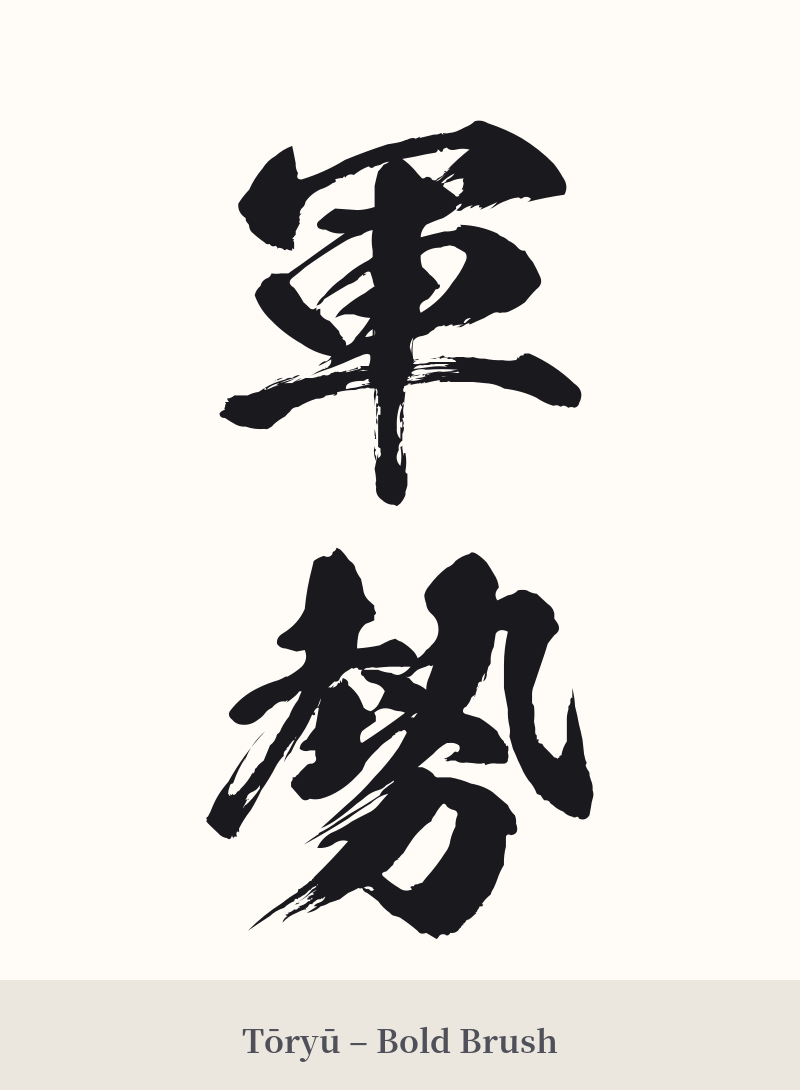
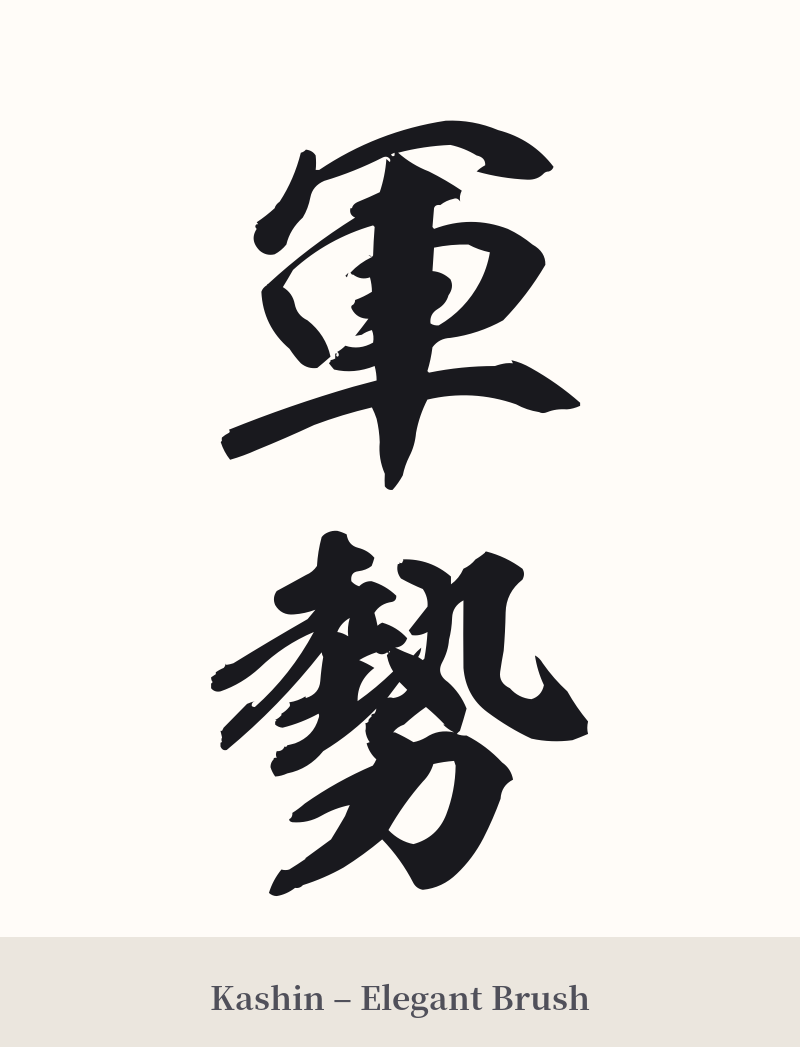
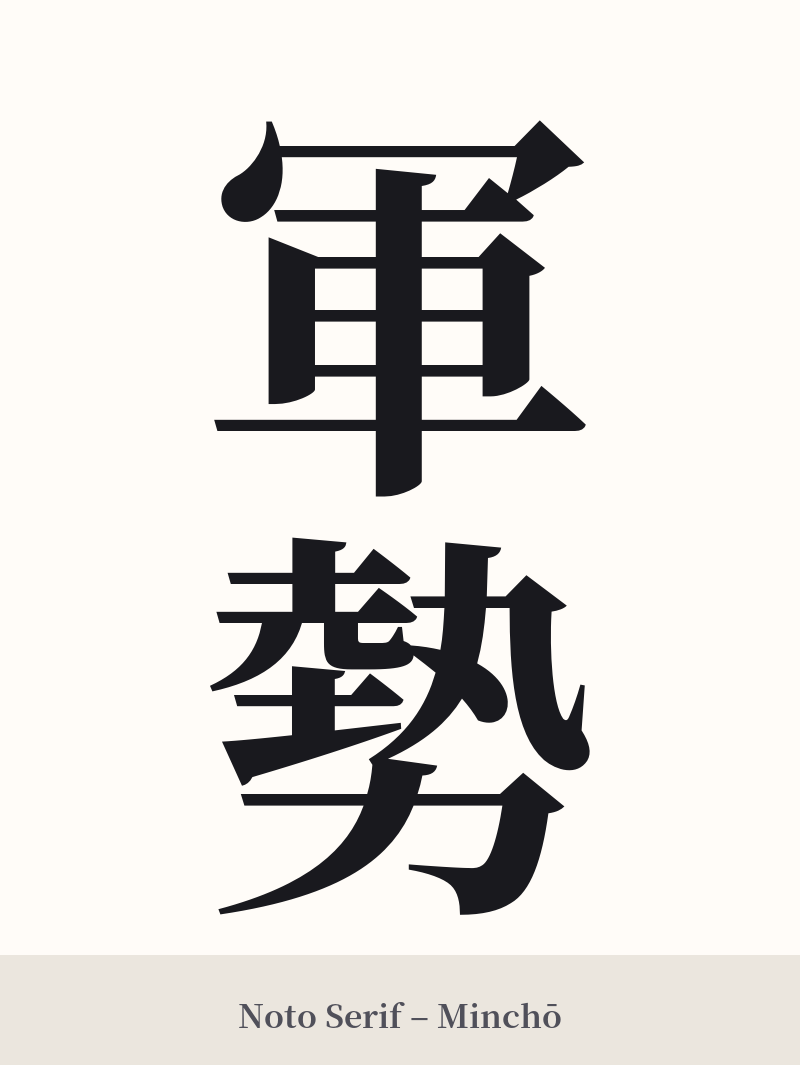
🖌️ Font Styles for 軍勢
The same kanji can look dramatically different depending on the calligraphy style. Choose a font that matches the mood you want for your tattoo or design.
🎨 Tattoo Suitability
📐 Tattoo Design Guide
When designing a tattoo for 軍勢, the goal is to convey strength and momentum. The two characters work well together both vertically and horizontally.
– Placement: For a vertical arrangement, the spine, forearm, or calf are excellent choices. For a horizontal layout, the chest, upper back, or across the back of the shoulders works well. Ensure the placement allows for sufficient size to maintain the detail in the character 勢.
– Font Style: A bold, angular script like Kaisho (block script) emphasizes the order, discipline, and power of an army. Alternatively, a more fluid, semi-cursive style like Gyosho can capture the 'momentum' and 'energy' (勢) of a force in motion, as if written with a swift brushstroke.
– Visual Tips: Consider incorporating a related visual element. A subtle background of wind bars or dust clouds can enhance the feeling of movement. Placing the kanji near or within a Kamon (family crest) of a famous samurai clan could also add a layer of historical significance.
Comments