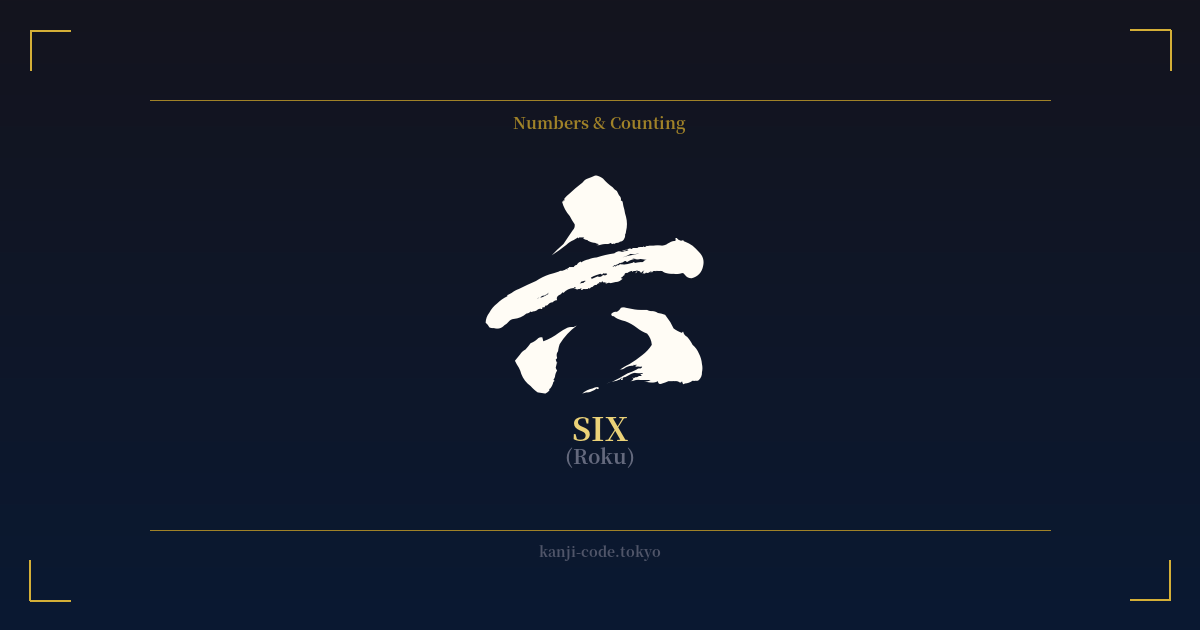
✍️ 六 (Roku) — Cultural Context
The kanji 六 (Roku) is the Japanese character for the number six. Its form is simple, composed of just four strokes, and its primary meaning is straightforwardly numerical. While its ancient pictographic origins are debated, with some theories suggesting it represented a small hut, today it functions exclusively as a numeral, devoid of its original imagery.
In everyday Japanese, you'll encounter 六 in various contexts, from counting objects (六つ, muttsu) to telling time and dates. The most common pronunciation is the Sino-Japanese reading 'roku,' used in compound words and for simple counting. The district of Roppongi (六本木) in Tokyo famously translates to 'Six Trees,' named for six zelkova trees that once marked the area.
Unlike the numbers four (四, shi), which sounds like 'death' (死), and nine (九, ku), which sounds like 'suffering' (苦), the number six holds no strong superstitious connotations of being either lucky or unlucky in Japan. It is a neutral, functional number.
However, the true cultural depth of 六 emerges from its significance in Buddhism, which has profoundly shaped Japanese thought. The number six is central to several core Buddhist concepts. Perhaps the most well-known is the Rokudō (六道), the 'Six Realms of Rebirth.' These are the six states of existence into which a being can be reborn, dictated by their accumulated karma: the realms of heavenly beings (Deva), demigods (Asura), humans, animals, hungry ghosts (Preta), and hell (Naraka). This concept is a cornerstone of Buddhist cosmology and a powerful reminder of the cycle of life, death, and rebirth (samsara).
Furthermore, Buddhism speaks of the Rokkon (六根), the 'Six Senses' or 'Six Roots of Perception': sight, hearing, smell, taste, touch, and mind (consciousness). The phrase Rokkon Shōjō (六根清浄) refers to the 'purification of the six senses,' a spiritual goal to cleanse oneself of worldly delusions and desires to achieve clarity and enlightenment.
Thus, while 六 begins as a simple number, it opens a door to profound philosophical and spiritual ideas within Japanese culture. It represents the structure of the cosmos, the nature of human perception, and the path toward spiritual awakening. It is a number that is both mundane and metaphysical, grounding daily life in a much larger cosmic framework.
🖌️ Font Styles for 六
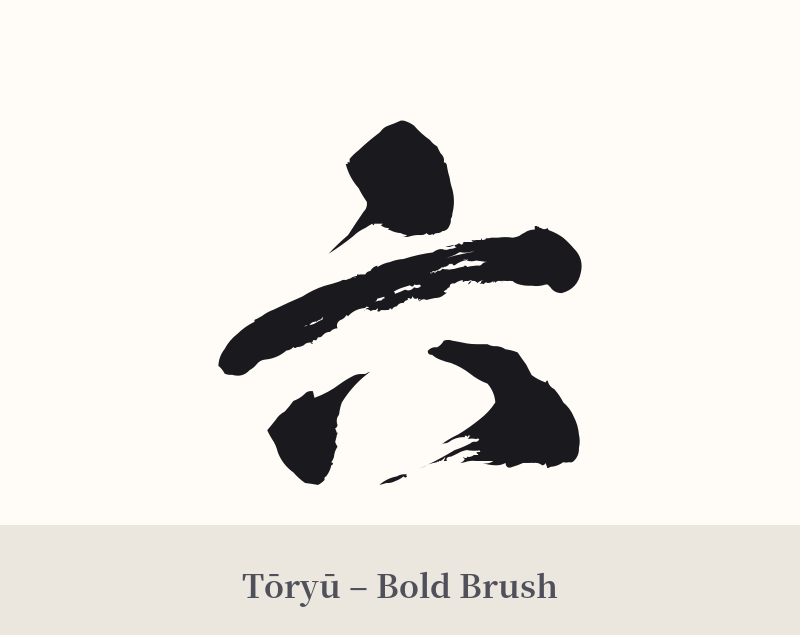
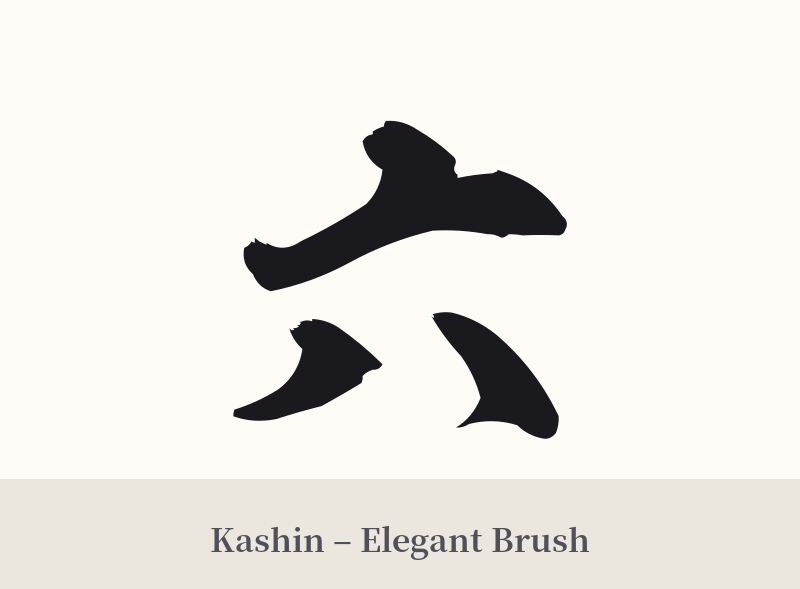
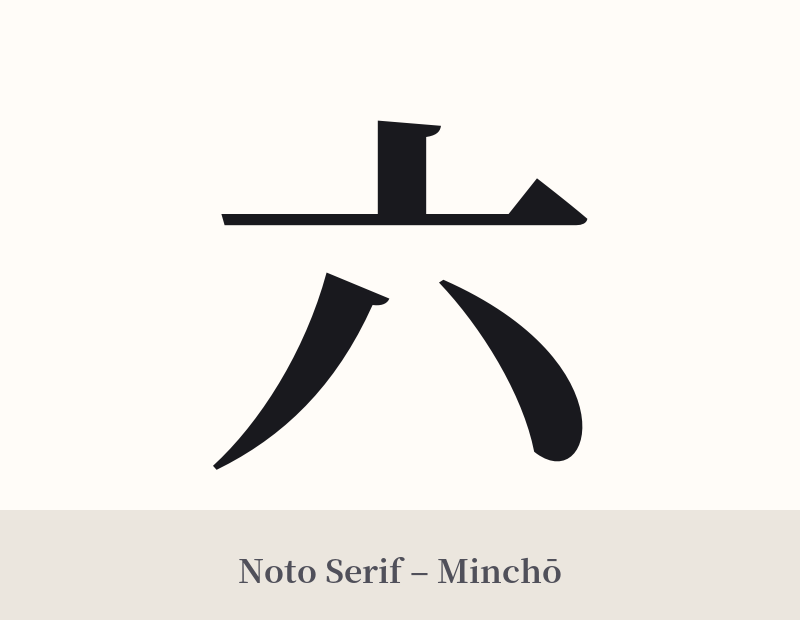
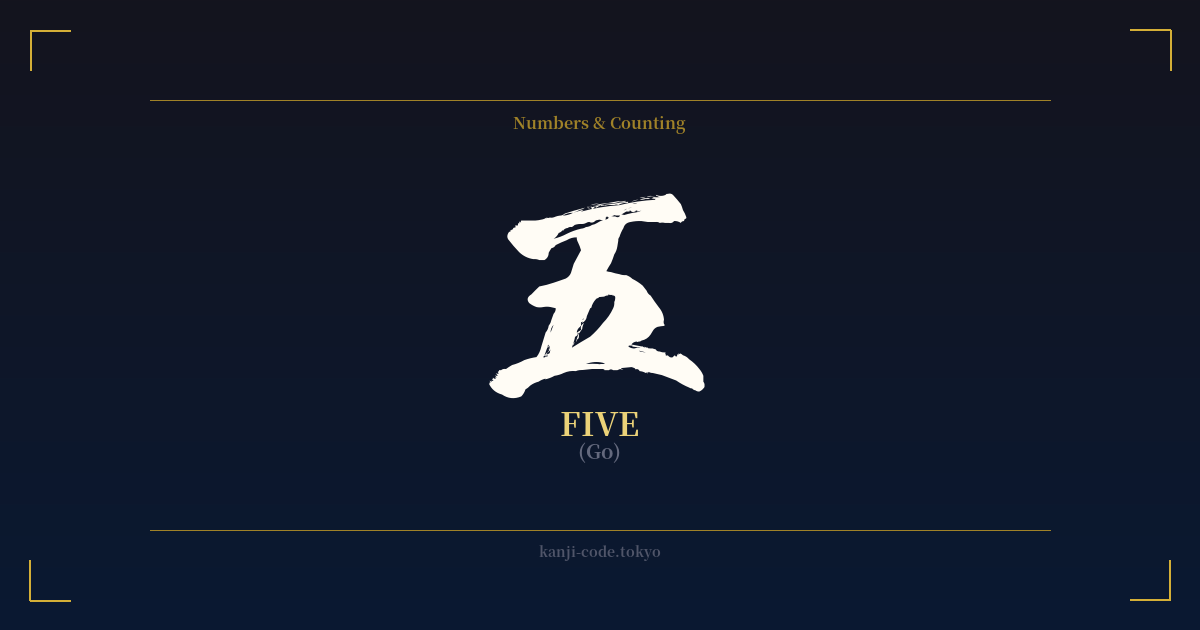
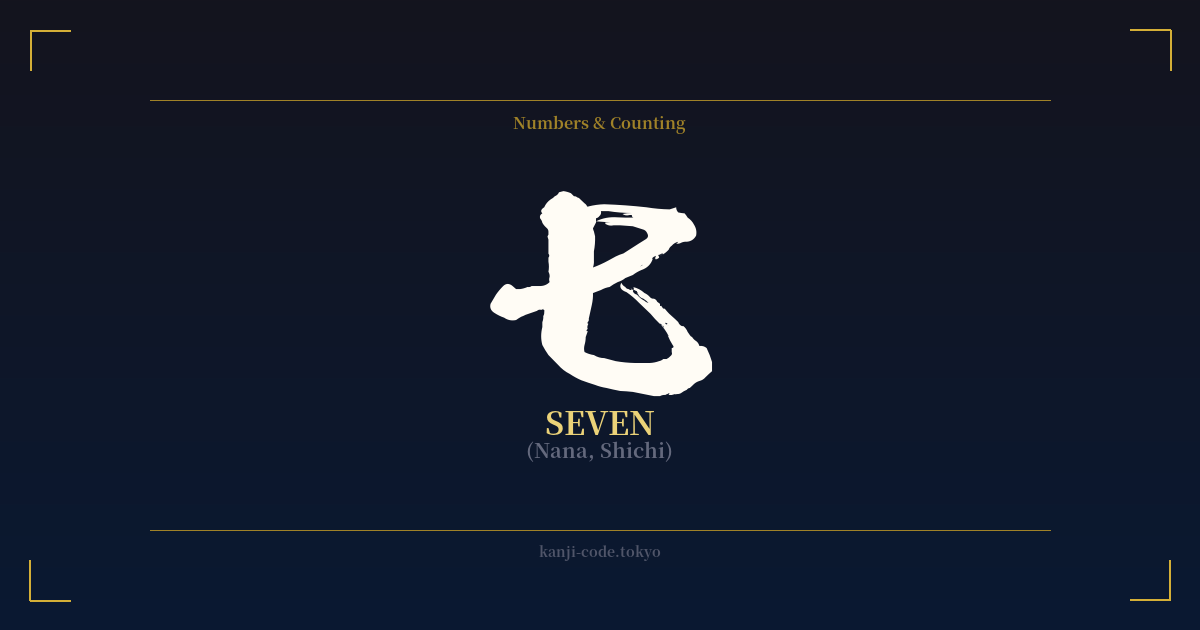
The same kanji can look dramatically different depending on the calligraphy style. Choose a font that matches the mood you want for your tattoo or design.
🎨 Tattoo Suitability
📐 Tattoo Design Guide
Due to its simplicity, the kanji 六 presents a unique design challenge. A standalone tattoo can look sparse, so execution and context are key.
– Placement: Its small, simple form works well in discreet locations like the wrist, behind the ear, on a finger, or the ankle. For a larger statement, it must be integrated into a bigger piece, such as a sequence of numbers for a significant date or as part of a compound word like 六道 (Rokudō).
– Style: Avoid thin, faint lines, as the character might become illegible or look like a random mark. Instead, consider a bold, architectural block font (like a Mincho style) to give it weight and presence. Alternatively, a dynamic and expressive calligraphy (shodō) style can inject energy and movement into the simple strokes, transforming it from a mere number into a piece of art.
– Visual Tips: Consider embedding the character within a larger image. For example, if it represents the Six Realms, it could be part of an Enso circle or surrounded by imagery representing one of the realms. If it's a lucky number, it could be incorporated into a design with other lucky symbols.
Comments