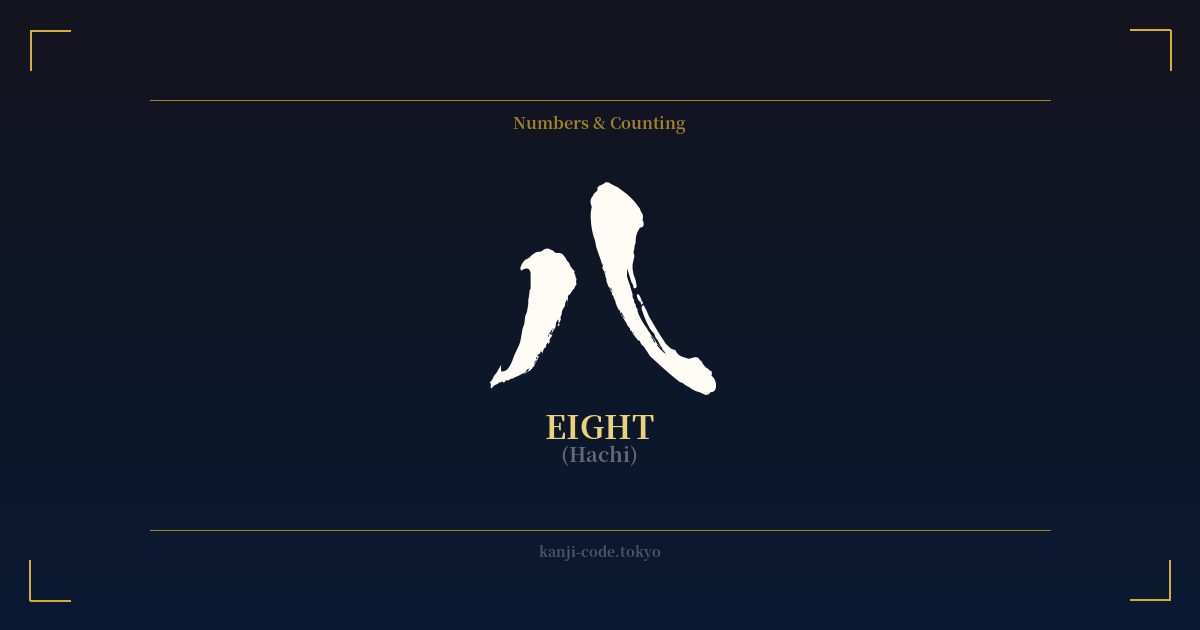
✍️ 八 (Hachi) — Cultural Context
The kanji 八 (hachi) is far more than just the number eight in Japanese culture; it is a symbol steeped in concepts of luck, prosperity, and infinity. Its significance is deeply woven into the fabric of Japanese philosophy, religion, and daily life, making it one of the most auspicious numbers.
The most important concept tied to 八 is 'suehirogari' (末広がり), which literally means 'widening towards the end'. The visual form of the kanji itself—two lines that spread outwards from top to bottom—is seen as a metaphor for a future that grows increasingly prosperous and expansive. This shape symbolizes a fan opening up, representing a path that starts small and blossoms into greatness, success, and good fortune. For this reason, the number eight is beloved in Japan, often used in gift-giving, brand names, and celebrations to invoke a sense of ever-increasing luck.
This positive association stands in stark contrast to other numbers, such as four (四, shi), which is often avoided because its pronunciation is the same as the word for death (死, shi). The number eight, however, enjoys a revered status, celebrated for its promise of a bright and boundless future.
In a religious context, the number eight appears frequently. In Buddhism, the Noble Eightfold Path (八正道, Hasshōdō) outlines the eight practices leading to liberation from suffering. There are also the Eight Legions (八部衆, Hachibushū), deities who protect the Buddhist faith. In Shinto, the term 'yaoyorozu no kami' (八百万の神) translates to 'eight million gods', but is used idiomatically to mean an infinite or countless number of deities, highlighting how 八 can represent the concept of 'many' or 'infinity'.
This idea of 'many' or 'all-encompassing' extends into common language. For instance, the old name for Japan, Ōyashima (大八島), means the 'Great Eight Islands', referring to the main islands that formed the ancient country. From ancient mythology to modern commerce, the kanji 八 consistently carries a powerful and positive charge, representing not just a quantity, but a quality of endless potential and unfolding prosperity.
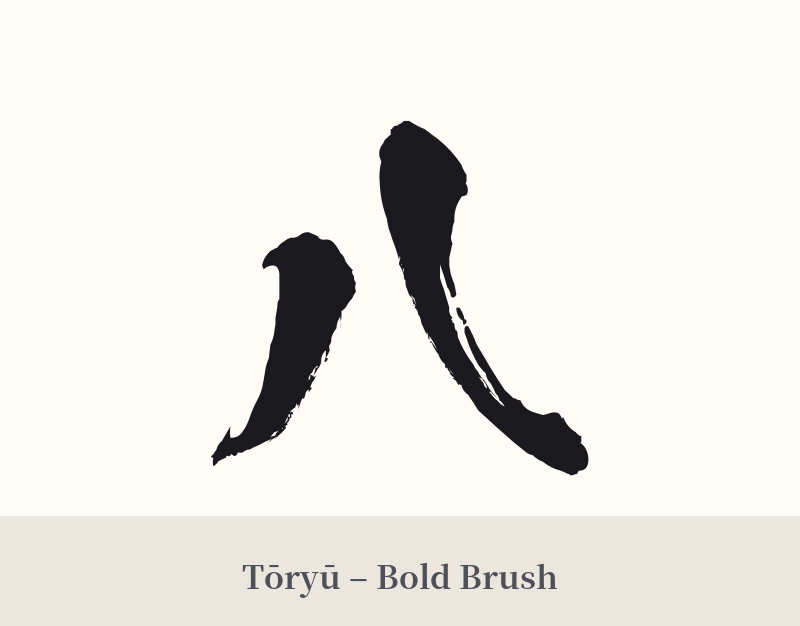
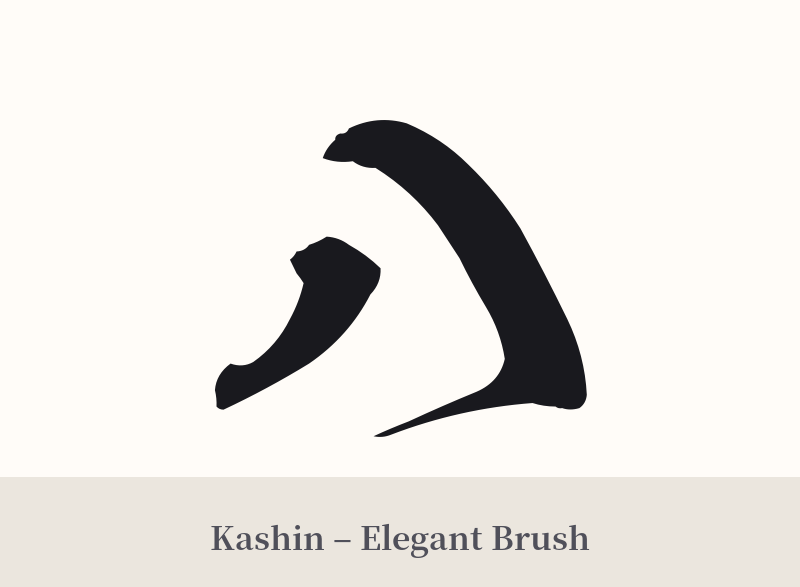
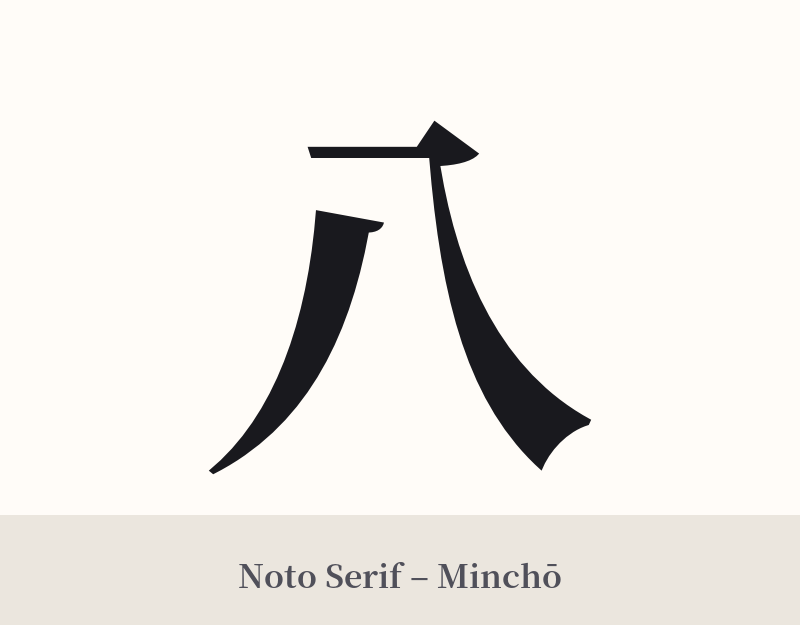
🖌️ Font Styles for 八
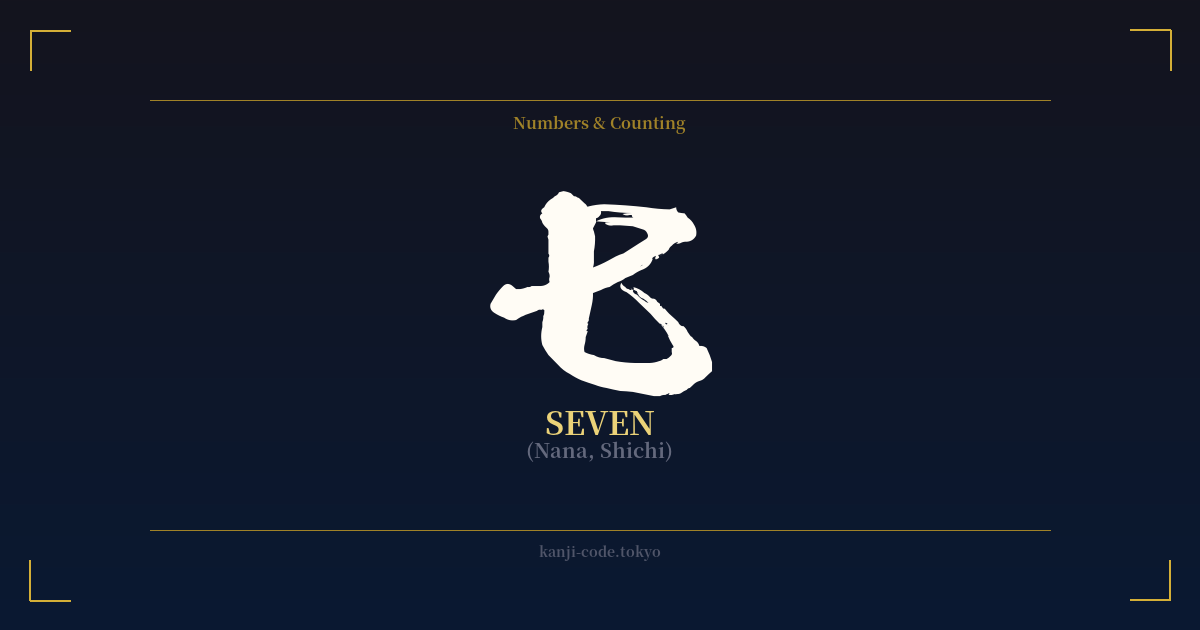
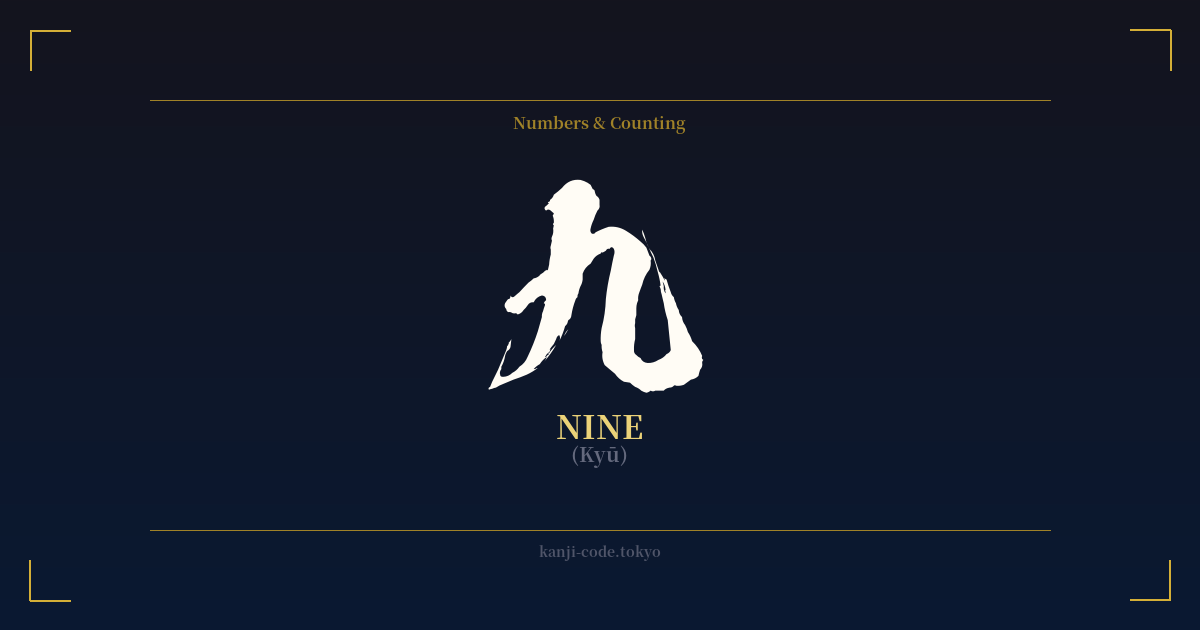
The same kanji can look dramatically different depending on the calligraphy style. Choose a font that matches the mood you want for your tattoo or design.
🎨 Tattoo Suitability
📐 Tattoo Design Guide
The beauty of the kanji 八 lies in its powerful simplicity, making it a versatile choice for a tattoo. Its minimalist form allows for a wide range of stylistic interpretations.
– Placement: Its clean lines work well in small, discreet locations like the wrist, ankle, behind the ear, or on a finger. For a more impactful statement, a larger, bold rendering on the forearm, calf, or nape of the neck can be very effective.
– Font Style: A traditional shodō (calligraphy) style with dynamic brushstrokes can emphasize the 'suehirogari' concept of expansive energy. Conversely, a clean, geometric Mincho or sans-serif font gives it a modern, sharp, and architectural feel. Consider having a calligrapher design a unique version for you.
– Visual Tips: You can play with the proportions. Make the strokes thick and grounded for a sense of stability, or thin and elegant for a lighter feel. It can also be seamlessly integrated as a component within a larger Japanese-themed piece, such as with an enso circle, a koi fish, or a dragon, to add a layer of meaning related to luck and infinity.
Comments