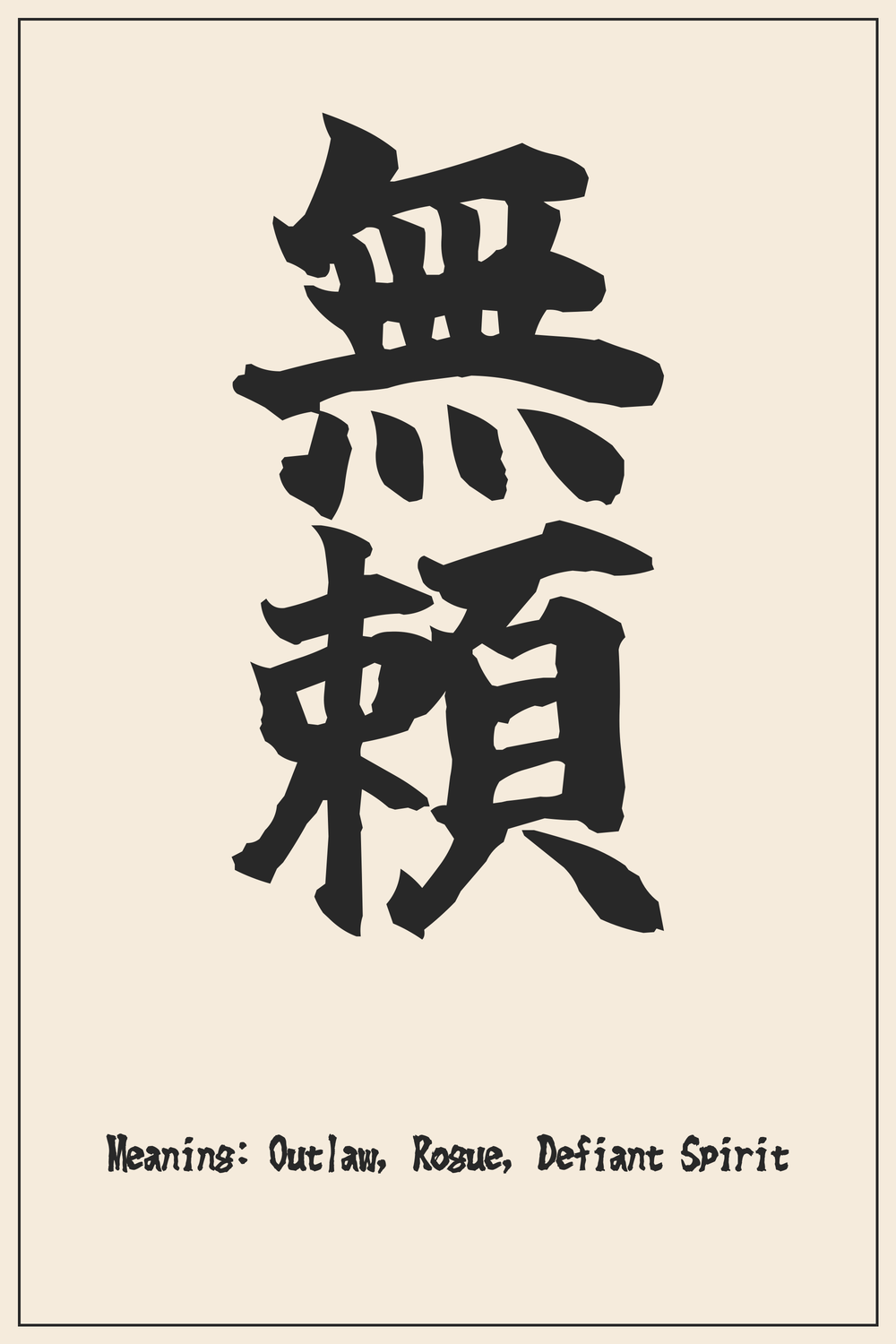
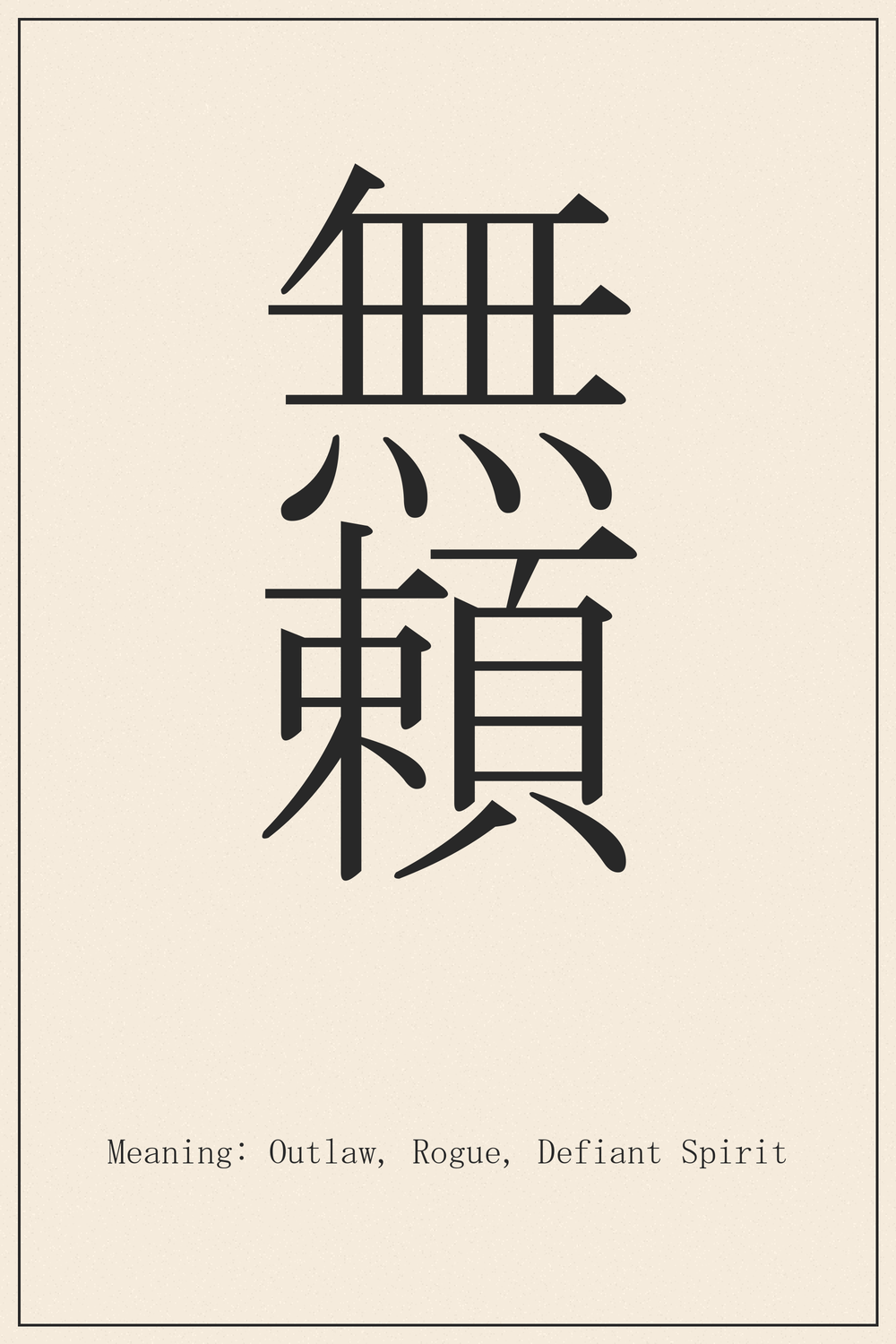
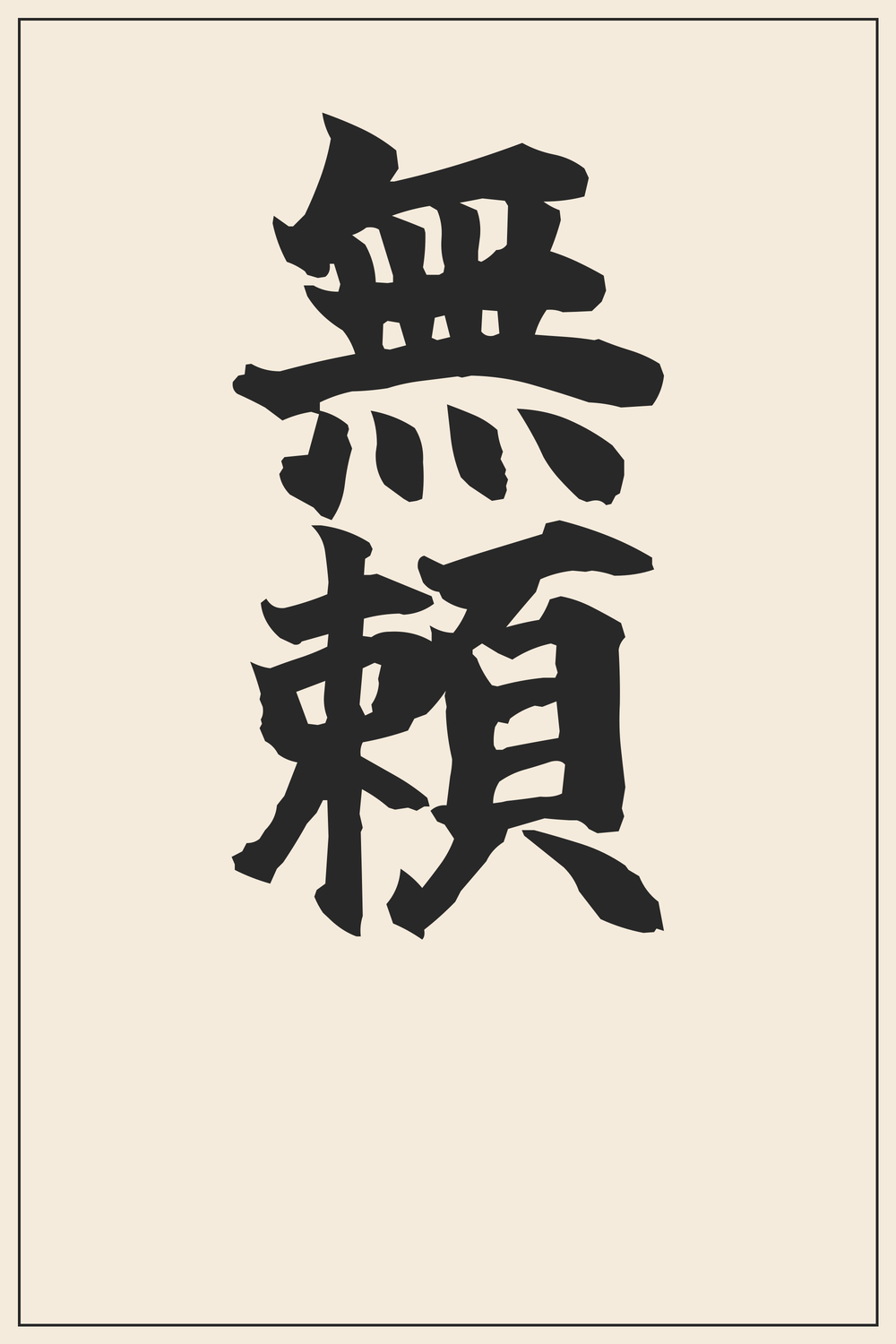
Dive into the raw spirit of defiance with ‘無頼’ (Burai), a kanji capturing the essence of an outlaw and an unyielding rebel. This character embodies a powerful refusal to conform, reflecting a life lived by one’s own rules.
The atmosphere of a Kanji character changes dramatically depending on the font style. A character that looks elegant in a brush style might look bold and modern in a different font.
Recommendation:
Since a tattoo is permanent, we strongly recommend comparing various font styles beyond what is shown here. Use our designs as a trusted reference for the correct structure, but feel free to explore different artistic variations to find the perfect match for your vision.
The Deep Meaning Behind 無頼
The term ‘無頼’ (Burai) is a compound of two significant kanji. ‘無’ (mu) signifies ‘nothingness,’ ‘without,’ or ‘non-existent,’ originally depicted as a person dancing with decorative feathers, evolving to denote absence. ‘頼’ (rai) means ‘to rely on,’ ‘to trust,’ or ‘to request.’ While its modern form visually combines 束 (soku, ‘bundle’) and 頁 (ketsu, ‘head’), its ancient origin is rooted in the character for ‘Shell’ or ‘Money’ (貝), signifying ‘value’ and the act of relying on something worth trusting.
Together, ‘無頼’ fundamentally means ‘without reliance’—having no external power or value to depend on. This linguistic evolution led to its current meaning of an outlaw, a rogue, or a person who lives outside societal norms and expectations. In Japanese culture, ‘無頼漢’ (burai-kan) often refers to a romanticized figure—a tough, independent individual, sometimes a vagrant or a rebellious hero, seen in literature, film, and historical accounts as someone who challenges the established order.
Kanji Breakdown
To understand the full depth of ‘無頼’, let’s break down its individual characters.
Meaning: Nothingness, Without, Non-existent.
This character signifies “nothingness” or “non-existence.” Interestingly, its ancient script originally depicted a dancer holding decorative ornaments. Over time, the meaning shifted phonetically to represent “absence” or “lack,” symbolizing a state unburdened by material things.
Meaning: Rely, Trust, Request.
While the modern form consists of “Bundle” (束) and “Head” (頁), its traditional etymology is far more telling. The ancient form (賴) contained the character for Shell/Money (貝). This signified “profit” or “value,” evolving to mean “relying on something valuable” or “trust.”
Conclusion
The kanji ‘無頼’ beautifully encapsulates the essence of a defiant spirit—one who chooses an unconventional path, unbound by external expectations. It speaks to a powerful sense of independence and a refusal to be swayed by the ordinary, embodying a life lived on one’s own terms.
For those who resonate with the spirit of the free-spirited individual, the maverick, or the honorable rogue, ‘無頼’ serves as a profound and visually striking tattoo. It’s a statement of self-reliance and rebellion, a symbol of embracing one’s unique journey with unyielding conviction.
Comments