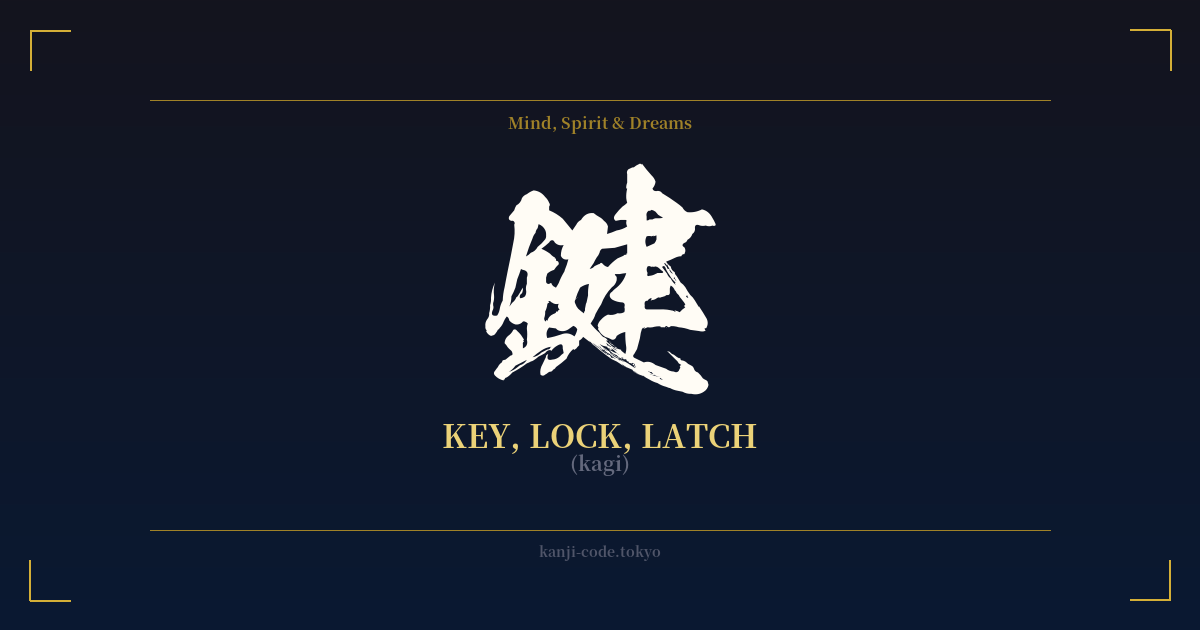
✍️ 鍵 (kagi) — Cultural Context
The Japanese kanji 鍵 (kagi) is a fascinating character that holds both a simple, everyday function and a deep, metaphorical significance. At its most basic, it refers to a physical key or a lock, the tools we use to secure and access our homes, cars, and personal belongings. This dual meaning in a single character is a point of interest; context is everything. Saying 'kagi o kakeru' (to apply the key) means 'to lock,' while 'kagi de akeru' (to open with the key) clarifies its unlocking function.
The character’s structure tells a story of its own. It is composed of two radicals: 金 (kane) on the left and 建 (ken) on the right. The 金 radical means 'metal' or 'gold,' pointing directly to the material from which keys and locks were traditionally forged. The 建 radical means 'to build' or 'to construct.' Together, they form the image of a 'metal construction,' a device built to secure something valuable.
Beyond its literal use, 鍵 shines as a powerful metaphor in the Japanese language and culture. It frequently represents a solution, a crucial element, or the means to achieve a goal. You might hear phrases like 'mondai kaiketsu no kagi' (the key to solving a problem) or 'seikō no kagi' (the key to success). In this sense, 'kagi' is not an object you hold, but an insight or action that unlocks a path forward.
This symbolism is prevalent in Japanese popular culture, especially in video games, anime, and manga. From the iconic keys in 'The Legend of Zelda' that open new dungeons to the Keyblades of 'Kingdom Hearts' that unlock worlds and hearts, the 'kagi' is a common trope. It represents gaining access to new powers, uncovering hidden truths, or fulfilling one's destiny. This makes it a universally understood symbol of progress and discovery.
On a more personal and philosophical level, 鍵 can symbolize the key to one's own heart ('kokoro no kagi'), mind, or potential. It can represent a personal breakthrough, the overcoming of a mental block, or the journey to understanding oneself. It embodies the idea that we hold the power to unlock our own futures, making it a profound and introspective symbol for anyone on a path of self-discovery.
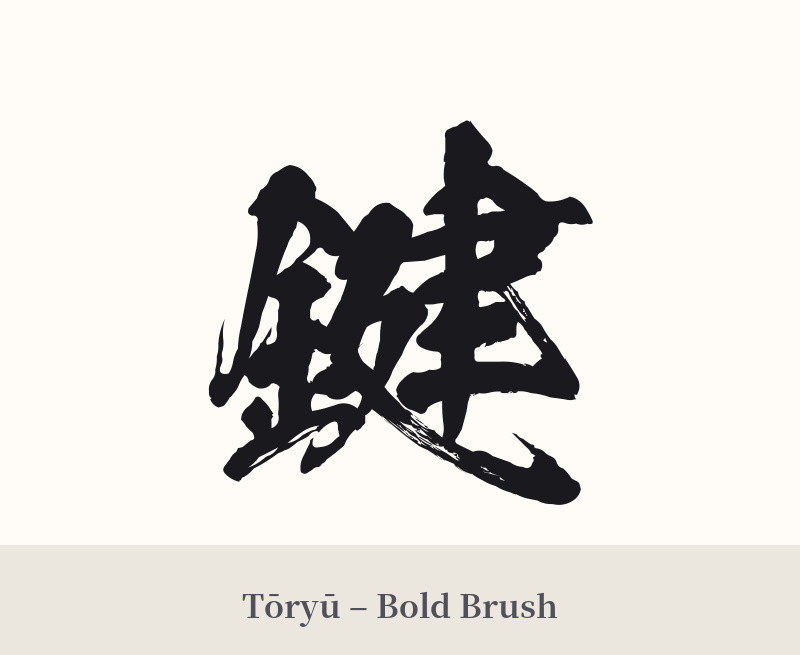
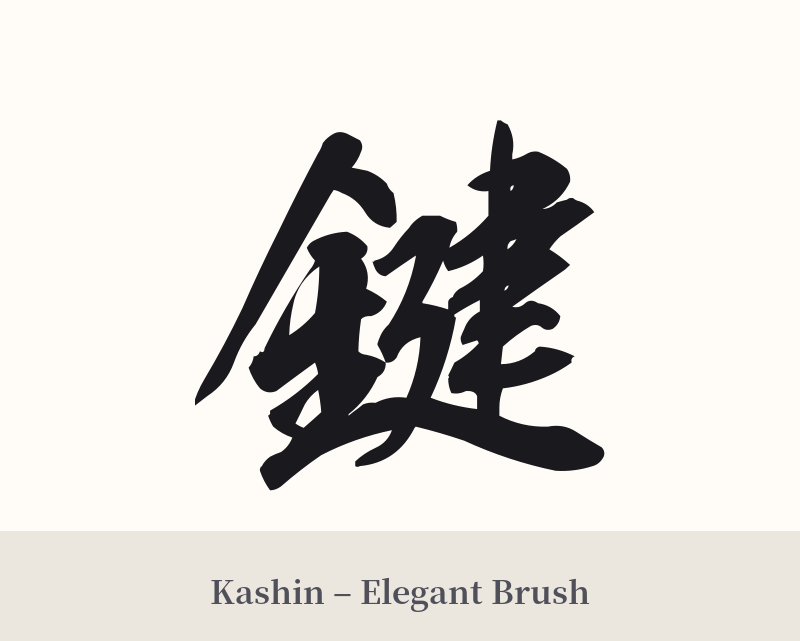
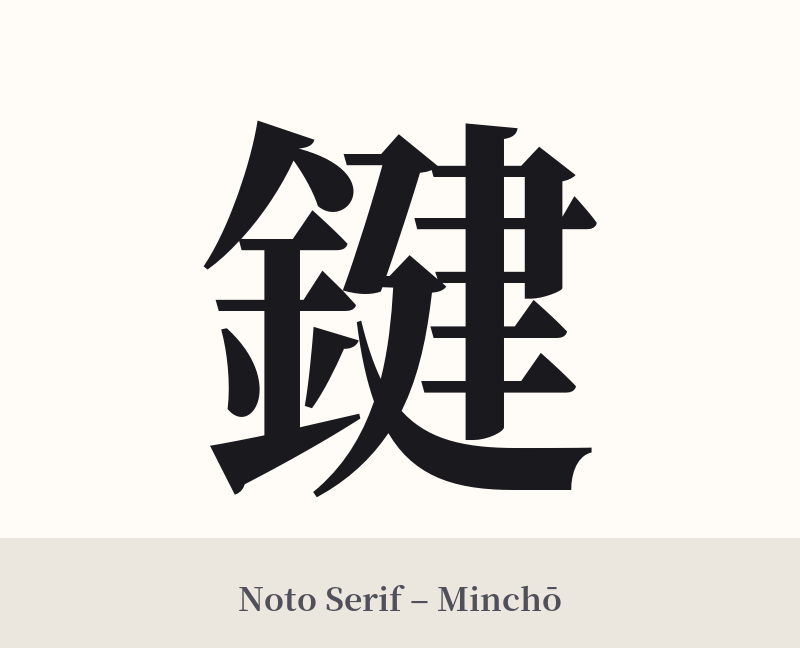
🖌️ Font Styles for 鍵
The same kanji can look dramatically different depending on the calligraphy style. Choose a font that matches the mood you want for your tattoo or design.
🎨 Tattoo Suitability
📐 Tattoo Design Guide
Due to its intricate 17-stroke structure, the kanji 鍵 (kagi) requires careful consideration in a tattoo design. Its complexity is both a challenge and an opportunity for a beautiful, detailed piece.
– Placement: Choose a location that allows for adequate size to preserve clarity. The forearm, calf, upper back, or thigh are excellent choices. Avoid small areas like the wrist, ankle, or fingers, as the lines are likely to blur over time.
– Style Suggestions: A standard 'Kaisho' (block) style will emphasize the character's architectural structure, giving it a solid, traditional feel. For a more artistic and fluid look, a 'Gyōsho' (semi-cursive) script can soften the edges, but be sure the artist can maintain legibility. A minimalist approach, focusing on clean lines, can also work well for a modern interpretation.
– Complementary Imagery: Consider incorporating 鍵 into a larger design to enhance its meaning. It could be shown unlocking a traditional Japanese puzzle box, a heart-shaped lock, or a stylized keyhole. Another powerful image is having the kanji as part of a key itself, with the character forming the handle or bit, visually merging its literal and symbolic meanings.
Comments