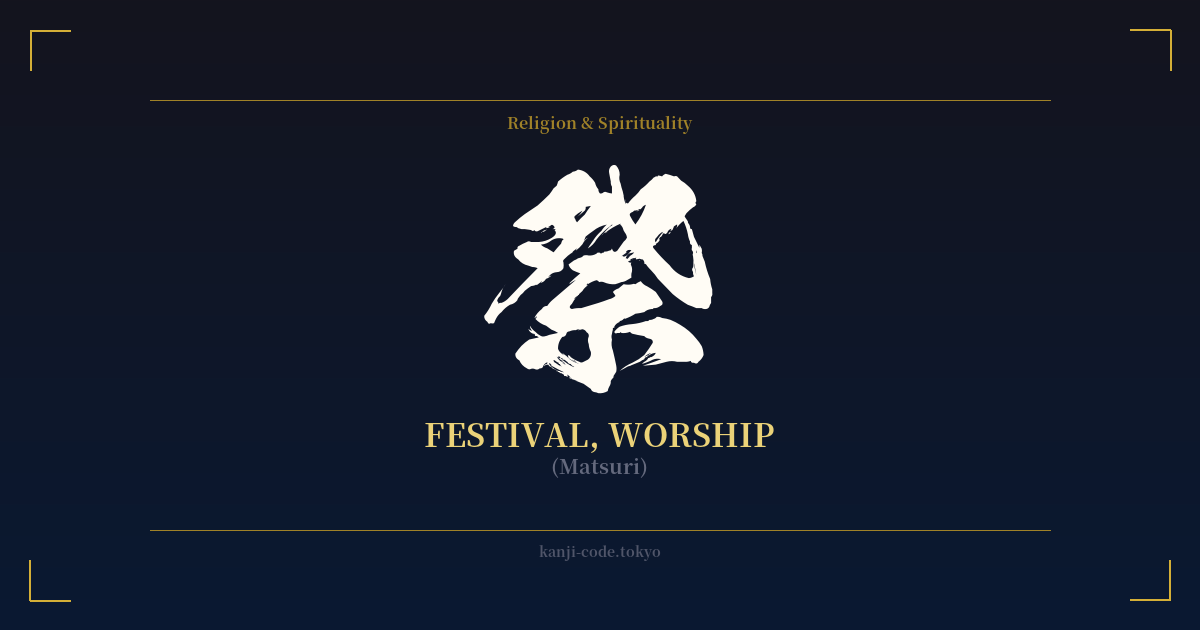
✍️ 祭 (Matsuri) — Cultural Context
The kanji 祭, read as 'Matsuri,' is more than just a word for 'festival' in Japan; it is the very pulse of Japanese community and spiritual life. Its ancient origins are beautifully captured within the character's form. The pictograph is a composite of radicals representing a hand (又) holding a piece of meat (肉) before an altar (示). This image vividly depicts the foundational act of a matsuri: making an offering to the gods, or 'kami.'
Historically, matsuri were solemn, sacred rites intended to communicate with the divine. Communities would gather to pray for bountiful harvests, give thanks for success, appease wrathful spirits, or purify themselves from misfortune. These events were essential for maintaining harmony between the earthly and celestial realms, a core concept in Shintoism. The act of worship and offering was the central purpose, with celebration being a secondary, albeit important, consequence.
Over centuries, this solemnity blossomed into the vibrant, energetic festivals known today. While the sacred rituals performed by priests remain at the core, the public-facing side of a matsuri is a riot of color, sound, and flavor. Streets are filled with people in traditional 'yukata,' the air thick with the smell of food from countless 'yatai' (street stalls). The highlight for many is the procession of the 'mikoshi,' an ornate portable shrine carried on the shoulders of chanting participants, believed to house the local deity as it tours and blesses the neighborhood.
Famous festivals like Kyoto's Gion Matsuri, with its magnificent floats, or Aomori's Nebuta Matsuri, with its giant illuminated paper figures, draw millions of visitors. Yet, countless smaller, local matsuri take place in towns and villages across the country, each reinforcing local identity and community bonds. These events are a time for families to reunite, for neighbors to cooperate, and for generations to pass down traditions.
The term has also expanded beyond its purely religious origins. A school's annual fair is a 'bunkasai' (文化祭) or 'gakuensai' (学園祭) — a 'culture festival.' A music event can be an 'ongaku-sai' (音楽祭). In this way, 祭 has come to signify any special, communal event marked by celebration and a break from the everyday. It is a character that encapsulates the bridge between the sacred and the secular, the ancient and the modern, and the individual and the community.
🖌️ Font Styles for 祭
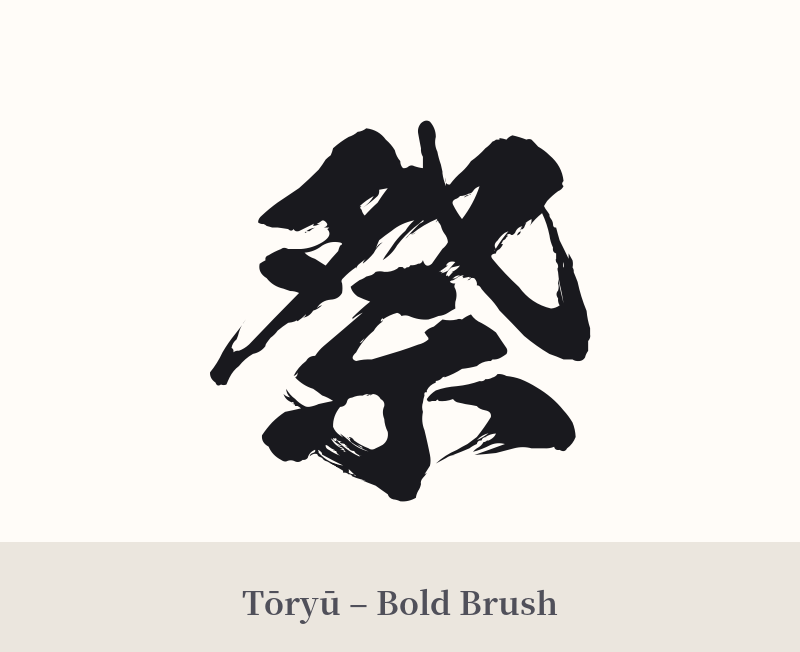
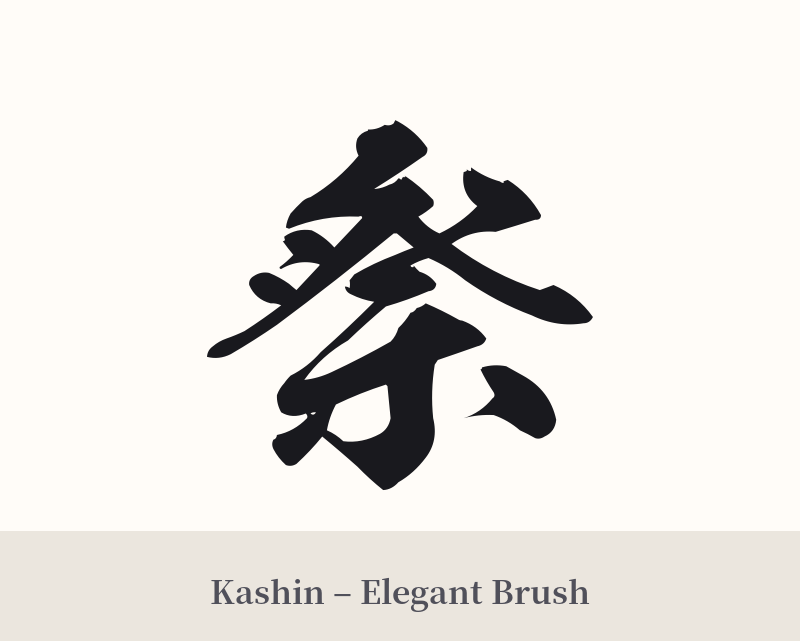
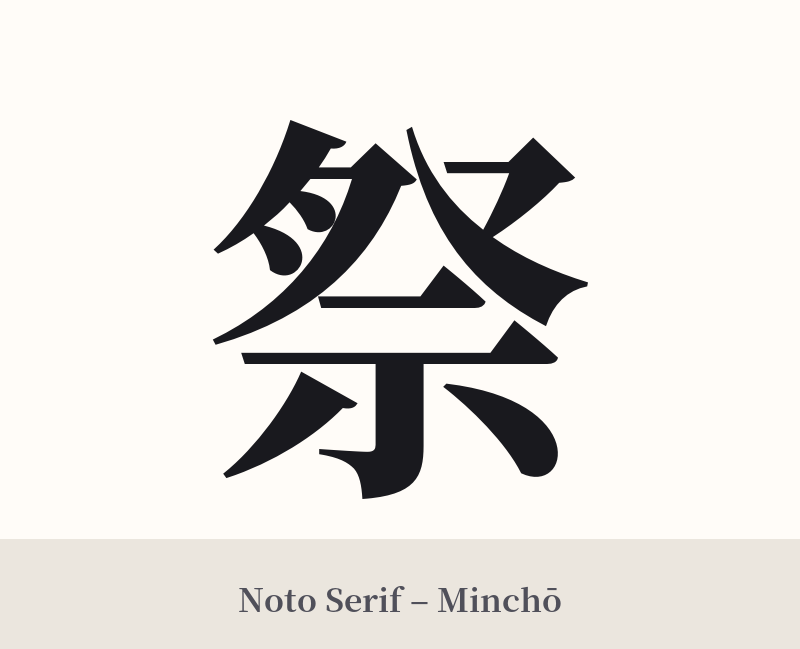
The same kanji can look dramatically different depending on the calligraphy style. Choose a font that matches the mood you want for your tattoo or design.
🎨 Tattoo Suitability
📐 Tattoo Design Guide
The kanji 祭 offers wonderful flexibility for a tattoo design, capable of expressing both vibrant energy and quiet reverence.
For placement, consider areas that allow for its detail to be appreciated. The forearm, calf, or back of the shoulder are excellent choices for a medium-to-large piece. For a smaller, more discreet tattoo, the wrist or ankle can work, but the design may need to be slightly simplified to prevent the strokes from blurring over time.
Font style is key to conveying the desired mood: – A dynamic, flowing cursive style ('Sōsho') can capture the chaotic energy and movement of a festival procession. – A bold, strong brushstroke style ('Kaisho') emphasizes the kanji's ancient roots and the solemnity of the ritual offerings. – A semi-cursive 'Gyōsho' offers a beautiful balance between readability and artistic flair.
To enhance the design, consider incorporating related elements. You could frame the kanji with a 'torii' gate, have it appear on a festival lantern ('chōchin'), or surround it with symbolic imagery like cherry blossoms for spring festivals or maple leaves for autumn ones. Abstract splashes of color, mimicking confetti or fireworks, can also add a celebratory feel.
Comments