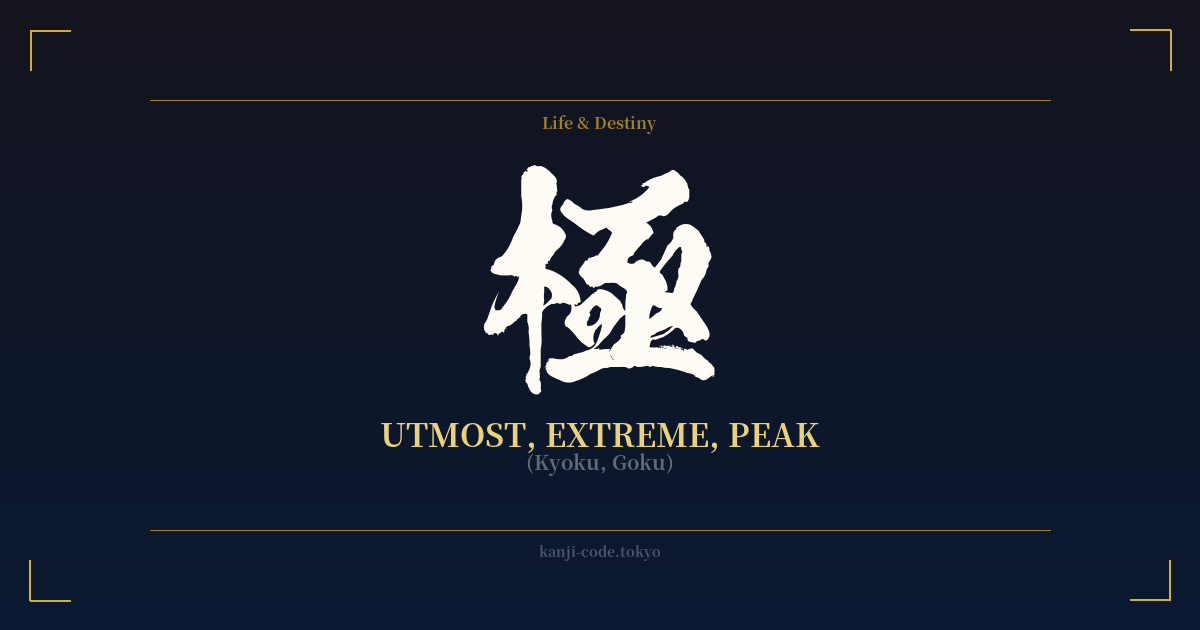
✍️ 極 (Kyoku, Goku) — Cultural Context
The kanji 極 (kyoku/goku) is a character steeped in the pursuit of perfection and the concept of reaching an ultimate point. Its very structure hints at this, combining the radical for 'tree' (木) with a component that originally depicted the ridgepole—the highest beam in a roof. From this, it evolved to mean the highest point, the terminus, the absolute extreme of any concept.
In Japanese culture, this idea of 'utmost' is not just a descriptor but a philosophy. It is deeply embedded in the world of budō (武道), the martial arts. To practice an art like karate, judo, or kendo is to embark on a path (道, Dō) with the goal of 'kiwameru' (極める), the verb form of this kanji, meaning 'to master completely.' This isn't just about physical skill but about spiritual and mental refinement. The ultimate aim is to reach the 'gokui' (極意), the innermost secrets or hidden truths of the art, a state of profound understanding that transcends mere technique.
This pursuit of the extreme finds a parallel in Zen Buddhism. Zen practice often involves pushing the mind and body to their limits through meditation and discipline to break through conventional thought and achieve enlightenment (satori). The concept of reaching the 'kyoku' state is akin to this breakthrough, where the self falls away, leaving only pure action and awareness. It is the pinnacle of focus and dedication, where effort becomes effortless.
Beyond philosophy and martial arts, 極 is a fundamental part of the Japanese language used to describe physical and conceptual extremes. The North Pole is 'Hokkyoku' (北極, literally 'North Extreme'), and the South Pole is 'Nankyoku' (南極, 'South Extreme'). When used as a prefix, 'goku' (ごく) acts as an intensifier, turning 'good' into 'the absolute best' (極上, gokujō) or 'secret' into 'top secret' (極秘, gokuhi). This versatility shows how the character's core meaning of 'the ultimate point' can be applied to everything from geography to gastronomy.
To choose 極 is to embrace the idea of pushing boundaries. It represents an unwavering commitment to a chosen path, a declaration of intent to strive for the pinnacle, whether that be in a skill, a spiritual journey, or a personal code of conduct. It is a powerful symbol of aspiration, dedication, and the relentless human drive to reach the very end of the line.
🖌️ Font Styles for 極
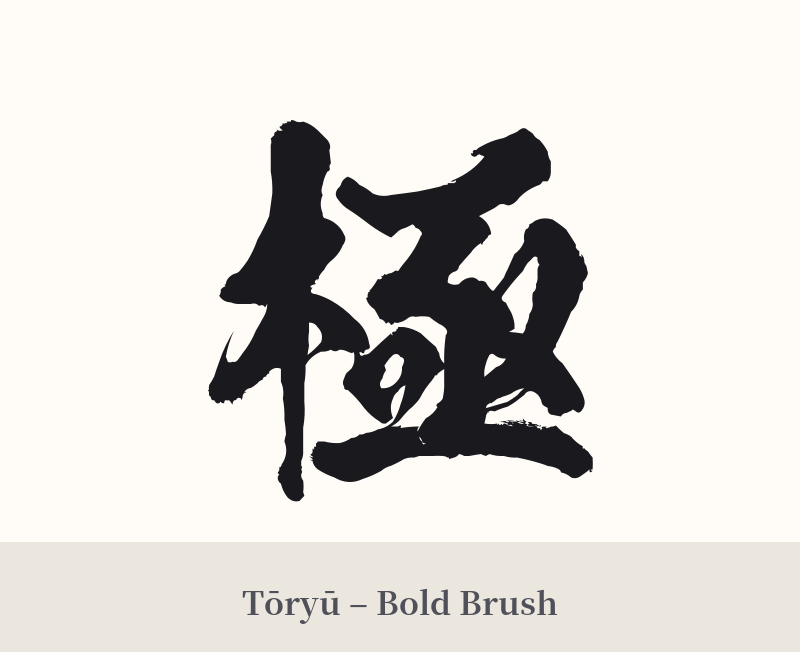
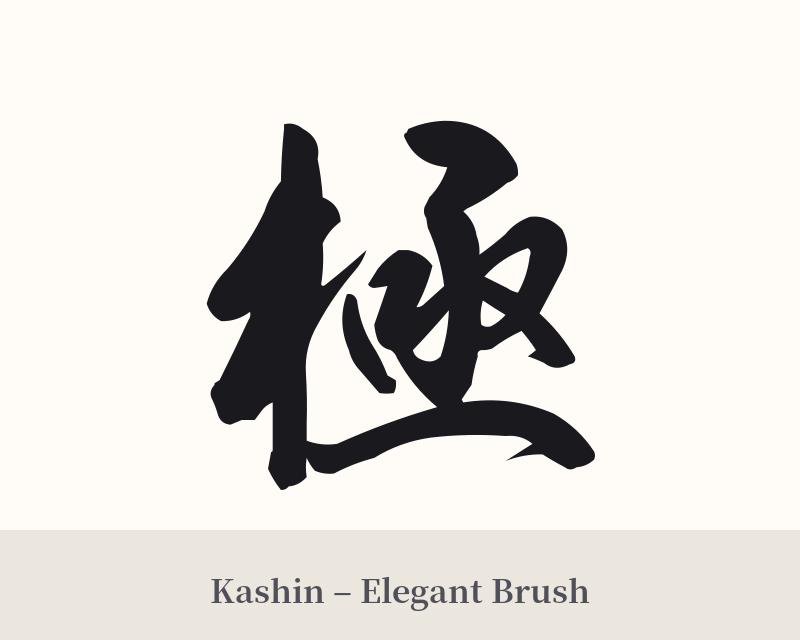
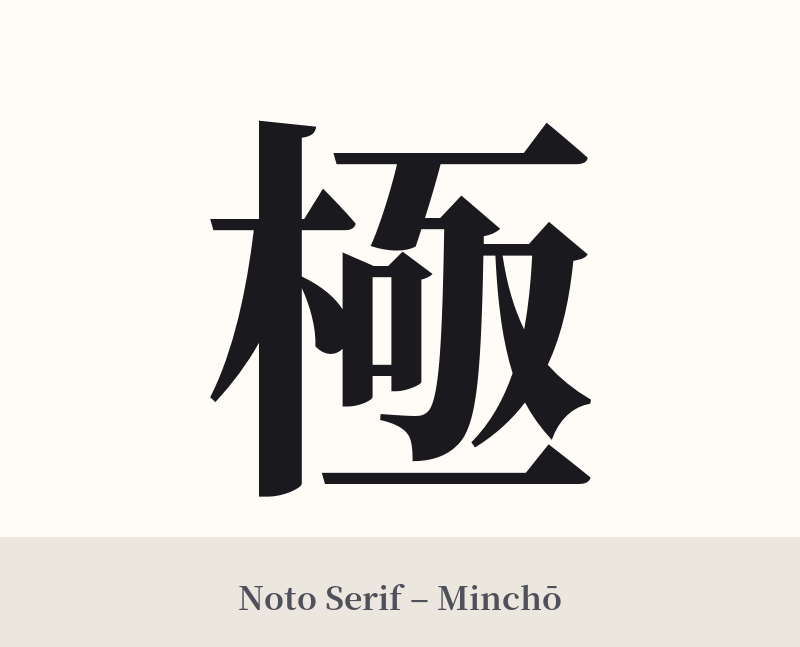
The same kanji can look dramatically different depending on the calligraphy style. Choose a font that matches the mood you want for your tattoo or design.
🎨 Tattoo Suitability
📐 Tattoo Design Guide
The kanji 極 is visually balanced and powerful, making it a strong choice for a standalone tattoo. Its structure offers opportunities for both bold and intricate designs.
– Placement: For a vertical orientation, the spine, forearm, or calf are excellent choices. They provide a long canvas that complements the character's form. For a bolder, more centered piece, the back between the shoulder blades or the center of the chest works well.
– Style: A dynamic, semi-cursive calligraphy style (gyōsho) can capture the energy and journey of 'mastery.' For a statement of finality and stability, a crisp, architectural block script (kaisho) emphasizes the 'peak' aspect. A rough, powerful brushstroke style (sōsho) can convey the intensity and raw power of 'extreme.'
– Visual Elements: While 極 is strong on its own, it can be paired with an enso circle to symbolize the contained perfection and enlightenment of mastery. It could also be placed atop a stylized mountain peak or a breaking wave to visually represent the concept of a pinnacle.
Comments