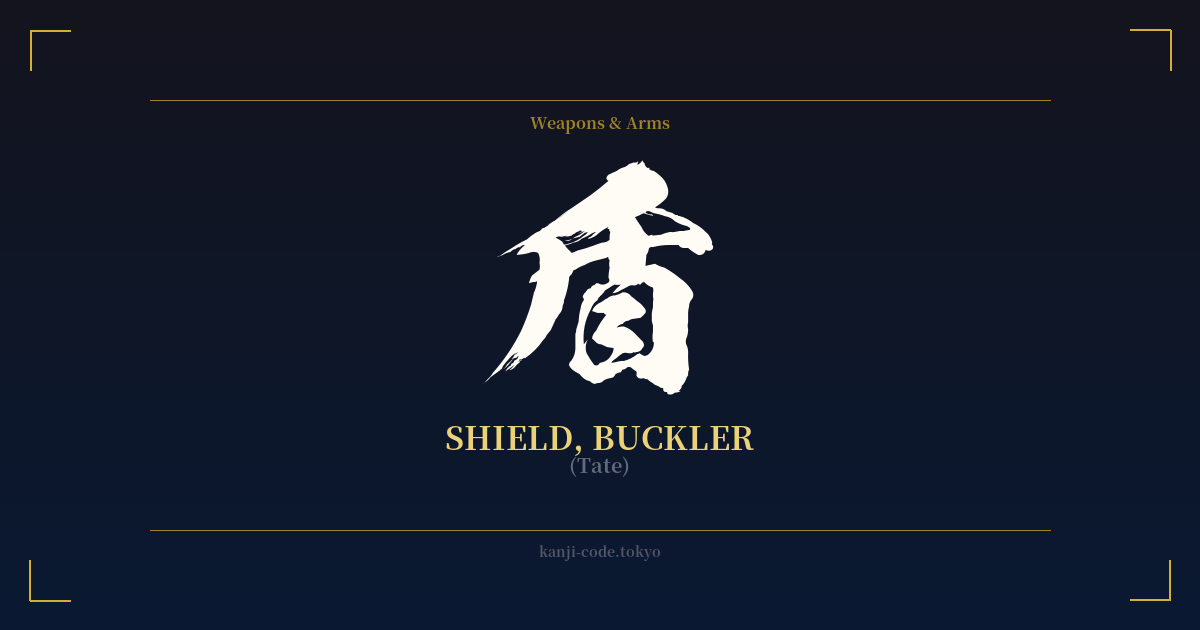
✍️ 盾 (Tate) — Cultural Context
The kanji 盾 (tate) is a fascinating character, not just for its literal meaning of 'shield', but for the deep cultural and philosophical layers it carries. Its origin is pictographic; the character itself is a drawing of an ancient shield, with the outer lines representing the shield's body and the central stroke depicting a handle or a central boss. This visual history grounds the character in the tangible world of ancient warfare.
Historically, the Japanese 'tate' was quite different from the hand-held shields common in European history. Traditional Japanese shields were typically large, heavy wooden planks, often propped up on the battlefield. They functioned more like portable walls, providing cover for archers and foot soldiers (ashigaru) from enemy projectiles. Samurai warriors, the elite class, rarely used hand-held shields in combat. Their primary forms of defense were their intricate armor (yoroi) and their supreme skill with weapons like the katana and yari (spear). This distinction is crucial; the shield in Japanese history was a tool of mass defense and fortification, not one of individual dueling.
Perhaps the most famous cultural concept associated with 盾 is the word 矛盾 (mujun), which means 'contradiction'. This word is a story in itself, derived from a Chinese tale about a merchant boasting about his wares. He held up a spear (矛, hoko/mu) and claimed it could pierce any shield. Then, he held up a shield (盾, tate/jun) and claimed it could block any spear. When a person in the crowd asked what would happen if the unstoppable spear struck the unbreakable shield, the merchant was left speechless. This story perfectly encapsulates the concept of a logical paradox and has cemented both 矛 and 盾 as powerful symbols in East Asian philosophy.
In a modern context, 盾 has evolved far beyond its military origins. It is a powerful metaphor for protection, defense, and resilience. To be someone's 'tate' is to be their protector, their guardian against harm. It can symbolize the inner strength to withstand emotional attacks, the resilience to endure hardship, or the steadfastness to defend one's principles. This symbolic meaning is frequently seen in Japanese pop culture, from video games where 'tank' characters act as the party's shield, to anime like 'The Rising of the Shield Hero,' where the protagonist's identity is defined by his role as a defender.
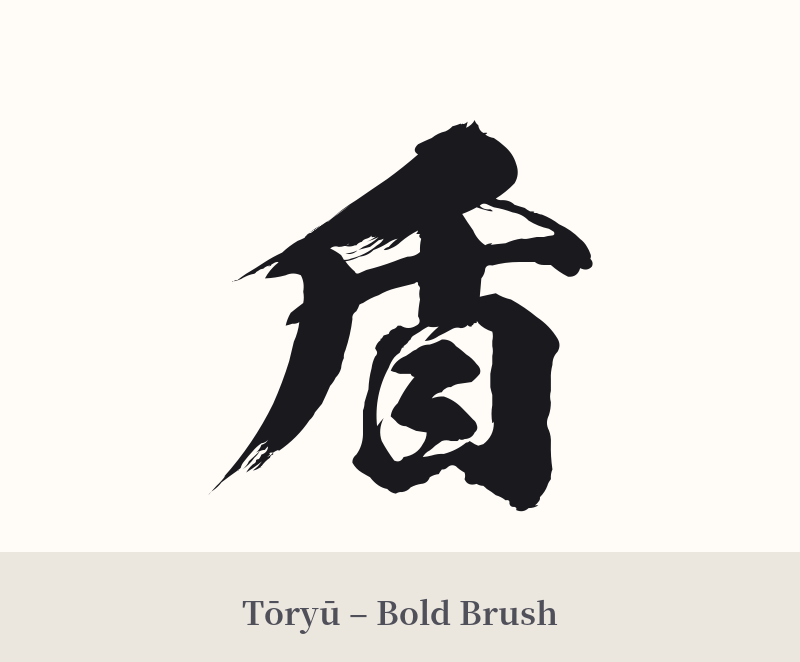
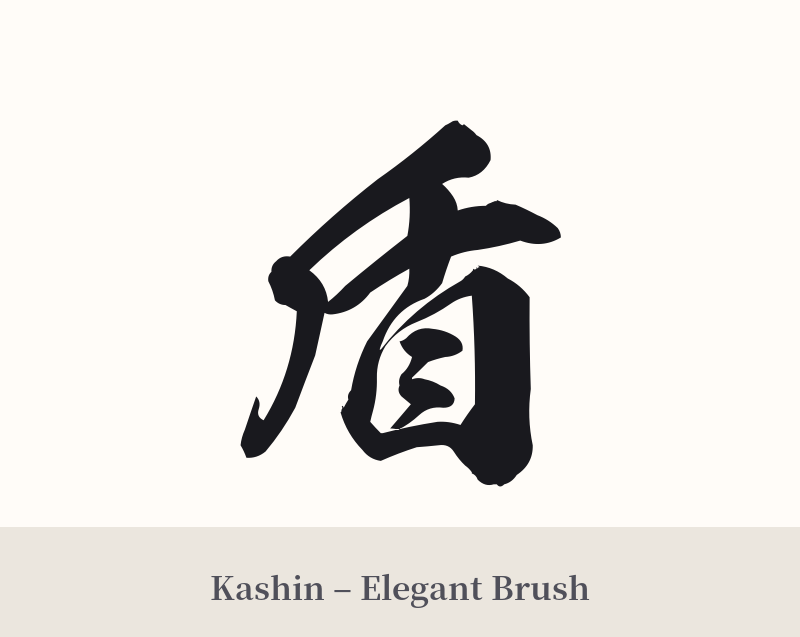
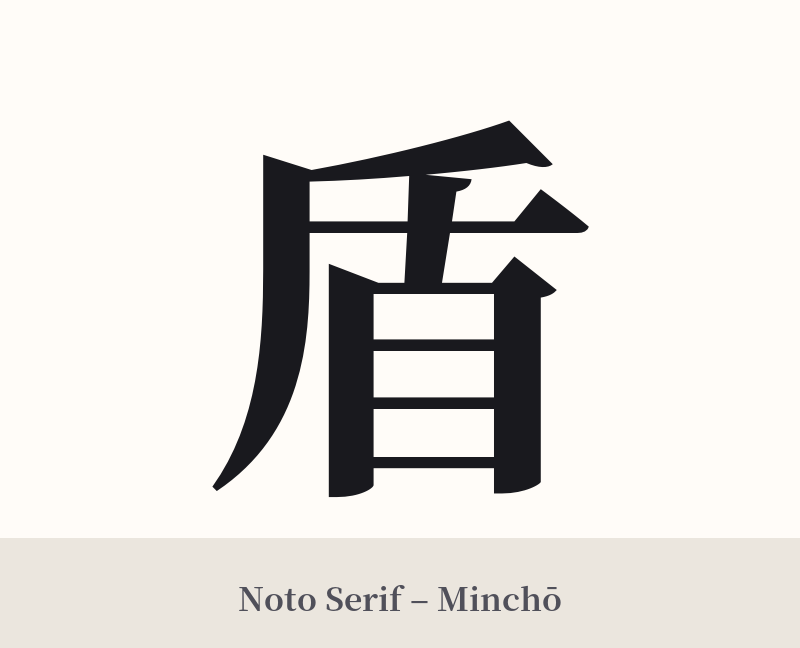
🖌️ Font Styles for 盾
The same kanji can look dramatically different depending on the calligraphy style. Choose a font that matches the mood you want for your tattoo or design.
🎨 Tattoo Suitability
📐 Tattoo Design Guide
For a tattoo, the kanji 盾 (tate) offers a powerful statement of protection and strength. Its design can be adapted to reflect the specific nuance you wish to convey.
– Placement: Consider areas that align with the concept of defense. The chest, over the heart, symbolizes protecting one's emotions or loved ones. The back, particularly between the shoulder blades, can represent guarding one's vulnerabilities or being a guardian for others. A forearm or bicep placement evokes the strength to 'hold up' the shield.
– Font Style: The choice of font is critical. A bold, thick Kaisho (block script) or a heavy Gothic style will emphasize the kanji's solid, unbreakable nature. For a more ancient or battle-worn feel, a slightly weathered Gyosho (semi-cursive) or a brushstroke style with ink splatters can suggest resilience through conflict.
– Visual Elements: While 盾 is strong on its own, it can be integrated into a larger piece. Consider having it as a central element in a mandala, or as a backdrop for a symbol you wish to protect (like an animal, flower, or another kanji). Adding subtle cracks or chips to the character can create a powerful visual of a shield that has endured and survived many battles, symbolizing your own resilience.
Comments