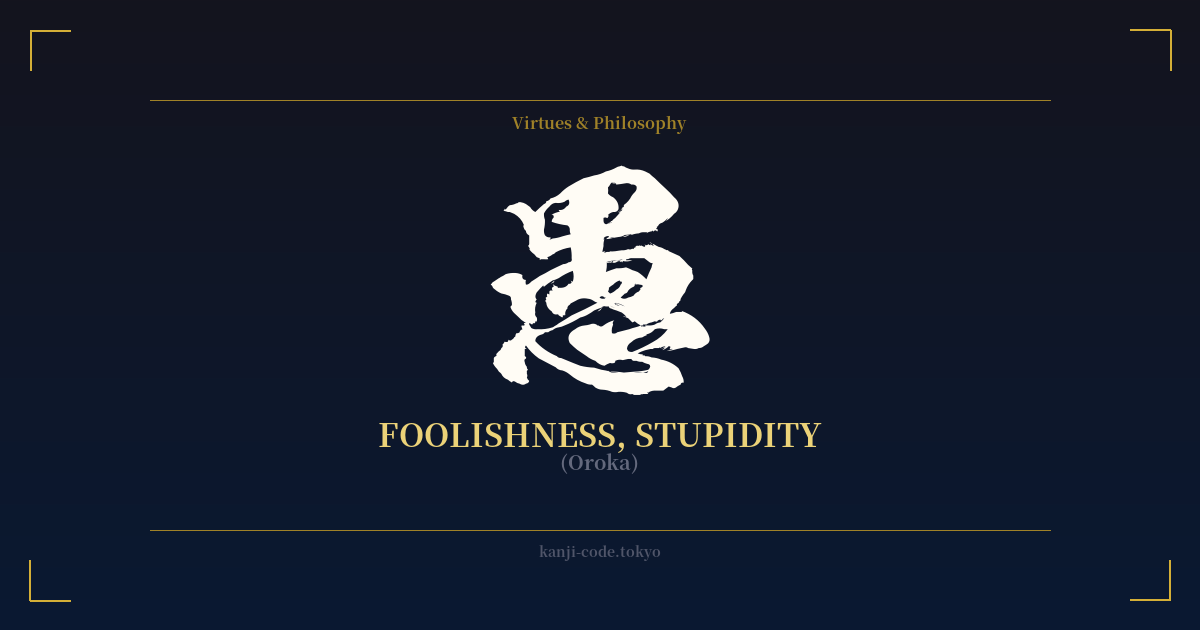
✍️ 愚 (Oroka) — Cultural Context
The kanji 愚 (oroka) is a stark and powerful character that directly translates to foolishness, silliness, and stupidity. Its etymology offers a fascinating window into its meaning. The character is composed of two parts: the top component 禺 (gu), which originally depicted a type of long-armed monkey and now serves as a phonetic element, and the bottom radical 心 (kokoro), meaning 'heart' or 'mind'. Together, they paint a picture of a 'monkey mind'—a heart that is restless, undisciplined, and clouded, unable to think clearly.
In everyday Japanese, to call something or someone 愚か (oroka) is a serious criticism. It’s a stronger and more formal term than the colloquial 馬鹿 (baka). While 'baka' can sometimes be used playfully or affectionately between friends, 'oroka' carries a heavier weight. It implies a fundamental lack of wisdom or judgment, describing an action or a person as pitiably foolish. You might hear it in historical dramas or literature to describe a lord who made a foolish decision that led to his downfall, or in a proverb like 愚の骨頂 (gu no kotchō), meaning 'the height of folly.'
Despite its overwhelmingly negative connotation, 愚 holds a fascinating, paradoxical role in Zen Buddhism and other philosophical traditions. Here, the character can be part of the concept of the 'wise fool' (愚者, gusha). This is not a celebration of ignorance, but rather an embrace of humility and the 'beginner's mind' (初心, shoshin). The 'wise fool' is one who has emptied themselves of intellectual pride and preconceptions, becoming open to true understanding and enlightenment. They are 'foolish' in the eyes of the world, which values ego and complex knowledge, but wise in the spiritual sense.
This philosophical inversion is profound but also highly specific and contextual. For the vast majority of Japanese speakers, 愚 is not a symbol of Zen humility; it is simply the word for 'stupid.' This deep cultural gap is what makes the character so problematic for uses like tattoos. The intended deep meaning is almost guaranteed to be lost, replaced by its blunt, literal, and insulting surface-level interpretation. It stands as a powerful reminder that in kanji, context is not just important—it is everything.
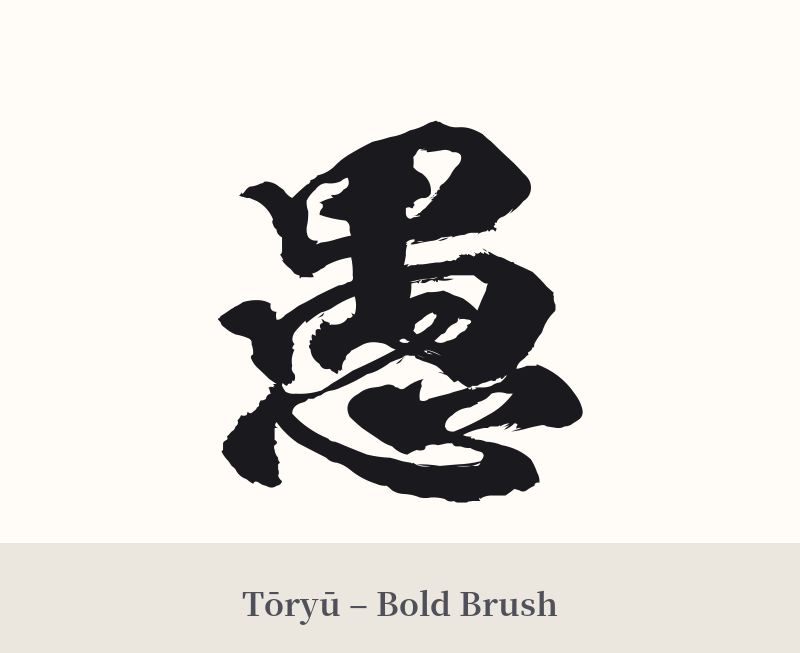
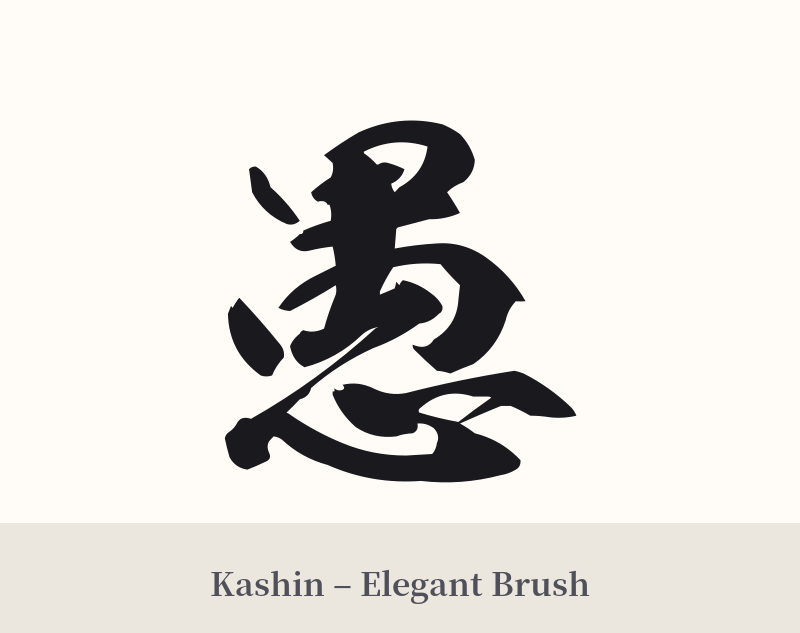
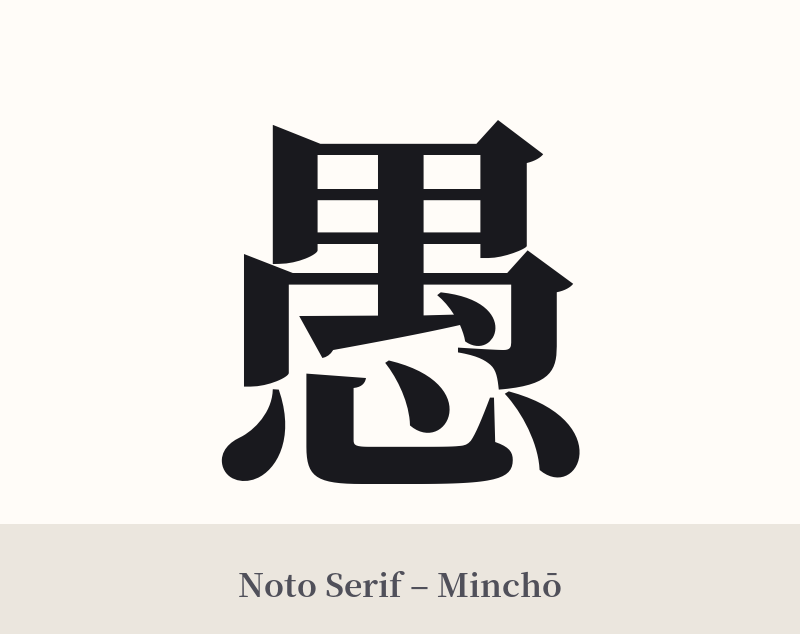
🖌️ Font Styles for 愚
The same kanji can look dramatically different depending on the calligraphy style. Choose a font that matches the mood you want for your tattoo or design.
🎨 Tattoo Suitability
📐 Tattoo Design Guide
Given the strong recommendation against using this kanji for a tattoo, this guide is offered as a caution. The meaning is overwhelmingly negative and likely to be misunderstood.
If you are absolutely set on this character for personal philosophical reasons, consider the following: – Placement: Choose a private location that is not for public display, such as the ribs, inner thigh, or inner bicep. This reinforces the idea that it is for personal reflection rather than a public statement. – Style: A rough, expressive calligraphy style (Sōsho) could capture the 'monkey mind' aspect of the character. Conversely, a stark, rigid block script (Kaisho) would emphasize the blunt, harsh nature of the word 'fool.' – Pairing: Do not pair this with other kanji without expert consultation, as you could easily create a phrase that is nonsensical or even more offensive. The best advice is to reconsider and choose a kanji that represents the quality you aspire to, such as 智 (chi, wisdom) or 悟 (satoru, enlightenment).
Comments