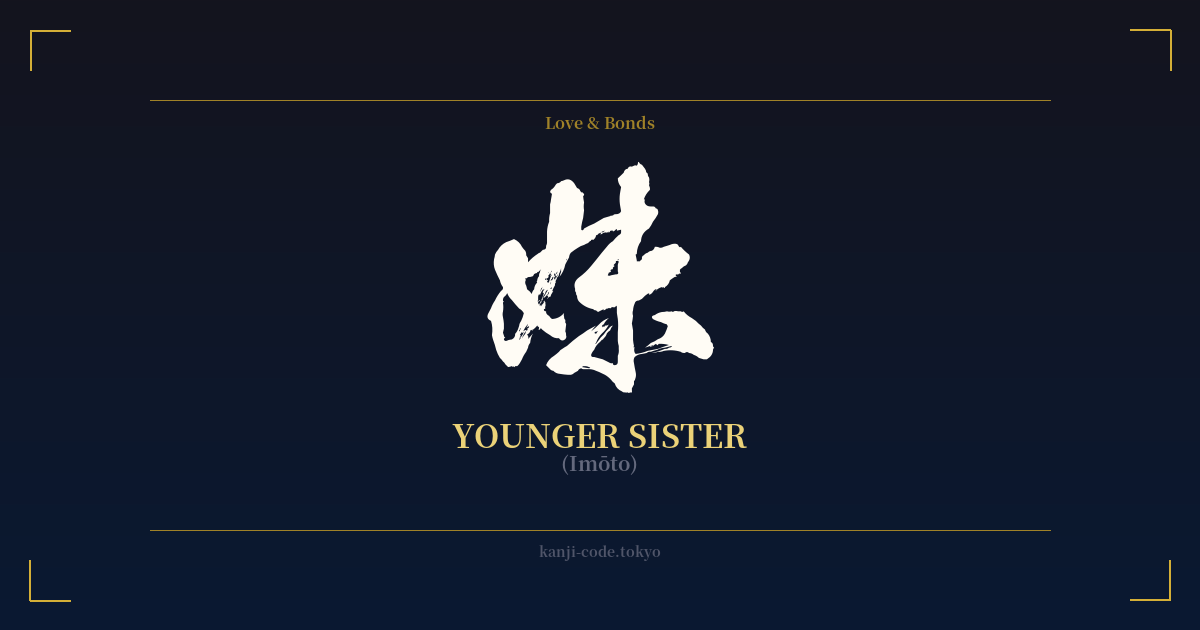
✍️ 妹 (Imōto) — Cultural Context
The kanji 妹 (Imōto) is one of the most fundamental characters in the Japanese language, representing the concept of a 'younger sister.' Its beauty lies not in complexity, but in the deep well of familial affection and cultural nuance it contains. To understand 妹 is to understand an important pillar of the Japanese family structure.
The character itself offers a glimpse into its meaning. It is a composite of two radicals: 女 (onna), meaning 'woman,' on the left, and 未 (mi), meaning 'not yet' or 'un-' on the right. Together, they form a poetic image: the 'not yet fully grown woman' of the family. This etymology subtly captures the sense of youth, potential, and a position relative to an older sibling.
In Japan, family relationships are often defined with precise language that reflects age and hierarchy. Unlike the single English word 'sister,' Japanese makes a clear distinction between an older sister, 姉 (Ane), and a younger sister, 妹 (Imōto). This isn't just a linguistic quirk; it's a reflection of a social structure where birth order traditionally played a significant role in defining responsibilities and expectations. The older sibling was often seen as a protector and role model, while the younger sibling was the recipient of that care.
While these traditional roles have softened in modern Japan, the language preserves this sense of relationship dynamics. Calling someone 'Imōto' carries a feeling of endearment, familiarity, and often, a sense of protectiveness. In everyday life, a person would typically call their own younger sister by her first name, often with an affectionate suffix like '-chan.' The word 'Imōto' is used when speaking about her to others, or in more formal or written contexts.
Modern Japanese pop culture, particularly in anime and manga, has created a prominent 'imōto character' archetype. This character is often portrayed as sweet, devoted to her older brother, and sometimes a bit mischievous or dependent. This trope has made the image of the 'imōto' a recognizable and beloved figure in contemporary media, adding another layer of cultural association to the kanji beyond its literal family meaning. It represents a specific kind of innocent, affectionate bond that resonates widely.
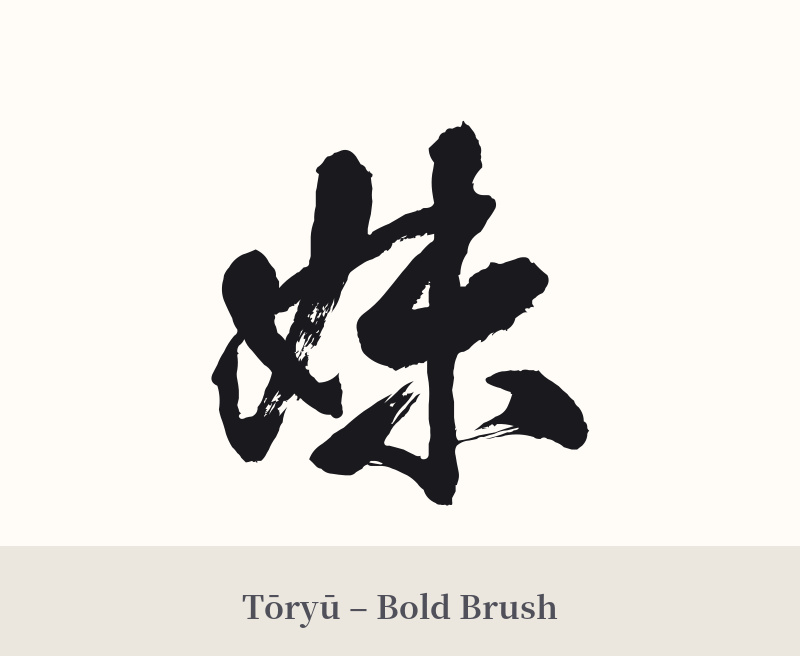
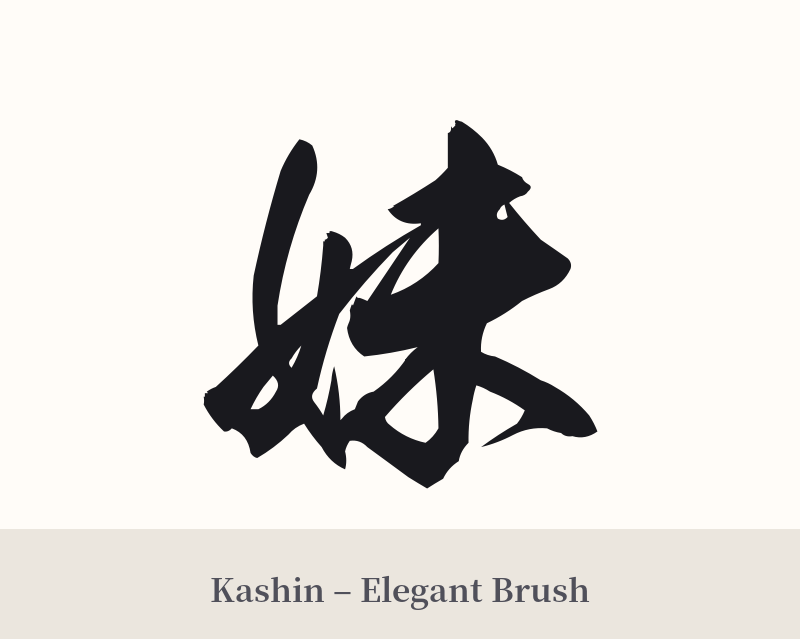
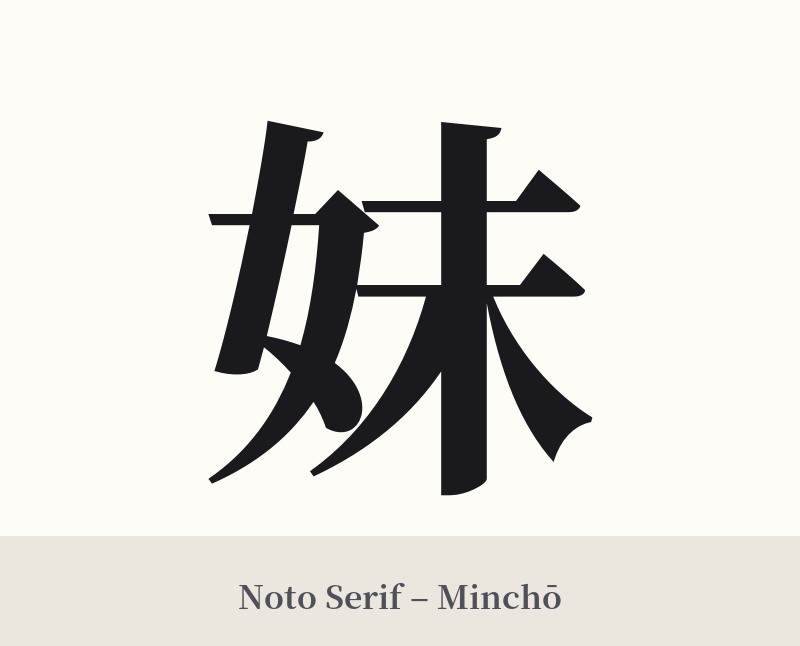
🖌️ Font Styles for 妹
The same kanji can look dramatically different depending on the calligraphy style. Choose a font that matches the mood you want for your tattoo or design.
🎨 Tattoo Suitability
📐 Tattoo Design Guide
A tattoo of 妹 (Imōto) is an intimate and personal statement. The design choices should reflect the warmth and affection inherent in the word.
– Placement: This kanji suits smaller, more personal locations. Consider the inner wrist, the area over the heart, the ribs, or the ankle. These placements keep the tribute close to you, reflecting the personal nature of the bond.
– Font Style: Avoid aggressive or overly bold fonts. A flowing, semi-cursive calligraphy style (gyōsho) can capture the gentle and affectionate feeling of the word. A clean, classic Mincho-style font works well for a minimalist and timeless look.
– Visual Tips: Because the character is simple, it pairs beautifully with other elements. Consider incorporating your sister's birth flower, her initial in a subtle script, or a small, delicate symbol that represents a shared memory. Placing it alongside the kanji for 'bond,' 絆 (Kizuna), can create a powerful two-character design symbolizing the unbreakable connection you share.
Comments