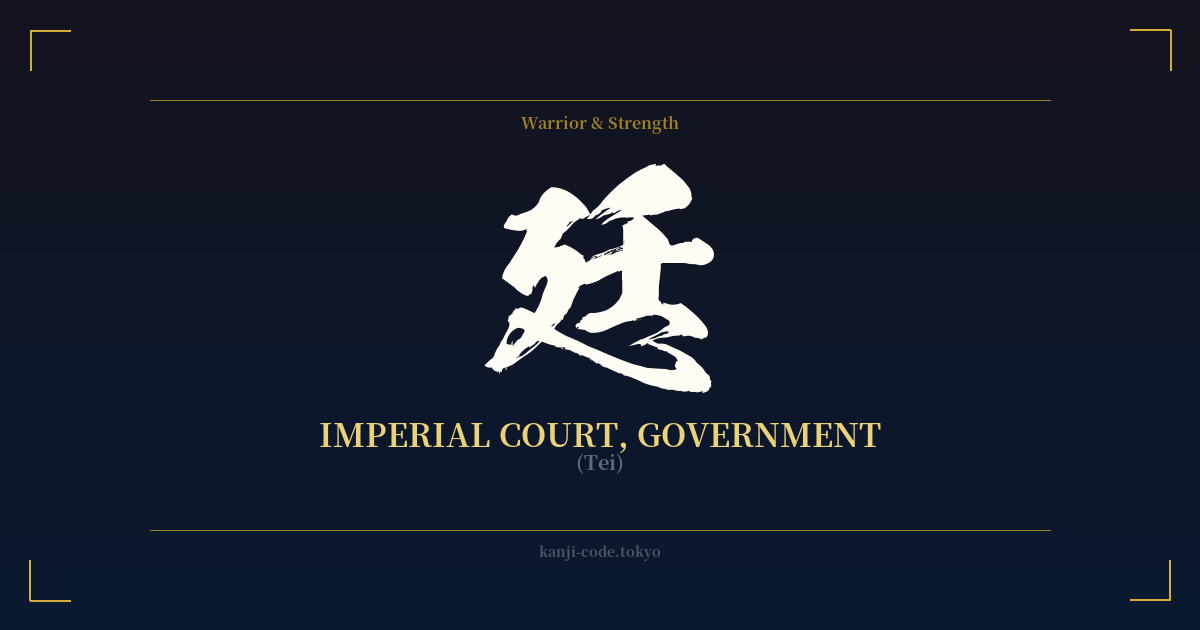
✍️ 廷 (Tei) — Cultural Context
The kanji 廷 (Tei) carries the weight of history, law, and imperial authority in Japan. Its primary meaning is 'court,' but this extends beyond a simple courtroom to encompass the imperial court, government offices, and public halls where matters of state were decided. It is a character steeped in formality and structure.
Historically, the concept of the 'court' was the nucleus of Japanese civilization. During the Heian period (794-1185), the Imperial Court (宮廷, kyūtei) in Heian-kyō (modern-day Kyoto) was the center of politics, art, and culture. This was the world depicted in 'The Tale of Genji,' a place of intricate etiquette, political maneuvering, and refined aesthetics. The character 廷 is a direct link to this era, evoking images of grand halls, robed officials, and the solemn proceedings that shaped the nation.
The character’s visual components hint at its meaning. It is composed of the radical 廴 (in), which means 'to stride' or 'to move along,' and the phonetic component 壬 (jin). Together, they can be interpreted as a place where people move and gather in an orderly fashion, often before a figure of authority.
In modern Japan, 廷 is almost never used as a standalone word. Its significance is unlocked when combined with other kanji. For instance, 法廷 (hōtei) specifically means a 'court of law' or 'courtroom,' the place where justice is administered. 朝廷 (chōtei) refers to the 'Imperial Court' as a governing body, a term with strong historical resonance. By itself, 廷 simply feels like a building block, a piece of a larger, more complete idea.
This is why, despite its dignified meaning, it's not a common choice for personal expression. It represents the system, the institution, and the physical place of power, rather than a personal virtue like 'courage' (勇) or a philosophical concept like 'emptiness' (空). It is formal, impersonal, and deeply connected to the machinery of government and law, both ancient and modern.
🖌️ Font Styles for 廷
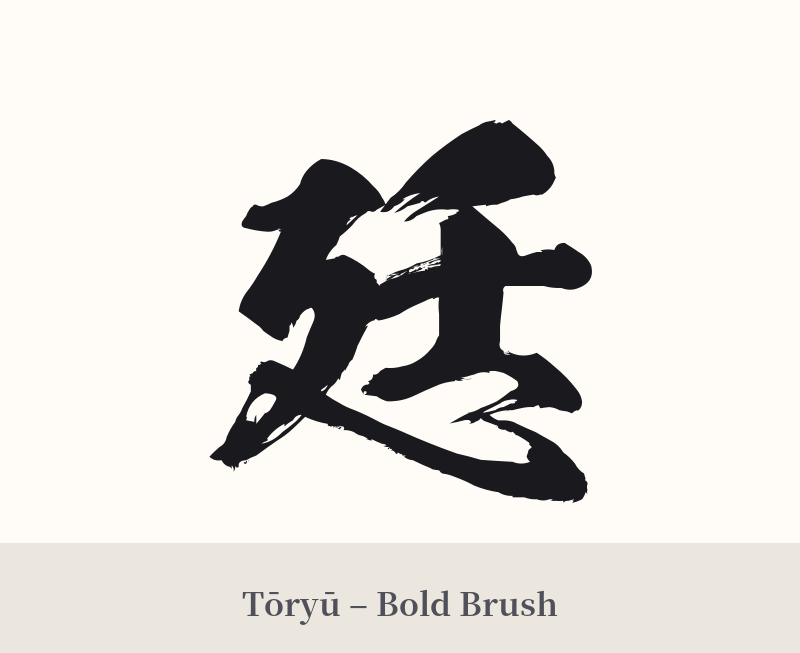
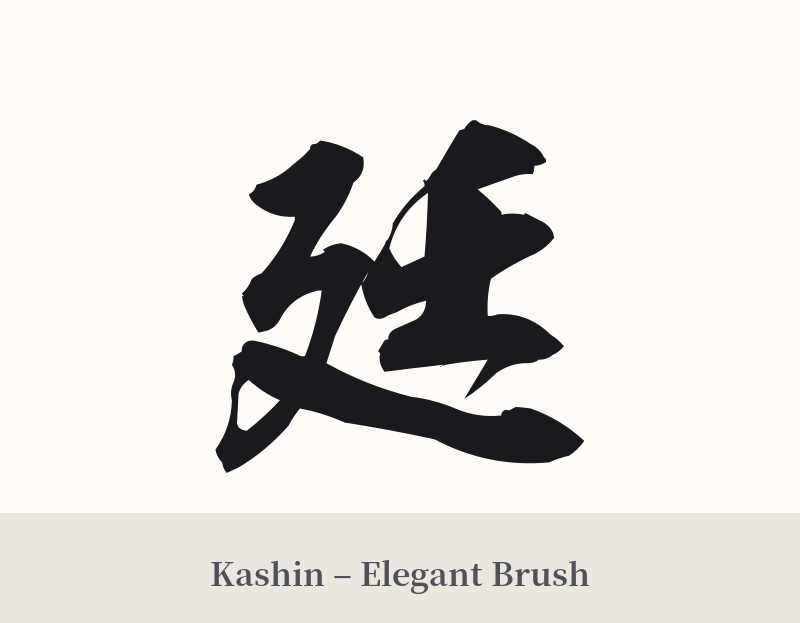
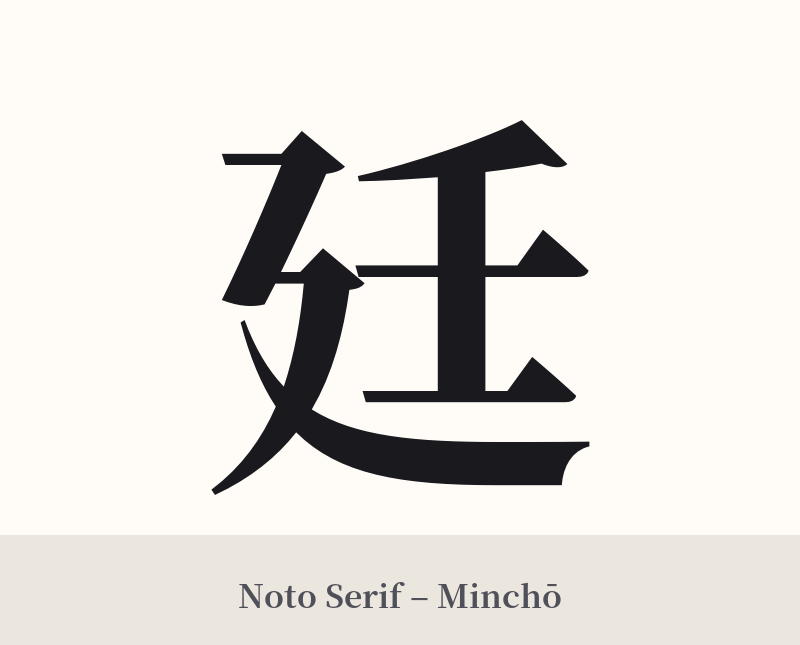
The same kanji can look dramatically different depending on the calligraphy style. Choose a font that matches the mood you want for your tattoo or design.
🎨 Tattoo Suitability
📐 Tattoo Design Guide
If you are set on using 廷, a thoughtful design is crucial to convey its intended meaning and overcome its standalone weakness.
– Placement: Its formal and structural nature pairs well with linear placements. The inner forearm, along the spine, or on the back of the calf can provide a strong, upright canvas. Avoid more fluid or organic parts of the body.
– Font Style: A classic, blocky Kaisho (楷書) script will emphasize its association with law and government. For a more historical and unique feel, a Tensho (篆書) or seal script can evoke the ancient imperial courts of Japan. Cursive or casual styles would clash with the kanji's formal meaning.
– Visual Tips: Because it feels incomplete on its own, consider incorporating it into a larger design. It could be placed on a scroll, framed by architectural elements of a Japanese palace, or paired with a symbol of justice like scales (though scales are a Western symbol). This provides the context that the single character lacks.
Comments