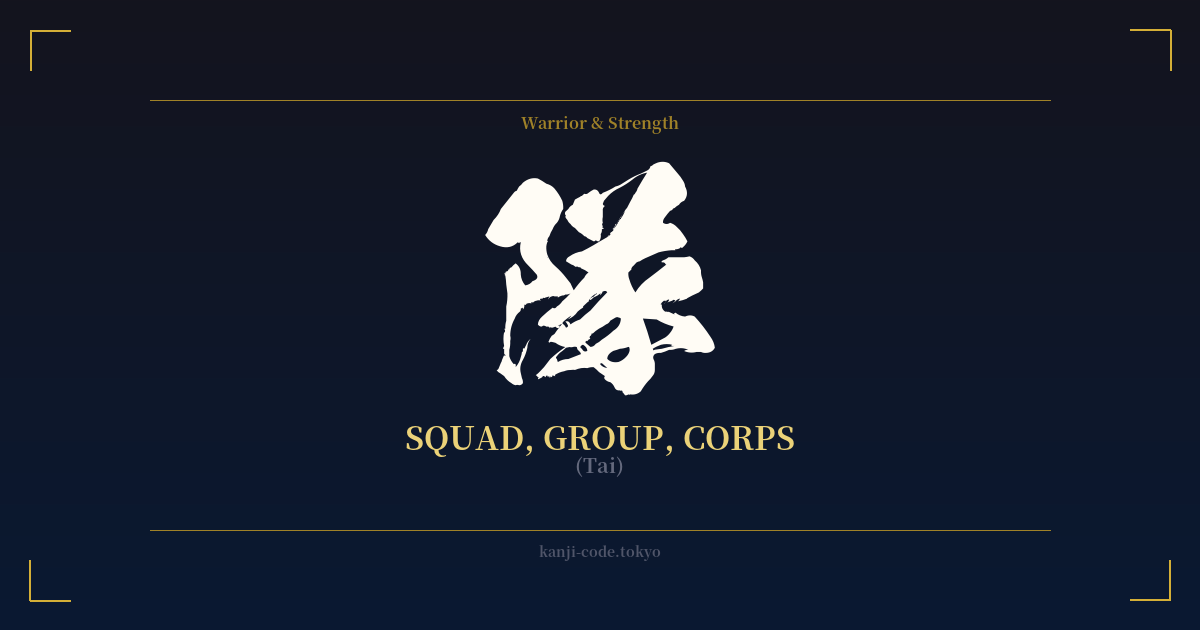
✍️ 隊 (Tai) — Contexto cultural
El kanji 隊 (tai) es un carácter fundamental para comprender el concepto de grupos organizados en la cultura japonesa. Su significado va mucho más allá de una simple reunión de personas; representa una unidad estructurada y disciplinada con un propósito o misión compartida. Este carácter es esencial en el lenguaje de la organización, desde los servicios de emergencia hasta las aventuras épicas.
Etimológicamente, el carácter ofrece una visión fascinante de su propio significado. Se compone de dos partes principales. A la izquierda se encuentra el radical 阝 (kozato-hen), una variante de 阜, que significa 'colina' o 'montículo'. Esto sitúa al carácter en un espacio físico, sugiriendo una unidad posicionada en el paisaje. El lado derecho transmite la sensación de un grupo, históricamente relacionado con una procesión o seguidores. Juntos, pintan la imagen de un grupo organizado que se desplaza o mantiene una posición en el terreno, una representación visual perfecta para un escuadrón o cuerpo.
Su asociación más destacada y poderosa es con los servicios militares y uniformados. La palabra para 'ejército' es 軍隊 (guntai), para 'policía' es 警察隊 (keisatsutai), y las fuerzas armadas modernas de Japón se denominan 自衛隊 (Jieitai), o Fuerzas de Autodefensa. En estos contextos, 隊 transmite jerarquía, disciplina y deber oficial.
Sin embargo, el uso de 隊 no se limita al campo de batalla. Se extiende a cualquier grupo organizado para una tarea específica. Un cuerpo de bomberos es un 消防隊 (shōbōtai), un equipo de expedición es un 探検隊 (tankentai), e incluso un grupo de animadores puede llamarse 応援隊 (ōentai). Esto demuestra su flexibilidad para describir cualquier colectivo que sea más que una simple multitud: son un equipo con una función específica.
En la cultura pop japonesa, este kanji está por todas partes. El anime, el manga y los videojuegos están repletos de unidades especiales y grupos de trabajo cuyos nombres terminan en 隊. El Equipo Ninja Científico Gatchaman (科学忍者隊, Kagaku Ninjatai) es un ejemplo clásico. Este uso ha consolidado a 隊 en el imaginario popular como símbolo de trabajo en equipo de élite y habilidades especializadas, a menudo superando obstáculos insuperables.
En definitiva, 隊 encarna el principio de la fuerza colectiva. Representa la idea de que los individuos, cuando se organizan y unifican por un objetivo común, se vuelven más poderosos y eficaces. Es un carácter que no habla de individualidad, sino del poder que reside en la estructura, la unidad y una misión compartida.
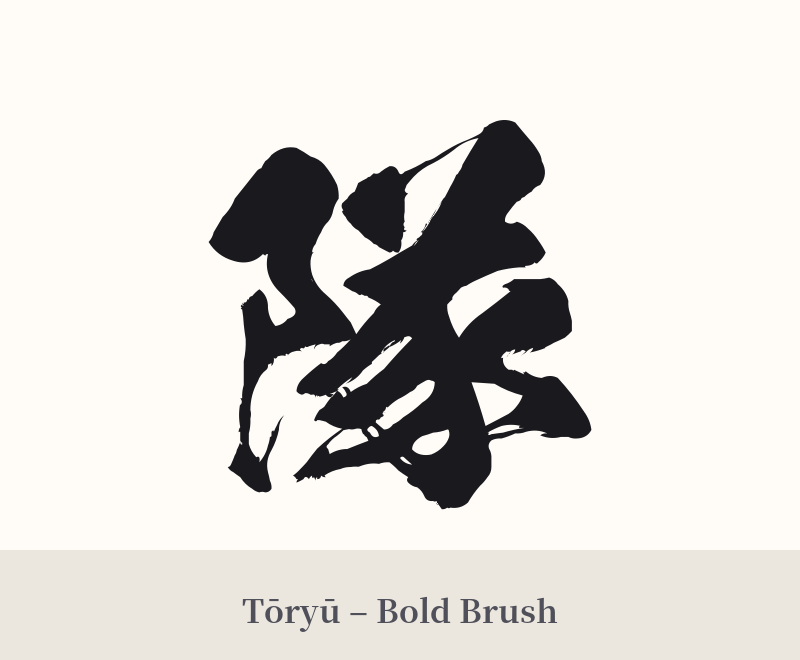
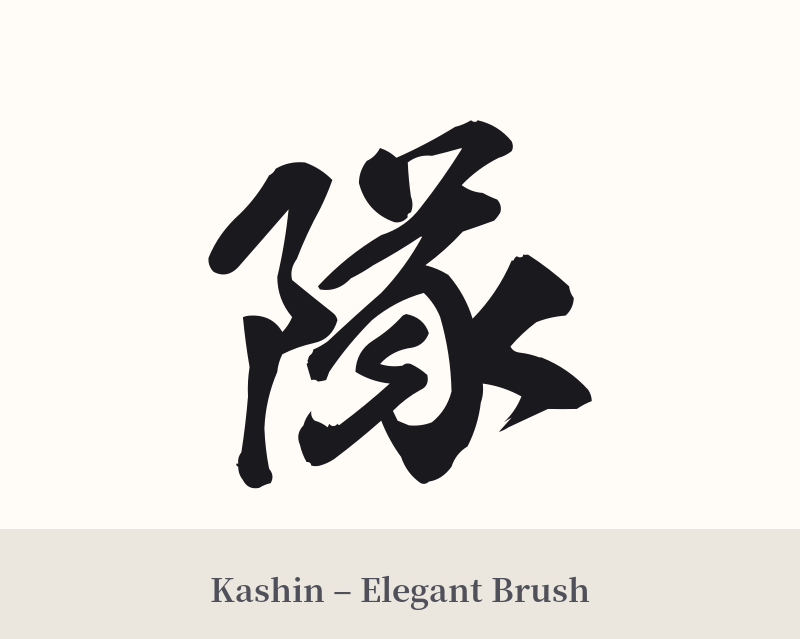
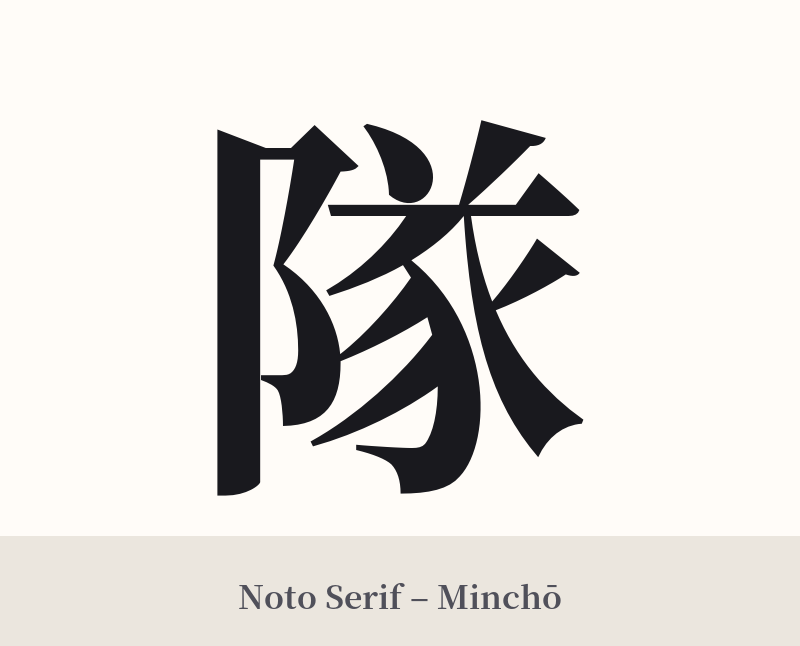
🖌️ Estilos de fuente para 隊
Los mismos caracteres kanji pueden verse muy diferentes según el estilo de caligrafía. Elige una fuente que se ajuste al ambiente que deseas para tu tatuaje o diseño.
🎨 Idoneidad para tatuajes
📐 Guía de diseño de tatuajes
Dado que 隊 funciona mejor como parte de un concepto más amplio, su diseño debe reflejarlo. Si se prefiere usarlo de forma aislada, debe representarse con intención y fuerza.
– Ubicación: Considere áreas que se presten a un símbolo único y contundente, como el antebrazo, la parte posterior del hombro o la pantorrilla. Estas ubicaciones permiten que el personaje se muestre con autoridad.
– Estilo de fuente: Se recomienda encarecidamente una tipografía robusta y compacta como Kaisho (escritura estándar) para enfatizar su carácter estructurado y disciplinado. Una fuente audaz y angular realzará sus connotaciones militares y oficiales. Para un estilo más dinámico, una tipografía Gyosho (semicursiva) controlada podría funcionar, pero evite los estilos demasiado fluidos que podrían desvirtuar su significado principal.
Consejos visuales: La mejor manera de usar este kanji en un tatuaje suele ser incorporarlo a una palabra compuesta que tenga significado para ti, como por ejemplo, formar una palabra de dos kanji con otro carácter que represente a tu grupo (por ejemplo, 'Fuego', 'Arte', 'Música'). También puede ser un elemento más pequeño dentro de un tatuaje pictórico más grande que represente a un equipo o grupo al que perteneces.
Comentarios