諸行無常
Shogyō Mujō
all conditioned things are impermanent
諸行無常 (All Things Are Impermanent, The Transience of All Phenomena): Meaning & Origin – Japanese Kanji Design
Checked by a native Japanese speaker| Kanji | 諸行無常 |
|---|---|
| Meaning | all conditioned things are impermanent |
| Made of | 諸 (Sho (on) / Moro (kun), 15 strokes, various / many) + 行 (Kō, Gyō, An (on) / Iku, Yuku, Yuki, Yuki, Iki, Iki, Okonau, Okonau (kun), 6 strokes, going / journey) + 無 (Mu, Bu (on) / Nai (kun), 12 strokes, nothingness / none) + 常 (Jō (on) / Tsune, Toko (kun), 11 strokes, usual / ordinary) |
| Strokes | 44 |
諸行無常 (Shogyō Mujō) means all things are impermanent: everything that arises changes and passes. It is not a poetic invention but a fundamental Buddhist statement — one of the Three Marks of Existence — and the most famous phrase of its kind in Japan. This page breaks down the four characters, gives the exact reading, and is clear about the phrase’s religious weight.
Kanji Breakdown: 諸行無常
| Character | Reading in this word | Meaning | Role in the word |
|---|---|---|---|
| 諸 | sho (on’yomi: sho; kun’yomi: moro) | various, many, all | “All” — every phenomenon, without exception |
| 行 | gyō (on’yomi: kō / gyō / an; kun’yomi: iku, okonau) | in this Buddhist term, conditioned phenomena — things formed and in flux | Read gyō here, not kō: 諸行 (shogyō) is “all conditioned things” |
| 無 | mu (on’yomi: mu / bu; kun’yomi: nai) | nothing, not, without | Negates what follows: “no…” |
| 常 | jō (on’yomi: jō; kun’yomi: tsune) | permanence; what is always the same | With 無: 無常, “no permanence” — impermanence |
The reading to fix in mind is 行: in everyday words it is often kō (as in 旅行, travel) or iku, but in this phrase it is gyō — shogyō mujō (しょぎょうむじょう). The whole phrase parses as “all conditioned things / have no permanence.”
Cultural Context
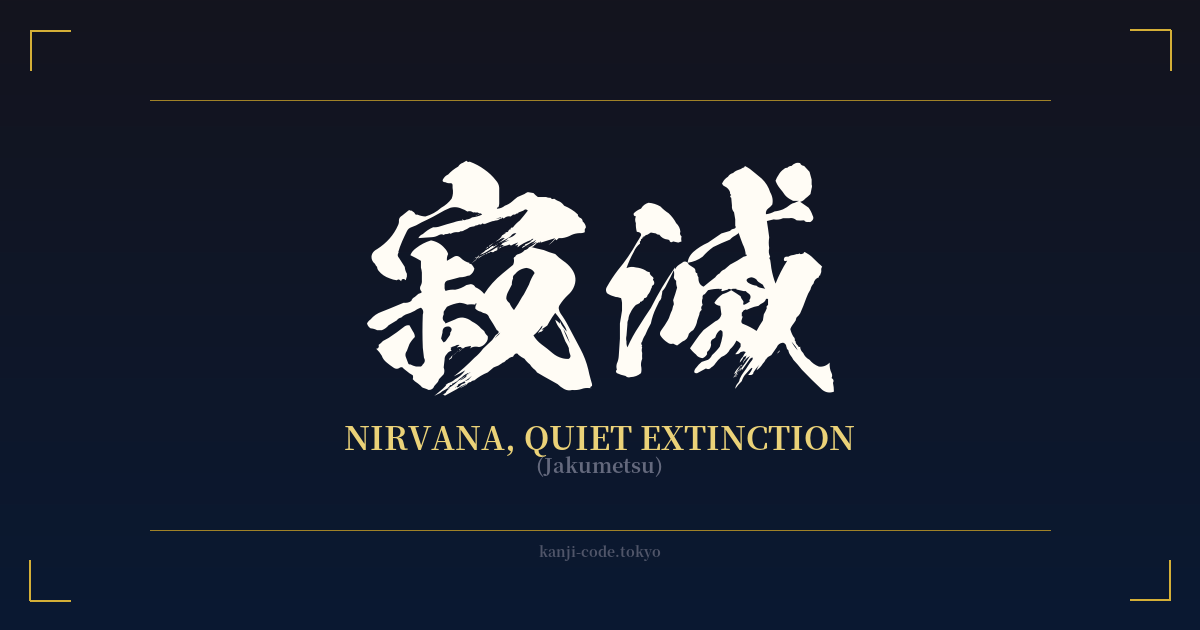
In Buddhism, 諸行無常 is doctrine, not decoration: together with 諸法無我 (all things lack a fixed self) and 涅槃寂静 (nirvana is stillness), it forms the Three Marks of Existence, the seals of the teaching. Attachment to what cannot last is, in this account, the root of suffering; seeing impermanence clearly is a step out of it. The phrase carries that full doctrinal weight wherever it appears.
In Japan it is also literature. The Tale of the Heike (平家物語), the great medieval epic of the Taira clan’s rise and fall, opens with it: “The sound of the Gion Shōja bells echoes the impermanence of all things” (祇園精舎の鐘の声、諸行無常の響きあり). Generations of Japanese readers have learned the line at school, which is why the phrase is recognised instantly even by people with no temple connection — recognised, that is, as a solemn Buddhist sentence that opens a story of downfall.
Font Styles
諸行無常
筆文字 — Brush
Yuji Syuku
諸行無常
明朝 — Mincho
Shippori Mincho
諸行無常
ゴシック — Gothic
Noto Sans JP
The four characters total 44 strokes, and 諸 (15) and 無 (12) are dense. A formal block script (kaisho) or a Mincho style suits the phrase’s gravity and keeps the dense characters open. This is a phrase to render at a size where 諸 stays fully legible; flowing cursive that merges its strokes works against the text’s authority.
Tattoo Suitability
Rating: ★★☆ — Moderately Suitable
Shogyō Mujō is one of Buddhism’s fundamental statements — all things are impermanent — and in Japan it is famous far beyond temples through the opening of the Tale of the Heike. The meaning is deep, exact, and instantly recognised. The single caution is its religious association: this is a doctrinal phrase, one of the Three Marks of Existence, and it reads as a serious Buddhist statement rather than a general reflection on change. That weight, not any defect in meaning, sets the rating.
How it reads to a native speaker: the Heike opening line and a core Buddhist teaching at once — solemn, literary, and unmistakably religious in origin.
Cultural note: wear it as what it is — a Buddhist teaching. For a Buddhist wearer, or someone marking loss and change in those terms, the fit is exact. If you want only the general idea “everything changes” without the doctrine, expect Japanese readers to supply the doctrine anyway.
Tattoo Design Guide
- Placement: a vertical four-character column along the spine, forearm, or calf suits the phrase’s formal, textual character.
- Size: medium-to-large. 諸 has 15 strokes and 無 has 12; both need room to stay open.
- Combinations: a temple bell, falling cherry blossom, or water imagery echoes the Heike line and the teaching without adding text. Keep the four characters central.
- Reading check: 行 is gyō here — shogyō mujō. A rendering read as shokō would be wrong; confirm the romaji wherever it appears.
FAQ
How do you read 諸行無常?
Shogyō mujō (しょぎょうむじょう). Note 行 in particular: it is read gyō in this phrase, not its more common kō.
What does 諸行無常 mean, exactly?
“All conditioned things are impermanent.” 諸行 (shogyō) is all phenomena that arise and change; 無常 (mujō) is “no permanence.” It is one of the Three Marks of Existence in Buddhism.
Where does the phrase 諸行無常 appear in Japanese literature?
Most famously at the opening of the Tale of the Heike: “The sound of the Gion Shōja bells echoes the impermanence of all things.” The line frames the epic’s story of the Taira clan’s rise and fall.
Is 諸行無常 a good tattoo?
Rated ★★☆ here. The meaning is profound and universally recognised in Japan, but it is a core Buddhist doctrinal phrase, and it will be read as one. It suits a wearer who means it in those terms.
Sources
- KANJIDIC2 — 諸(15画、音ショ、訓もろ、various / many)、行(6画、音コウ・ギョウ・アン、訓いく・おこなう、going / carry out)、無(12画、音ム・ブ、訓ない、nothingness)、常(11画、音ジョウ、訓つね、usual / always)
- 『平家物語』冒頭 — 「祇園精舎の鐘の声、諸行無常の響きあり」
- 三法印 — 諸行無常がその一つであることは仏教の基礎的事項
Related Kanji


Get this design as a sticker
Selected kanji from this dictionary are available as stickers and prints.
Browse designsVerify before you ink
Check this kanji’s tattoo suitability — meaning, native impression and association risk, rated under our rubric.
Open the Tattoo Checker